Until three years ago, I had never noticed a stink bug (family Pentatomidae), also called a shield bug. My garden in Bratislava, Slovakia, grew vibrant tomatoes and corn, and every autumn ladybirds decorated the house. Then the stink bugs arrived and took their place.
After that I found them everywhere. Under pillows. Once inside my high heels, which I had forgotten to check — I crushed one as I slipped the shoe on, and the smell stayed on my feet through an important meeting. They rode into the dryer with the wet laundry and left their stench on every piece, so I washed it all again. Worst of all, they hitchhiked in our luggage as far as the Maasai Mara in Kenya. I dislike killing anything, but we killed every one we found, and I still wonder how many escaped.
Frustrating as they are, stink bugs are more than pests, and I wanted to understand them properly. If you are curious too, follow along — these nested questions cover what stink bugs are, why they smell, what makes them such persistent survivors, and whether we can get rid of them.

This symbol marks a Nested Question — a branched question tucked under the answer. Open the box below it whenever you’d like to dig deeper.
What are the defining characteristics of stink bugs?
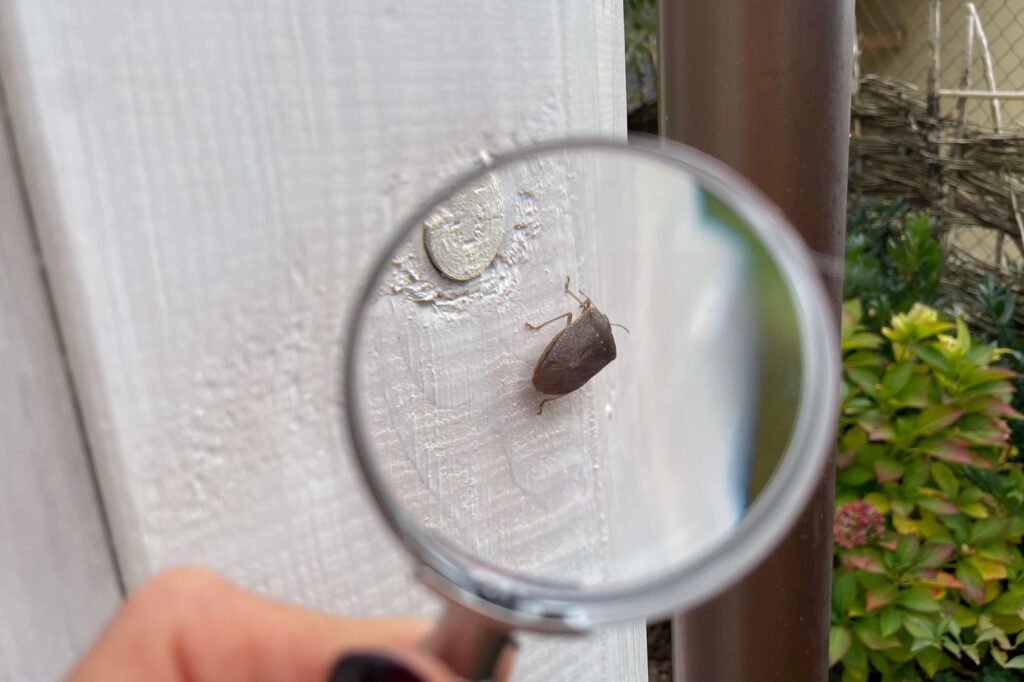
A stink bug is a shield-shaped insect belonging to the family Pentatomidae. It is one of the “true bugs”, a group of insects that feed through a beak instead of chewing. No single feature fits every member of the family, because the family is large and very varied. What identifies a stink bug is a combination of traits.
Start with the antennae. In most species they have five segments. In two smaller groupings within the family, the Cyrtocorinae and the Serbaninae, they have four, and in the genus Omyta only three.
Next, look at the scutellum. This is the large plate in the middle of the bug’s back, and in stink bugs it is usually big and roughly triangular. It is what gives the insect its shield-like outline.
The body is usually broad and oval, although some grass-feeding species are long and slender. The feet normally have three segments. The front wings are leathery near the base and thin and clear towards the tip. The mouth is a slender beak, built for piercing and sucking rather than for chewing.
Then there is the smell. Adult stink bugs have scent glands that open on the underside of the thorax, the middle section of the body. Young stink bugs have a separate set on the upper surface of the abdomen. Nearly every species in the family carries this equipment, at both stages of life.
The family is enormous: 940 genera and 4,949 described species, arranged in ten subfamilies, with many more still to be named. More than 200 species live in North America alone. The smallest, such as Sepontia, are only a couple of millimetres long (under 0.1 in). The largest approach or pass 25–35 mm (1–1.4 in). Their colours run from the greens, tans and browns that let a bug disappear against a leaf, to bright reds, oranges and blues, sometimes with a metallic sheen.
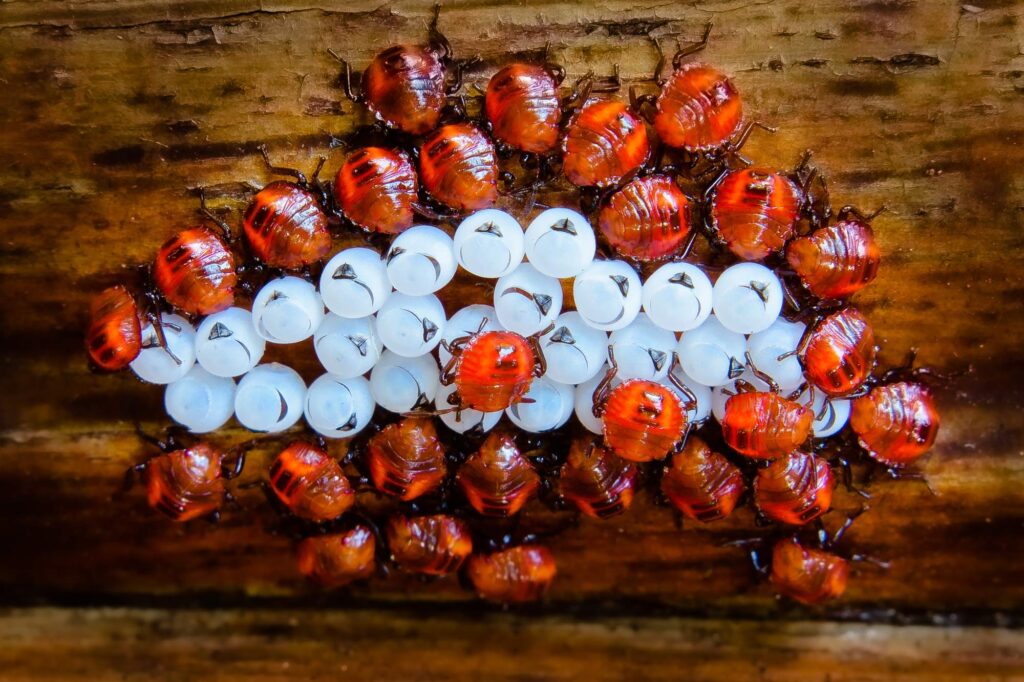
The eggs are another clue. They look like tiny barrels with a lid on top, and they are laid in neat clusters rather than one at a time.
One split within the family decides what a stink bug eats. Most are plant feeders, and the base of their beak is slender. The members of one subfamily, the Asopinae, are predators that hunt other insects, and the base of their beak is short and thick — a sturdier tool for stabbing prey rather than sipping from plants.
Sources
- J. E. McPherson (ed.), Invasive Stink Bugs and Related Species (Pentatomoidea), CRC Press, 2018 — Ch. 2, “Higher Systematics of the Pentatomoidea”
- C. A. Triplehorn & N. F. Johnson, Borror and DeLong’s Introduction to the Study of Insects, 7th ed. — Ch. 22, “Order Hemiptera”
- P. J. Gullan & P. S. Cranston, The Insects: An Outline of Entomology, 5th ed. — Ch. 7, “Insect Systematics: Phylogeny and Classification”
- F. A. Marques et al., “Identification of defensive compounds in metathoracic glands of adults of the stink bug Dichelops melacanthus,” Journal of the Brazilian Chemical Society 18(6), 2007
What is a true bug?
A true bug is not simply any small crawling insect. It is a member of one particular branch of the insect family tree, the Heteroptera, and the term is a precise scientific label rather than a loose one.
Two features together identify a true bug. The first is the beak, which is segmented and arises from the front of the head. The second is the front wings. Each one is thickened and leathery at the base and thin and transparent towards the tip, and that half-and-half construction is where the wider group gets its name: Hemiptera means “half wings.” The hind wings are thin and transparent throughout. At rest, both pairs lie flat along the insect’s back, with the see-through wing tips overlapping.
That combination — the beak in front, the half-and-half front wings — is what separates true bugs from their closest relatives. True bugs sit inside the Hemiptera alongside cicadas, leafhoppers, planthoppers, aphids, whiteflies and scale insects. Every one of those feeds through a beak as well, so the beak on its own does not settle the question. Their front wings, though, are the same texture from base to tip — either thin all the way across or slightly thickened all the way across, never split into a leathery half and a clear half. Their beak also arises elsewhere — further back on the head in the cicadas and hoppers, and between the bases of the front legs in the aphids, whiteflies and scale insects.
So the rule runs in one direction only. Every true bug is a hemipteran, but not every hemipteran is a true bug.
The group is also much broader than its plant-feeding members might suggest. Alongside stink bugs it contains assassin bugs, bed bugs, lace bugs, water striders that walk on the surface of ponds, and backswimmers that swim upside down. Some are hunters, some drink blood, and some feed on plants.
The closest relatives of the true bugs are worth a mention for their obscurity. They are the moss bugs, a single small family of fewer than thirty species, found only in the southern hemisphere. They are small, well camouflaged and rarely collected, yet they have attracted a great deal of scientific attention, because they combine ancient features with more recently evolved ones and so help show how the whole group is related.
Everyday English is much looser than that definition. People call almost any small crawling creature a bug. An entomologist would not: a beetle is not a bug, a ladybird is not a bug, and a spider is not even an insect.
Sources
- P. J. Gullan & P. S. Cranston, The Insects: An Outline of Entomology, 5th ed. — Ch. 7, “Insect Systematics: Phylogeny and Classification”
- C. A. Triplehorn & N. F. Johnson, Borror and DeLong’s Introduction to the Study of Insects, 7th ed. — Ch. 22, “Order Hemiptera”
- J. E. McPherson (ed.), Invasive Stink Bugs and Related Species (Pentatomoidea), CRC Press, 2018 — Ch. 1, “Introduction”
How are beetles, true bugs, and stink bugs related to each other?
They are related the way boxes of different sizes sit one inside the next — except that beetles sit in a box of their own, entirely outside the other two. Stink bugs are one family within the true bugs. Beetles are a separate group at the same level as the whole order that contains the true bugs, and are not bugs at all.
Working from the outside in: beetles and true bugs are both insects, but there the shared address ends. Beetles form the order Coleoptera. True bugs sit in a different order, the Hemiptera, in its own subgroup, the Heteroptera. Stink bugs are one family inside that subgroup. So a stink bug is a true bug, and a true bug is a hemipteran — but a beetle is none of these things.
Two differences make the split easy to see. The first is the mouth. Beetles chew, using well-developed jaws that many species employ to crush seeds or gnaw wood. True bugs cannot chew at all; they can only pierce and drink.
The second is the front wings, and this is the detail most often confused. Beetles and true bugs both have hardened front wings covering the body, so both can look armoured from above. But a beetle’s front wings are hard along their entire length, forming solid cases that normally meet in a straight line down the middle of the back. A true bug’s front wing is hard only at the base and thin and transparent at the tip, so the wing tips overlap each other rather than meeting edge to edge. Once you have noticed that difference, a shield bug never again looks like a beetle.
A third difference is how they grow up. Beetles change form completely, passing through a grub-like larva and then a pupa before the adult appears. Stink bugs and other true bugs do not; the young resemble small, rough versions of the adult from the start.
There is one more asymmetry worth knowing. Beetles are the largest order of insects by a wide margin, holding almost 40% of all described insect species — more than 350,000 of them, against over 100,000 for the Hemiptera. So although stink bugs and beetles are often confused in a garden, the two are not close relatives — though both have hardened front wings covering the pair beneath.
Sources
- C. A. Triplehorn & N. F. Johnson, Borror and DeLong’s Introduction to the Study of Insects, 7th ed. — Ch. 26, “Order Coleoptera: Beetles”; Ch. 22, “Order Hemiptera”
- P. J. Gullan & P. S. Cranston, The Insects: An Outline of Entomology, 5th ed. — Ch. 1, “The Importance, Diversity and Conservation of Insects”; Ch. 2, “External Anatomy”; Ch. 6, “Insect Development and Life Histories”; Taxoboxes 20 and 22
How do stink bugs live and survive?
Stink bugs grow up in stages, without the pupa stage that a butterfly or a beetle passes through. There is no chrysalis and no cocoon. Among the things that keep them going are a beak that turns plant tissue into liquid food, a set of bacteria inherited from their mother, and a dormant period that carries them through winter.
The life cycle runs from egg, through five young stages, to adult. A young stink bug is called a nymph. It looks like a rough draft of the adult, and it comes closer to the finished form each time it sheds its skin.
In the brown marmorated stink bug, the young hatch three to six days after the eggs are laid. They reach the second stage three to five days after that. They shed their skin into the third stage about twelve or thirteen days after hatching. In the mid-Atlantic region of the eastern United States, where this species is at its worst, it fits one or two generations into a year.
The strangest part happens in the first hours of life. As a female lays her eggs, she smears bacteria from her own gut onto the outside of the shells. Her offspring collect their own supply of those bacteria before they go anywhere: newly hatched brown marmorated stink bugs feed at the empty shells, and the young of other species probe the shell surface.
Those bacteria matter. When nymphs of the Costa Rican species Sibaria englemani were denied the coating on the shells, they needed 9.1 days to get through their second stage instead of 7.9, and they grew more slowly throughout. In other stink bugs, removing the bacteria has meant more deaths, a longer wait to reach adulthood, and fewer eggs. Exactly how much the insect depends on them is still argued over.
Feeding is done with a bundle of fine needles inside the beak. A plant feeder first pumps in saliva that hardens into a tube around those needles. Then it pumps in a second, watery saliva. This one carries the substances that break plant tissue down into a liquid the bug can drink.
Winter is survived by shutting down. Adults enter a dormant state called diapause: they stop reproducing and find shelter. The southern green stink bug goes further and changes colour for the season. It is green in summer, brown while it spends the winter under fallen leaves or bark, and green again in spring — a change driven partly by day length, and thought to help it stay camouflaged.
Sources
- K. B. Rice et al., “Biology, Ecology, and Management of Brown Marmorated Stink Bug,” Journal of Integrated Pest Management 5(3): A1, 2014
- K. S. I. Bistolas et al., “Symbiont polyphyly, co-evolution, and necessity in pentatomid stinkbugs from Costa Rica,” Frontiers in Microbiology 5: 349, 2014
- Gullan & Cranston, The Insects, 5th ed. — Ch. 6, “Insect Development and Life Histories”
- R. F. Chapman, S. J. Simpson & A. E. Douglas, The Insects: Structure and Function, 5th ed. — Ch. 2, “Mouthparts and Feeding”; Ch. 25, “Visual Signals: Colour and Light Production”
What are the bacteria a stink bug inherits from its mother, and how do they help it?
They are gut bacteria, and in the brown marmorated stink bug the main one has been given a name: Candidatus Pantoea carbekii.
The bacteria live in a specific place — a set of pouches called gastric caeca, which branch off the far end of the insect’s midgut. They are not scattered through the body but concentrated there, as the main occupants of those pouches.
What they do for their host comes down to filling gaps in a poor diet. A diet of plant sap and plant tissue can be short of certain essential amino acids, the building blocks of protein that an animal cannot make for itself, and short of some vitamins. Reading the bacterium’s genome suggests it can supply a good deal of that shortfall, though not everything: it carries the machinery to build most amino acids, but not proline, isoleucine, leucine or valine, and it appears unable to make the vitamin biotin. So the bacteria provide a substantial subsidy rather than a complete one.
How much the insect depends on the bacteria becomes clear when they are taken away. If the outside of an egg mass is sterilised, so that the newly hatched young pick up far less of their supply, the consequences are severe and they compound across generations. In one laboratory study, adults from sterilised eggs peaked in number at 62.9 days against 54.8 days for untreated ones, and 15.7% were still present at the adult stage against 24.8%. The females that did make it waited 25 days before laying rather than 15.5, and produced 0.52 egg masses each against 1.59, with clutches about 38% smaller. In the following generation the effect became severe: 0.3% of the young were still present as adults, against 20.8% in the untreated line.
This dependence has not gone unnoticed by people looking for new ways to control the insect. Because the bacteria travel on the outside of the eggshell rather than inside the egg, they are unusually exposed. Treating the egg surface with a mixture of copper, zinc and citric acid removed the bacterium and caused high death rates among the youngest nymphs in the laboratory. Whether that treatment works in the field has not been tested. That is a control idea aimed not at the insect but at its lodger.
One caution about the naming. An earlier study of the same relationship identified the bacterium as a member of a broader, already-named species rather than as the distinct organism described later. The two names refer to closely related bacteria in the same genus, and the general picture — a gut bacterium, acquired from the eggshell, that the insect depends on — is not in dispute.
Sources
- C. M. Taylor, P. L. Coffey, B. D. DeLay & G. P. Dively, “The Importance of Gut Symbionts in the Development of the Brown Marmorated Stink Bug, Halyomorpha halys (Stål),” PLOS ONE 9(3): e90312, 2014
- L. J. Kenyon, T. Meulia & Z. L. Sabree, “Habitat Visualization and Genomic Analysis of ‘Candidatus Pantoea carbekii,’ the Primary Symbiont of the Brown Marmorated Stink Bug,” Genome Biology and Evolution 7(2): 620, 2015
- R. F. Chapman, S. J. Simpson & A. E. Douglas, The Insects: Structure and Function, 5th ed. — Ch. 4, “Nutrition”
- E. Gonella, B. Orrù, R. Marasco, D. Daffonchio & A. Alma, “Disruption of Host-Symbiont Associations for the Symbiotic Control and Management of Pentatomid Agricultural Pests — A Review,” Frontiers in Microbiology 11: 547031, 2020
- P. J. Gullan & P. S. Cranston, The Insects: An Outline of Entomology, 5th ed. — Ch. 3, “Internal Anatomy and Physiology”
Why do stink bugs become invasive?
Almost no stink bugs become invasive. A species is called invasive when it arrives somewhere new, spreads, and causes harm there. Out of nearly five thousand stink bug species, only a handful have ever done it. Certain traits tend to make an insect more likely to succeed as an invader, although not every species that has them becomes one. The brown marmorated stink bug has several of these traits at once.
One is an indiscriminate appetite. This species feeds on around 100 different kinds of plant, so arriving on a new continent never leaves it short of food.
Another is the habit of sheltering inside human buildings for the winter, which is unusual among stink bugs. Bugs that crowd into a shed, a crate or a shipping container in autumn are bugs that travel. Clusters of these dormant bugs are exactly what inspectors keep finding inside internationally shipped cargo, and a shipping container carries them across an ocean far more reliably than their own wings could.
A third is that it spreads well once it arrives, moving across whole landscapes rather than staying in the field where it landed.
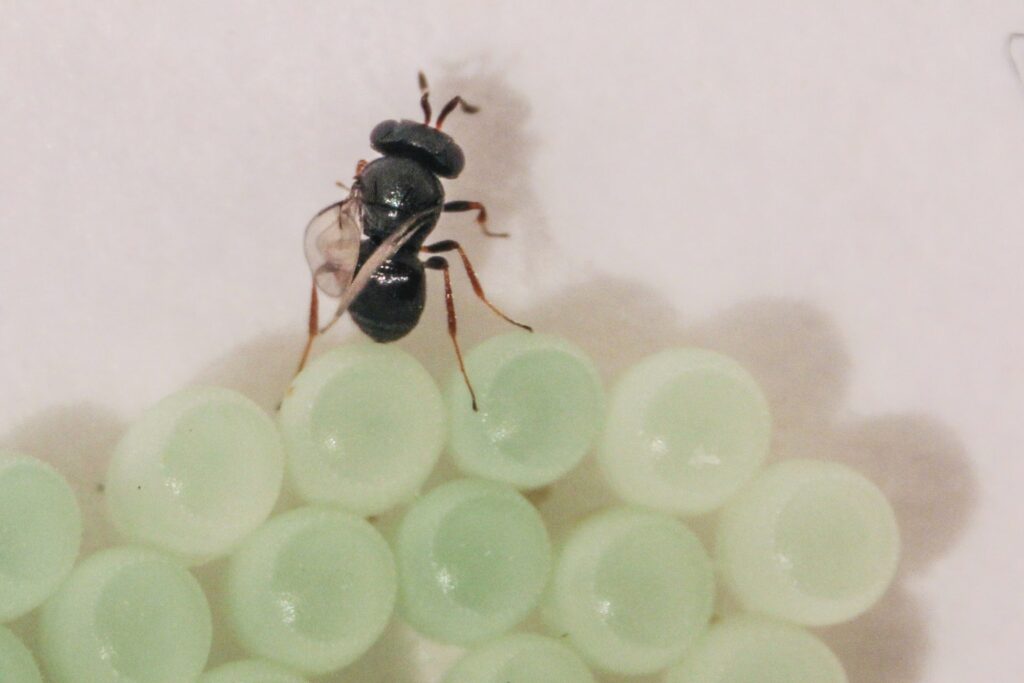
A fourth is the absence of the particular creatures that hold its numbers down at home. In eastern Asia, where the species originally comes from, it is an occasional outbreak pest rather than a disaster. Much of that quiet control is done by tiny wasps that destroy its eggs, and in Asia parasitism of its eggs has been recorded as high as 63–85%. Arriving on a new continent means arriving without those particular wasps. Enemies in the new range do attack it — parasitoid wasps have been reared from its eggs in the mid-Atlantic United States and Oregon — but the specialists that hold it down at home are absent.
Add a climate that suits it, and the result is the spread on record. Conditions look favourable across much of Europe and North America, and parts of Australia and New Zealand. The species was first collected in Allentown, Pennsylvania, in the United States, in 1996. It has since been reported from at least 40 US states, and separate invasions have been detected in Canada, Switzerland, France, Germany, Italy and Liechtenstein.
So the question is slightly the wrong way round. Stink bugs as a group are not especially invasive. One species turned out to suit the conditions of modern shipping, and it is the one everybody now knows.
Sources
- Rice et al., Journal of Integrated Pest Management 5(3): A1, 2014
- USDA National Invasive Species Information Center, “Brown Marmorated Stink Bug”
- L. J. Nixon et al., “Identification of volatiles released by diapausing brown marmorated stink bug,” PLOS ONE 13(1): e0191223, 2018
- J. E. McPherson (ed.), Invasive Stink Bugs and Related Species (Pentatomoidea), CRC Press, 2018 — Ch. 2, “Higher Systematics of the Pentatomoidea”
What quality lets the brown marmorated stink bug spread across whole landscapes when other stink bugs do not?
Flight is one clear part of it — specifically, a flight capacity far greater than the insect’s appearance suggests, combined with a small minority of individuals that travel much further than the rest.
Measured on a flight mill, a laboratory device that tethers an insect to a rotating arm and records how far it flies, adults covered a good deal of ground in a single day. Over 22 hours, males averaged 2,442 metres (about 1.5 miles) and females 2,083 metres (about 1.3 miles).
The more important number is the spread around that average. On the flight mill, 88.9% flew less than 5 kilometres (about 3 miles). But roughly one in ten was a long-distance flier, and the extreme was remarkable — one foraging male covered 117 kilometres, about 73 miles. A population in which nine out of ten insects stay local while one in ten can cross tens of kilometres, or tens of miles, has the capacity both to fill in ground steadily and to send a few individuals far beyond it.
Two further details sharpen the picture. Adults taken straight from their winter shelters still managed around 2 kilometres (1.2 miles) in a day, with one in ten of them capable of long-distance movement — so the insect does not emerge from winter weakened and grounded. And flight distances rose sharply through May and June, as adults left their winter shelters and moved out to host plants, concentrating the greatest movement into the weeks just after they emerge.
Wind matters too, at least for whether they take off at all. In still air, 83% of individuals took off. Once wind speed reached about three-quarters of a metre per second, roughly 1.7 miles per hour — a light breeze — fewer than one in ten would take off at all. In these trials, at least, they flew when the air was still.
Three cautions belong with these flight figures. A flight mill measures what an insect is capable of, not what it chooses to do in an open landscape, and a tethered insect cannot land, rest or refuse to continue. The work behind these figures did not measure other stink bugs for comparison, so how far this sets the species apart has not been directly tested. And flight is not the whole explanation for its success: it works together with the very wide diet that lets the insect exploit new ground once it arrives. Flight explains how it reaches the next valley. It does not, by itself, explain why it thrives there.
Sources
- D.-H. Lee & T. C. Leskey, “Flight behavior of foraging and overwintering brown marmorated stink bug, Halyomorpha halys (Hemiptera: Pentatomidae),” Bulletin of Entomological Research 105(5): 566–573, 2015
- J. E. McPherson (ed.), Invasive Stink Bugs and Related Species (Pentatomoidea), CRC Press, 2018 — Ch. 1, “Introduction”
Which wasp attacks stink bug eggs, and can it survive the conditions of a new environment as well as the stink bug can?
The wasp is the samurai wasp, and on temperature it appears to hold up at least as well as the stink bug — better in the cold, and no more heat-sensitive early in development. Both need winter shelter. What the wasp needs on top of that is a second source of food and a supply of host eggs.
Start with the cold. Half of the samurai wasps died between −17.4 °C and −20.0 °C (about 1 °F to −4 °F). Stink bugs studied through the winter in Minnesota, in the United States, froze at an average of −17.06 °C (about 1 °F). The comparison is not like for like: it sets what kills the wasp against what freezes the stink bug, in two different studies.
Heat has been tested on both, and the result surprises. Heat waves of 36–42 °C (97–108 °F), four hours a day for five days, cut stink bug egg hatching: at 38 °C it fell to between nothing and half, and above that few nymphs emerged. The wasp fared better — exposed as eggs or larvae its adults emerged normally, and even pupae at 40 °C mostly still produced adults. Heat did tell on it: pupae developed more slowly and fewer emerged, heat-exposed adults survived less well though still parasitised as successfully as ever, and where parents met 42 °C as eggs and larvae fewer offspring emerged next generation. On that evidence the stink bug may be the more heat-sensitive, at least early in development.
Then the conditions unrelated to temperature. In outdoor trials in Oregon, in the United States, wasps survived up to 16 weeks of winter, better in bark than in leaf litter, where the decline coincided with the winter rains. Wet, decomposing litter is the likely reason.
Food is the next requirement. The samurai wasp does not feed on the eggs it parasitises; if it behaves like its relatives, it feeds on nectar and honeydew, making early spring — when little is in flower — thin for it.
Hosts are the last condition, and there it does well. In sentinel egg masses at one orchard in its native northern China, parasitism on peach rose from 22.5% in May to 59.6% by August in 2014, and reached 78–80% on mulberry and jujube in 2013. It is not fussy whose eggs it uses: in laboratory tests it developed in seven of eight other stink bug species offered, and in the field took 63–88% of the eggs of the sloe bug, Dolycoris baccarum, in August and 31% of those of Arma chinensis.
That breadth cuts both ways. It could let the wasp fall back on other hosts, though whether they would sustain it is untested. It is also a risk where the wasp is released: Arma chinensis is itself a predator, the kind a grower wants.
So: hardier in the cold, no more heat-sensitive early on, and — beyond the shelter both need — reliant on nectar and host eggs as the stink bug is not.
Sources
- E. Nystrom Santacruz, R. Venette, C. Dieckhoff, K. Hoelmer & R. L. Koch, “Cold tolerance of Trissolcus japonicus and T. cultratus, potential biological control agents of Halyomorpha halys, the brown marmorated stink bug,” Biological Control, 2017
- J. Zhang, F. Zhang, T. Gariepy, P. Mason, D. Gillespie, E. Talamas & T. Haye, “Seasonal parasitism and host specificity of Trissolcus japonicus in northern China,” Journal of Pest Science 90(4): 1127-1141, 2017
- O. Simaz & M. Szűcs, “Heat waves affect an invasive herbivore and its parasitoid differentially with impacts beyond the first generation,” Ecosphere 12(10): e03796, 2021
- D. M. Lowenstein et al., “Establishment in an Introduced Range: Dispersal Capacity and Winter Survival of Trissolcus japonicus, an Adventive Egg Parasitoid,” Insects 10(12): 443, 2019
Why do stink bugs produce their smell?
The smell is a defence. A stink bug releases it deliberately, when something disturbs or seizes it, and the fluid from its scent glands is effective protection against being eaten.
What comes out is not one chemical but a mixture. Most of it is made of aldehydes — small, sharp-smelling carbon compounds — together with hydrocarbons, which are simpler compounds of carbon and hydrogen. In Dichelops melacanthus, a stink bug of tropical Central and South America, the main ingredient is tridecane. Next come roughly equal amounts of two others, (E)-4-oxo-2-hexenal and (E)-2-octenal. A further compound, (E)-2-hexenal, appears in smaller quantities alongside nine others. The brown marmorated stink bug’s mixture rests on the same chemistry: tridecane, dodecane, (E)-2-decenal and (E)-2-octenal. The aldehydes and esters in the blend are the strongly irritating part. What the hydrocarbons are doing is less clear, though they may act as solvents.
There is a second job, and this one is aimed at other stink bugs rather than at predators. The mixture also works as an alarm signal. In the brown marmorated stink bug, one of its components, (E)-2-decenal, is picked up by the antennae. Five proteins that grip odour molecules were tested against it: four bound it strongly and the fifth only weakly. Both adults and young respond to the compound. So when a predator seizes one bug, the smell it releases warns the bugs around it to get away.
Adults and young use different glands for this, but for the same purpose — which means a stink bug is chemically defended from the day it hatches to the day it dies.
Sources
- Y.-Z. Zhong et al., “Behavioral Evidence and Olfactory Reception of a Single Alarm Pheromone Component in Halyomorpha halys,” Frontiers in Physiology 9: 1610, 2018
- F. A. Marques et al., “Identification of defensive compounds in metathoracic glands of adults of the stink bug Dichelops melacanthus,” Journal of the Brazilian Chemical Society 18(6), 2007
Could their own smells be turned into a tool against them — for example, using scent to draw stink bugs into an environment where they cannot survive?
Using the stink bugs’ own gathering scent against them has been tried, and the result is a genuinely useful half-answer: the luring works, and the killing does not. In one careful trial the combination left more damage than doing nothing.
The lure itself is a solved problem. The scent that stink bugs use to gather has been identified, synthesised and sold commercially, so the first half of the idea — drawing them to a chosen spot — is not speculation.
The second half is where the plan comes apart. The obvious next step is called attract-and-kill: bait a small number of stations, let the insects come to those, and kill them there, instead of spraying a whole orchard. In pear orchards in Emilia-Romagna, in northern Italy, the trial ran across four pairs of sites through 2021, with two stations per hectare (about two per two and a half acres) at the treated sites and none at the others. Each station was a net treated with a long-lasting insecticide, baited with a high-strength version of the gathering scent.
The result was the wrong way round. Damage to the pears at harvest was higher where the stations stood: 18.1% against 9.7% on one variety, and 11.1% against 4.2% on another. Fruit at the baited sites was nearly twice as likely to fall into the worse damage categories. After harvest, once the fruit was already off the trees, catches at the baited sites did fall — the stations were killing bugs, but too late to protect the fruit.
The likely reason is that the insects take too long to pick up a lethal dose from the treated net, and some recover after being knocked down by it. So the scent was doing its job while the net failed to finish what it started. The killing method needs to be refined and improved before attract-and-kill can work.
Two limits on that conclusion. It is one trial, in one crop, in one region, with one insecticide, and it does not show that the whole approach is doomed — it shows that this version of it failed, and why. And an earlier approach, concentrating spraying on baited apple trees, could not be repeated here because European pesticide rules did not allow it, and it had already proved too expensive to sustain.
The way forward is a trap that holds the insects long enough for the insecticide to work, or pairing the scent with other methods such as mass trapping. The general shape of the attract-and-kill idea is sound. The attraction works. What has not been solved is making arrival reliably fatal.
Sources
- A. Masetti et al., “Evaluation of an Attract-and-Kill Strategy Using Long-Lasting Insecticide Nets for the Management of the Brown Marmorated Stink Bug in Northern Italy,” Insects 15(8): 577, 2024
- StopBMSB.org (USDA NIFA Specialty Crop Research Initiative), “Behavioral- and Landscape-Based Management”
What role do stink bugs play in ecosystems?
Most stink bugs are plant feeders. A smaller group are predators. And — this is the surprising part — remarkably few creatures seem to eat stink bugs themselves.
The bulk of the family feeds on plants, puncturing leaves, stems, seeds and fruit. That places them among the plant-eaters of an ecosystem, alongside insects such as caterpillars and aphids.
One subfamily, the Asopinae, took the opposite path and hunts other insects. These are genuine predators with genuine venom. The saliva that Arma custos injects contains over a hundred different proteins, most of them enzymes that break tissue apart, and the protein portion of that venom is on its own toxic to caterpillars, such as the larvae of the oriental armyworm moth. One of these bugs stabs its prey with its beak, injects the venom, and drinks the liquefied remains.
One clear ecological role is as hosts — living food supplies for something else’s young. Tiny wasps lay their own eggs inside stink bug eggs, and the young wasps then develop inside them. The pressure this puts on a stink bug population can be enormous: in eastern Asia, where the brown marmorated stink bug originally comes from, a single kind of wasp can destroy 50–80% of its eggs.
Adult stink bugs are attacked as well, by flies that lay eggs on the bug’s own body, though at much lower rates. Across five districts in Pennsylvania, in the United States, only 2.38% of adult brown marmorated stink bugs carried eggs of the fly Trichopoda pennipes. There is also a neat piece of eavesdropping here. Male stink bugs release a scent from the thorax that draws other stink bugs towards them, and this fly appears to follow that same scent to find the bug it needs.
Direct predation, though, looks thin. In cotton and soybean fields in southern Georgia, in the United States, the gut contents of more than 2,700 predatory insects and spiders carried stink bug DNA only very rarely — 0.23% for the brown stink bug and 0.09% for the green, with 3.3% for the southern green. In the peach and pecan orchards of that same US state, only three kinds of bird turned out to eat brown marmorated stink bugs at all: the northern cardinal, the tufted titmouse and the Carolina wren. Even those did so rarely.
Put predator and prey together in a laboratory container, though, and plenty of creatures will attack. Grasshoppers, katydids, damsel bugs, assassin bugs, the seven-spot ladybird, and — neatly — the predatory spined soldier bug, itself a stink bug, all reduced the survival of brown marmorated stink bug eggs or young in trials in New Jersey.
That is a gap in the picture rather than a settled answer. Both figures come from farmland in one US state, and earlier work found predators taking stink bugs far more often, so how much anything relies on them as food remains genuinely unknown.
Sources
- K. J. Athey et al., “Predation on stink bugs (Hemiptera: Pentatomidae) in cotton and soybean agroecosystems,” PLOS ONE 14(3): e0214325, 2019
- J. M. Pote & A. L. Nielsen, “Life stage specific predation of Halyomorpha halys by generalist predators,” Biological Control 114: 1–7, 2017
- E. E. Grabarczyk et al., “Low Incidence of Avian Predation on the Brown Marmorated Stink Bug in Southeastern Orchard Systems,” Insects 14(7): 595, 2023
- N. K. Joshi et al., “Parasitism of the Invasive Brown Marmorated Stink Bug by the Native Parasitoid Trichopoda pennipes,” Biology 8(3): 66, 2019
- Y. Qu et al., “The Predatory Stink Bug Arma custos Produces a Complex Proteinaceous Venom to Overcome Caterpillar Prey,” Biology 12(5): 691, 2023
Do stink bugs affect the numbers of local insects, such as ladybirds?
For ladybirds, no effect was found. More broadly, no study was found measuring whether stink bugs have directly changed any local insect’s numbers. What the research describes is an interaction, not a change in numbers.
Here is the interaction. The brown marmorated stink bug arrived carrying something local insects can use: eggs. Small wasps that lay inside other insects’ eggs will use its eggs readily. In laboratory tests, a European wasp, Trissolcus cultratus, drilled and marked more than 93% of the stink bug egg masses offered to it. So the newcomer amounts to a new supply of eggs across Europe and North America, where none existed before.
It is a poor supply. Where the stink bug eggs were freshly laid, less than a day old, fewer than 1% produced an adult wasp. Once they were more than a day old, none emerged at all.
No study was found comparing how these wasps fare where the stink bug is present against where it is absent — and the laboratory work behind those figures offered this wasp nothing but stink bug eggs. So the low success rate describes what happens inside a stink bug egg, not whether any wasp population has grown, shrunk or stayed the same.
The poor success holds outside the laboratory too. In a three-year survey in north-western Türkiye, wasps emerged from 17.39% of native green shield bug eggs but only 1.98% of brown marmorated stink bug eggs from the same region — the newcomer largely escapes the wasps that do well on native ones.
One route did change insect numbers, and it runs through people: the arrival of this stink bug pushed growers back onto sprays that kill most insects indiscriminately, and other pests rose once those sprays killed the insects holding them down — see how stink bugs affect agriculture.
On ladybirds, the answer points elsewhere. No strong evidence was found linking stink bugs to ladybird numbers. What is documented is that ladybirds across Europe have been under pressure from a different newcomer: the harlequin ladybird, native to Asia from Kazakhstan east to the Pacific coast, which may be helping to displace native ladybirds where it has established. The two-spot ladybird is thought to be at highest risk, and the harlequin’s spread has been tracked through recording schemes in the United Kingdom and France. Two unrelated insects arrived in the same decades, and both gather in houses in autumn — but no evidence was found connecting one’s arrival to the other’s decline.
So: a new and mostly unrewarding host for some native wasps, no measurement of whether that changed anyone’s numbers, and one case where numbers did shift — because of how people responded to this stink bug, not the insect itself.
Sources
- J. K. Konopka, T. Haye, T. Gariepy, P. Mason, D. Gillespie & J. N. McNeil, “An exotic parasitoid provides an invasional lifeline for native parasitoids,” Ecology and Evolution 7: 277-284, 2017
- I. O. Ozdemir et al., “Low Natural Parasitism of the Invasive Halyomorpha halys Versus Strong Native Suppression of Palomena prasina,” Insects 16(12): 1212, 2025
- M. Camacho-Cervantes, A. Ortega-Iturriaga & E. del-Val, “From effective biocontrol agent to successful invader: the harlequin ladybird (Harmonia axyridis) as an example of good ideas that could go wrong,” PeerJ 5: e3296, 2017
- K. B. Rice et al., “Biology, Ecology, and Management of Brown Marmorated Stink Bug,” Journal of Integrated Pest Management 5(3): A1, 2014
How do stink bugs affect humans, pets, and agriculture?
Agriculture takes the real damage. People are mostly just inconvenienced. And for pets there is simply no evidence to go on.
On farms the numbers are concrete. Feeding by brown marmorated stink bugs cost the apple crop of the mid-Atlantic United States US$37 million in 2010 alone, and the same insect attacks other fruit, vegetables, field crops and garden plants grown for their looks. Other stink bug species cost money too: controlling them in cotton and soybean in the southeastern United States runs to over $14 million a year.
The damage is not the neat hole you might picture. The bug pushes its beak into the plant, and its saliva breaks down the tissue underneath. What appears later is a scatter of tiny pale spots, patches of hard brown corky flesh, misshapen fruit, and grain of a lower quality that sells for less. The fine needles inside the beak can also carry plant diseases in with them, including the yeast Eremothecium coryli, which can cause fruit to rot.
There is a second, less obvious agricultural cost. The arrival of the brown marmorated stink bug pushed growers back onto broad insecticides — sprays that kill most insects indiscriminately rather than targeting one pest — which they had spent years moving away from. Those sprays also killed the useful insects that had been holding other pests down, and pests that had not been a problem before, such as woolly apple aphid and scale insects, increased sharply. An invasion can damage a farm’s system of pest control as well as its crop.
For people, the effects are mostly nuisance. Stink bugs do not bite or sting, and they do no structural damage to a house. They simply turn up indoors, in large numbers, all at once. The defensive fluid is the part that can genuinely bother you, because those compounds are strong irritants and they are released exactly when a bug is squashed or handled.
In an eye that fluid does real harm. A 74-year-old man got it in his right eye and damaged his cornea, the clear front surface of the eye. His sight there fell so far that he could barely make out at two metres (about six feet) what he should have been able to read at sixty (about two hundred feet). The cornea itself healed within days, but his vision took a month of treatment to come back to near-normal. Injuries like that are rarely reported.
For pets, no reliable evidence was found either way. Dogs and cats do put insects in their mouths, and the fluid is an irritant, but beyond that there is nothing solid to say.
Sources
- Rice et al., Journal of Integrated Pest Management 5(3): A1, 2014
- National Pesticide Information Center (Oregon State University / US EPA), “Stink Bugs”
- Y.-S. Shen & C.-C. Hu, “Irritant contact keratitis caused by the bodily fluids of a brown marmorated stink bug,” Taiwan Journal of Ophthalmology 7(4): 221–223, 2017
- Athey et al., PLOS ONE 14(3): e0214325, 2019
- F. A. Marques et al., “Identification of defensive compounds in metathoracic glands of adults of the stink bug Dichelops melacanthus,” Journal of the Brazilian Chemical Society 18(6), 2007
Why do stink bugs enter homes and gardens?
There are two separate reasons, and they have little to do with each other. Gardens offer food. Houses offer somewhere to spend the winter.
The garden part is simple. Many stink bugs feed on a wide range of plants, and vegetables, fruit trees and ornamental plants are all on the list. The bug is not seeking you out. It is following the food.
The house is the stranger story, and it is worth knowing how unusual it is. Most stink bugs pass the winter outdoors, under fallen leaves or bark. The brown marmorated stink bug is the one that has taken to buildings. Even this species still uses natural shelter, including dry crevices in dead standing trees with thick bark. But a building may improve its chances of surviving to spring, compared with a species that stays outdoors all winter, such as the southern green stink bug.
What sets the timing of the move indoors is the shortening of the days in autumn — though not day length by itself, since day length and temperature act together. The adults then enter a dormant state called diapause, in which they stop reproducing, and they look for somewhere sheltered and dark.
They arrive in numbers because they signal to one another. A bug that finds a good winter shelter releases a scent that draws others to the same place. A large cluster therefore grows out of one bug’s lucky find, rather than every bug discovering the spot independently. Tridecane — the hydrocarbon that also makes up the bulk of their defensive fluid — was present in the air around every cluster of dormant bugs sampled.
Their response to their own dead is stranger than the folklore suggests. Overwintering brown marmorated stink bugs took no notice of corpses that were a year old and dried out. They avoided freshly killed ones when they could smell them but not touch them. Yet when they were allowed to touch the bodies, they joined the piles of corpses more often than not, and even preferred them to clean cotton offered as an alternative. One practical point is clear: killing a stink bug indoors does not draw more of them in.
Sources
- Rice et al., Journal of Integrated Pest Management 5(3): A1, 2014
- National Pesticide Information Center, “Stink Bugs”
- B. D. Chambers et al., “Responses of Overwintering Halyomorpha halys to Dead Conspecifics,” Journal of Economic Entomology 112(3): 1489–1492, 2019
- Nixon et al., PLOS ONE 13(1): e0191223, 2018
- E. I. Koutsogeorgiou et al., “Females of Halyomorpha halys Experience a Facultative Reproductive Diapause in Northern Greece,” Insects 13(10): 866, 2022

Could we reduce stink bug numbers by not growing the plants they like?
Probably not — at least not for the brown marmorated stink bug. Its diet is too broad for the removal of any one plant, or even any one farm’s worth of plants, to make a real difference.
The obstacle is the sheer length of the list. The brown marmorated stink bug feeds on well over a hundred kinds of plant, and they are not all crops: the list takes in fruit trees, vegetables, field crops, hardwood trees, ornamental plants grown for their looks, and wild plants growing in hedges and woodland edges. A garden or a farm that removed everything on the menu would still sit in a landscape full of alternatives, and many of the insects arriving each season come from those margins rather than from the crop itself.
The second obstacle is timing. Stink bugs do not settle on one plant for the season. They work through a sequence, moving as each plant reaches the stage that suits them — typically when its seeds or fruits are soft and filling. Removing one link from that chain is unlikely to starve them; it shortens their itinerary. They move to the next thing that is ready.
What about the harder version — one year with none of their favourite plants grown at all? No study of that exact experiment was found, so there is no direct answer. What can be said is what the known behaviour implies: with wild hosts and non-crop trees still available across the wider landscape, the population would have somewhere to go, and a single bare season in one place would not remove it.
There is a real and instructive exception, and it points the other way. For the southern green stink bug on tomatoes in northern Florida, in the United States, three plants were tested as decoys, and the differences in appeal were sharp. Sorghum drew significantly more of these bugs than striped sunflower did, and two kinds of millet drew none at all. Sunflower attracted fewer of that species but pulled in significantly more of a different one, the brown stink bug — and also brought in useful insects and pollinators.
That result matters because it cuts both ways. It shows that these stink bugs strongly preferred some plants over others, so preference is real rather than indiscriminate. But it also shows what to do with that knowledge, and it is the opposite of removal: plant something they like more, in a place you choose, and let it draw them away from the crop you care about.
Taking their favourites away has not been put to the test. Offering a favourite has, and it concentrates them where you can act.
Sources
- R. F. Mizell III (University of Florida), eOrganic / eXtension, “Stink Bug Management Using Trap Crops in Organic Farming”
- T. L. Gordon, M. Haseeb, L. H. B. Kanga & J. C. Legaspi, “Potential of Three Trap Crops in Managing Nezara viridula (Hemiptera: Pentatomidae) on Tomatoes in Florida,” Journal of Economic Entomology, 2017
- J. E. McPherson (ed.), Invasive Stink Bugs and Related Species (Pentatomoidea), CRC Press, 2018 — Ch. 1, “Introduction”
How can stink bugs be controlled?
No single method works. Keeping them out is what helps at home. Chemical sprays are a crude option on farms. The most promising answer is a wasp.
In a house, sealing is the main task. Find and close the ways in — around doors and windows, and cracks in the foundations — before the bugs start moving indoors in autumn. Bugs already inside are best removed by hand or with a vacuum cleaner. A homemade trap works indoors too: put a roasting pan of soapy water in a dark room and shine a light on it. Insecticides sprayed indoors are usually ineffective, though a treatment applied to the outside walls of the building, at the right time of year, can help.
On farms the picture is harder. Insecticides that kill a wide range of insects do kill stink bugs, but they also kill the useful insects that keep other pests down. There is a further risk that repeated spraying breeds resistance in the bugs, which is why growers are advised to rotate between different classes of insecticide. Traps baited with the bugs’ own scent are used to track when and where they appear. Trap crops — plants grown to lure the bugs away from the crop the farmer is selling, with sunflower one candidate — are being explored. Neither approach solves the problem on its own.
The most promising development is biological control: using one living creature to hold another in check. The samurai wasp (Trissolcus japonicus) lays its eggs inside stink bug eggs, and it comes from the same part of eastern Asia as the brown marmorated stink bug. It has been the subject of deliberate release programmes — and it had also arrived in North America and Europe on its own. In the United States it was detected before permission for release had been obtained, and in Trentino it was found at one site the year before the release programme began.
Where it has been used carefully, it works. In the apple-growing region of Trentino, in northern Italy, wasps were released over four years, from 2020 to 2023. They were found again afterwards at 62.3% of the sites. The share of stink bug eggs destroyed by wasps rose from 18.3% to 50.6%. The share of stink bug eggs that hatched successfully fell from 61.6% to 29.0%. And damage to fruit trended downward in orchards within 2.5 km (1.6 miles) of the successful release sites. That is control achieved by putting back a natural enemy that was missing, rather than by spraying.
Sources
- National Pesticide Information Center, “Stink Bugs”
- C. Ioriatti et al., “Classical biological control of the brown marmorated stink bug (Halyomorpha halys) in apple orchard: a success story,” Pest Management Science 81(12): 8500–8509, 2025
- Rice et al., Journal of Integrated Pest Management 5(3): A1, 2014
- StopBMSB.org (USDA NIFA Specialty Crop Research Initiative), “Samurai Wasp (Trissolcus japonicus)”

Why has no pesticide been developed that affects only stink bugs?
Because insecticides are not aimed that precisely. Selectivity is achievable between very different animals, and to a degree between broad groups of insects, but many conventional compounds act broadly across insects rather than picking out one.
Most of the insecticides in common use attack the nervous system, and they do it at a small number of places: an enzyme that clears a signalling chemical from the gaps between nerve cells, and three kinds of channel or receptor in nerve membranes. They are also broad-spectrum: their killing action is non-specific. What they destroy alongside the pest includes pollinators, soil arthropods and the natural enemies that had been holding other pests down.
Where a real difference does exist, chemists have exploited it — but the difference is usually between insects and mammals, not between insects. One family of insecticides is more than a thousand times more potent on a cockroach’s nerve channels than on a rat’s, and in that case gains roughly a further fivefold advantage because it works better at insect body temperature than at the warmer temperature inside a mammal. Another compound is around 59 times more potent on cockroach receptors than on the equivalent in a rat, and it also blocks a type of channel that mammals do not possess at all. That last case is the ideal: a target the pest has and the bystander lacks. No equivalent was found for stink bugs — something they have and other insects lack.
The clearest demonstration of both the promise and the limit is a case where selectivity worked and stink bugs simply fell outside it. Crops engineered to carry an insect-killing toxin are genuinely selective, and stink bugs are barely affected by that toxin, because of how they feed and what their gut chemistry does to it. Those crops let growers cut back on sprays that kill most insects indiscriminately — and in cotton in South Carolina, in the United States, stink bugs moved in as that spraying fell away. The reduction in spraying may have played a real part in the stink bugs’ rise. A pest can be handed an opening by a selective tool that leaves it out.
One route to a stink-bug-only pesticide would be a target that stink bugs have, that they cannot do without, and that their relatives lack. No such target was found, and no such product. Existing conventional compounds are broad-spectrum in action, killing across the insects rather than within them; why no stink-bug-specific target has emerged is a separate question the evidence here does not settle.
Sources
- T. Narahashi, X. Zhao, T. Ikeda, K. Nagata & J. Z. Yeh, “Differential actions of insecticides on target sites: basis for selective toxicity,” Human & Experimental Toxicology 26(4): 361–366, 2007

- C. N. Chougule & B. C. Bonning, “Toxins for Transgenic Resistance to Hemipteran Pests,” Toxins 4(6): 405–429, 2012
- P. J. Gullan & P. S. Cranston, The Insects: An Outline of Entomology, 5th ed. — Ch. 16, “Pest Management”
- J. E. McPherson (ed.), Invasive Stink Bugs and Related Species (Pentatomoidea), CRC Press, 2018 — Ch. 1, “Introduction”
- T. L. Gordon, M. Haseeb, L. H. B. Kanga & J. C. Legaspi, “Potential of Three Trap Crops in Managing Nezara viridula (Hemiptera: Pentatomidae) on Tomatoes in Florida,” Journal of Economic Entomology, 2017
Could a plant that lures stink bugs and kills them reduce their numbers?
the luring half works. The killing half, done by the plant itself, was still confined to the laboratory as of a 2012 review.
The luring is established practice, and it is called trap cropping: a strip of something more attractive than the cash crop, planted along its edge to intercept the insects before they reach it. Sunflower, sorghum, millet, buckwheat and mixtures such as triticale with crimson clover and vetch are the main plants recommended against native stink bugs in the south-eastern United States. For the brown marmorated stink bug specifically, sunflowers, squash, zucchini (courgette) and pumpkin show strong promise, though which plants suit it best has not been settled, and no measured success rates were found.
Two practical rules come with it. The trap strip must go in early enough to catch the insects on their way in, because once they have settled into a crop that suits them, they will not be drawn back out. And it must be a border, not a mixture planted among the crop, since scattering it through the field simply builds paths inward.
Even then, the killing is still done by people. Bugs concentrated in a trap strip are removed by hand, by sweep net, by vacuum or blower, or by spraying that strip alone. The plant gathers them; something else finishes the job.
Which brings us to a plant that does the killing itself. It has been attempted, and the reason it has not succeeded against stink bugs is worth knowing.
The obvious model is the insect-killing toxin already engineered into crops such as cotton and corn. That toxin does very little to stink bugs, for three reasons that stack up. The toxin comes from a soil bacterium splashed onto leaf surfaces, and one proposed explanation is that it was never under pressure to work on insects that pierce into a leaf rather than chewing it. It needs a gut on the alkaline side — the opposite of acidic — to be switched on, and a sap-feeder’s gut is slightly acidic or neutral. And as of a 2012 review, no working receptor for it had been identified in a sap-feeding insect; without something to bind to, the toxin has little to act on.
Other substances have been engineered into plants to reach sap-feeders, with real but limited success. Lectins — sugar-binding proteins, one from snowdrops and one from garlic — have been put into tobacco, rice and chickpea, and reduced survival and egg-laying in the insects that fed on them. The important caution is that this work was done on aphids, planthoppers and leafhoppers, not on stink bugs. Toxins active against a related group, the plant bugs, have been patented, with limited published evidence of how well they work.
As of that 2012 review, no commercially grown plant killed stink bugs and most results came from feeding trials rather than fields — a research direction rather than a finished tool.
Sources
What genetic attempts have been made to control stink bug numbers, and which of them worked?
The genetic control work done on this insect has used a technique called RNA interference, and the short answer is that it works in the laboratory — but which gene you aim at decides whether the insect merely goes quiet or actually dies.
RNA interference exploits something cells already do. A gene issues its instructions as a messenger molecule, and if a matching double-stranded piece of RNA is introduced, the cell destroys that messenger and the gene falls silent. The appeal for pest control is precision: because the effect depends on matching a genetic sequence, a sequence unique to one species should in principle affect only that species.
One attempt on the brown marmorated stink bug silenced its target without reliably killing. Adults were injected with a small dose of double-stranded RNA aimed at a gene for an enzyme that protects cells against oxidative stress. Expression of that gene fell by 98% and stayed down — yet deaths ran at 60.0% against 43.3% among insects injected with harmless dummy RNA, a gap small enough to have arisen by chance. Near-total silencing, no statistically significant increase in deaths.
Choosing different targets changed the outcome entirely. When thirteen genes were screened, RNA aimed at five of them killed more than 70% of injected adults within a week. More importantly, double-stranded RNA also worked when the insects simply ate it: of five targets delivered as RNA in the food of young nymphs, three of the five RNAs produced more than 70% mortality within a week. Feeding matters because injecting insects one by one could never be done to a whole population, and an insect that will take double-stranded RNA by mouth is a far more practical target.
There is a further piece of luck. RNA interference works unevenly from species to species — the brown marmorated stink bug responded to both injection and feeding, while results in aphids and whiteflies have often been poorer. On the evidence so far, feeding the RNA looks like a possible control option for this pest.
What has not happened is the step from laboratory to field. All of this was done on captive insects under controlled conditions, using purpose-made RNA and known doses. Whether it works on a farm has not been shown.
A second idea has been proposed in general terms: using the same technique to make insects sterile, as a way of running a release-of-sterile-insects programme without permanently modifying any genome, since the RNA is delivered rather than inherited. That proposal is not specific to stink bugs, and no such programme for them was found.
One idea did not turn up at all: altering the insect so that predators would eat it more readily. No study proposing it was found. That is worth stating plainly rather than passing over. It would also require knowing what currently stops predators eating them, and no clear answer to that was found either.
Sources
- K. Mogilicherla, J. L. Howell & S. R. Palli, “Improving RNAi in the Brown Marmorated Stink Bug: Identification of target genes and reference genes for RT-qPCR,” Scientific Reports 8: 3720, 2018
- R. Bansal, P. Mittapelly, Y. Chen, P. Mamidala, C. Zhao & A. Michel, “Quantitative RT-PCR Gene Evaluation and RNA Interference in the Brown Marmorated Stink Bug,” PLOS ONE 11(5): e0152730, 2016
- M. Darrington, T. Dalmay, N. I. Morrison & T. Chapman, “Implementing the sterile insect technique with RNA interference — a review,” Entomologia Experimentalis et Applicata 164(3): 155–175, 2017
So, can you get rid of them? Not in the sense you want. You can seal a house well enough to keep most of them outside, and in the apple orchards of northern Italy a wasp that followed the bug across the world is quietly doing what the sprays could not. That is the honest shape of it: not eradication, but the slow return of something that was missing.
What stayed with me is the smell. The thing that makes a stink bug unbearable in a shoe is the same thing that makes it so hard to eat — a defence good enough that remarkably little seems willing to try. The bug at your window in October is not a failure of your housekeeping. It is an animal that is very good at not being eaten, looking for somewhere to wait out the winter.
This article was created through research, curiosity, and a deep love for the small creatures we overlook, by Niloofar Moharrami for Nested Questions.