
Forests and land ecosystems play a central role in stabilizing the climate and protecting biodiversity. When forests are cleared or soils are degraded, large amounts of carbon are released into the atmosphere, accelerating climate change. At the same time, restoring and managing land properly can reverse some of this damage.
Today, a mix of nature-based solutions and advanced technologies is helping protect forests, store carbon, and build resilience. The most effective approaches are those already working at scale—combining ecological knowledge with modern tools. Below are the key solutions making the biggest real-world impact.
Reforestation (Drones and Seed Bombing)
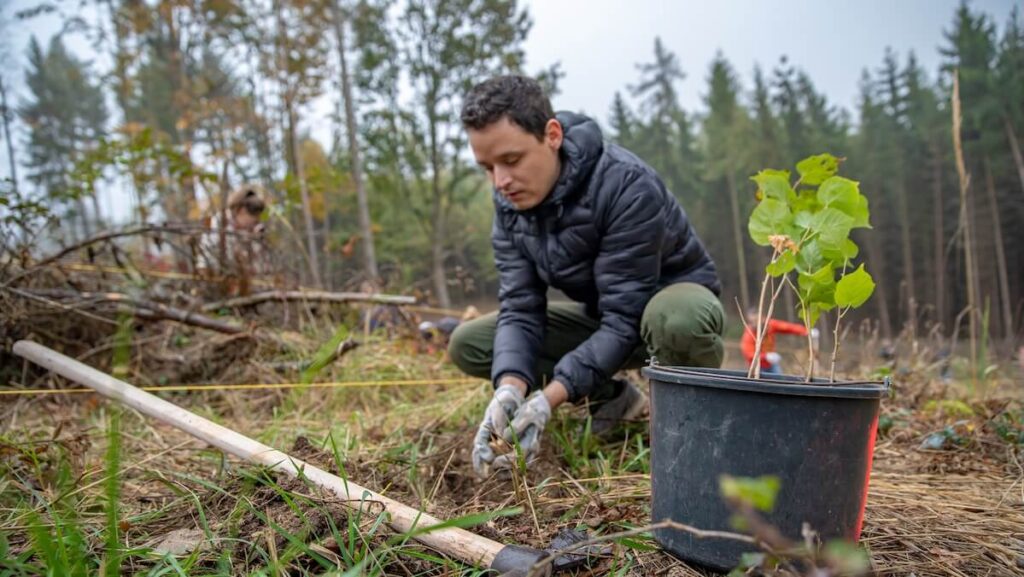
Reforestation is one of the most direct ways to remove carbon dioxide (CO₂) from the atmosphere. Trees absorb CO₂ through photosynthesis and store it in wood, roots, and soil.
Beyond carbon, forests support biodiversity, regulate water cycles, and prevent soil erosion. Restoring native forests can bring back entire ecosystems—from insects and birds to large mammals.
New technologies are speeding up this process. Drone-based planting systems can scatter thousands of seed pods across large areas quickly and efficiently. In some projects, a single drone team can plant millions of seeds per year, targeting areas that are difficult for humans to access.
This matters because scaling reforestation has always been limited by labor and cost. With automation and better data (like satellite mapping), restoration can now happen faster and more strategically.
Soil Carbon Storage
Soil is one of the largest carbon storage systems on Earth, holding more carbon than the atmosphere and all plants combined.
When land is managed carefully—using methods like no-till farming, cover crops, and organic inputs—carbon is stored in the soil instead of released into the air.
This improves soil structure, increases water retention, and supports healthier plant growth. For example, soils rich in organic matter can hold significantly more water, helping crops survive drought conditions.
The key challenge is that rebuilding soil carbon takes time. Once lost, it can take decades to recover. That is why protecting existing soil carbon is just as important as increasing it.
Blue Carbon (Mangroves, Seagrass, and Salt Marshes)
Blue carbon refers to carbon stored in coastal ecosystems like mangroves, seagrass meadows, and salt marshes.
These ecosystems are extremely efficient at capturing carbon—often storing several times more carbon per area than tropical forests. Much of this carbon is locked in sediments, where it can remain for hundreds to thousands of years.
They also provide critical benefits beyond carbon storage. Mangroves, for example, protect coastlines from storms, reduce erosion, and serve as nurseries for fish species.
Because these ecosystems are being lost rapidly, protecting and restoring them is one of the highest-impact climate and biodiversity actions available.
Satellite Monitoring of Deforestation
Satellite technology now allows near real-time monitoring of forests across the planet.
Modern systems combine optical and radar data to detect deforestation even through cloud cover. Some platforms can identify forest loss weeks or even months earlier than older methods.
This early detection is critical. It allows governments and organizations to respond quickly to illegal logging or land clearing.
Satellite monitoring does not directly remove carbon, but it protects existing forests—which are among the most important carbon stores on Earth.
Carbon Tracking and Verification Technologies
As carbon markets grow, measuring and verifying carbon storage has become essential.
New tools use satellite imagery, artificial intelligence (AI), and LiDAR (Light Detection and Ranging) to estimate how much carbon is stored in forests and soils.
These systems create detailed maps, sometimes at resolutions as fine as 30 meters (about 98 feet), allowing accurate tracking of carbon changes over time.
This matters because without reliable data, carbon credits and climate claims cannot be trusted. These technologies provide the transparency needed to scale conservation and climate finance responsibly.
Biochar Technology
Biochar is a stable form of carbon created by heating organic materials (like crop waste or wood) in a low-oxygen environment, a process called pyrolysis.
When added to soil, biochar can store carbon for decades or even centuries. It also improves soil quality by increasing nutrient retention and water-holding capacity.
In some cases, biochar-amended soils can significantly improve crop yields, especially in degraded or nutrient-poor land.
While still limited by production scale and cost, biochar is gaining attention as a practical way to combine carbon storage with agricultural benefits.
Climate Modeling AI
Artificial intelligence (AI) is transforming how scientists model climate systems and predict environmental changes.
AI models can process vast amounts of data quickly, producing forecasts using a fraction of the computing power required by traditional models.
For example, some AI systems can simulate global weather patterns up to 16 days ahead while using less than 1% of the computational resources of older methods.
These tools do not reduce emissions directly, but they help governments, scientists, and planners make better decisions—whether preparing for storms, managing water resources, or designing climate policies.
Climate-Resilient Infrastructure
Climate-resilient infrastructure focuses on designing systems that can withstand extreme weather, rising temperatures, and changing environmental conditions.
This includes both engineered solutions (like flood barriers) and nature-based solutions (like wetlands, mangroves, and green urban spaces).
For example, restored wetlands can reduce flood damage while also storing carbon and supporting wildlife. In some cases, every $1 invested in such systems can generate multiple dollars in avoided damage.
While these solutions do not directly remove carbon, they are essential for protecting ecosystems and communities as climate impacts intensify.