
If we want technologies that truly protect nature, water solutions need to do more than just provide clean water. The most effective ones solve multiple problems at once—securing water supply, reducing pollution, protecting ecosystems, and helping communities adapt to climate change.
The most impactful technologies today are not necessarily the newest or most high-tech. They are the ones already working in real cities, farms, and natural systems—quietly improving water quality, saving resources, and supporting ecosystems. These are practical solutions you can already find in places ranging from Singapore’s urban water systems to agricultural fields in India or California.
This ranking focuses on what works best today—not what sounds most futuristic. Technologies are ordered based on real-world impact, scalability, and how many environmental problems they solve at the same time.
For example, a system that reduces water use, prevents pollution, and protects ecosystems will rank higher than a technology that only solves one issue or is still too expensive or limited to specific conditions.
Using that approach, the order is: wastewater recycling systems, smart irrigation, nature-based flood control, wetland restoration, desalination with renewable energy, carbon capture and direct air capture (DAC), microplastic filtration systems, oil spill bioremediation, and atmospheric water generation. The top technologies are already delivering measurable results at scale, while the lower ones are more specialized or still developing.
The biggest gains available now
Wastewater Recycling Systems
Wastewater recycling is one of the most powerful solutions because it turns waste into a resource. Instead of discharging used water into rivers or oceans, it is treated and reused for irrigation, industry, groundwater recharge, or even drinking water.
Modern systems use multiple treatment steps, including membrane filtration, reverse osmosis, and ultraviolet (UV) disinfection. Together, these processes remove particles, bacteria, and dissolved pollutants to extremely high standards.
This matters because every liter (or gallon) reused reduces pressure on natural water sources like rivers and aquifers. At the same time, it prevents pollution from entering ecosystems. Cities like Singapore have built entire water strategies around reuse, while large-scale systems in California supply water to millions of people.
Smart Irrigation
Smart irrigation improves how water is used in agriculture, which consumes about 72% of global freshwater. Traditional irrigation often wastes water, but modern systems deliver it directly to plant roots using drip lines and sensors.
These systems use soil moisture sensors, weather data, and automated controls to irrigate only when needed. For example, instead of watering a field daily, the system activates only when soil moisture drops below a specific level.
The environmental benefit is significant: less water waste, reduced fertilizer runoff into rivers, lower energy use for pumping, and improved resilience during droughts. In regions like Israel, India, and parts of the United States, smart irrigation has already transformed farming efficiency.
Working with ecosystems instead of against them
Nature-Based Flood Control
Nature-based flood control works by cooperating with natural systems instead of trying to overpower them. Instead of forcing rivers into narrow concrete channels, these approaches allow water to spread safely into floodplains, wetlands, or coastal zones.
For example, the Netherlands’ “Room for the River” program allows rivers to expand during floods, reducing pressure on cities. Similarly, floodplains like California’s Yolo Bypass can temporarily store large volumes of water—protecting urban areas while supporting wildlife habitats.
These systems reduce erosion, improve water quality, recharge groundwater, and create habitats for species like migratory birds and fish. In many cases, they can perform as well as traditional infrastructure while providing additional ecological benefits.
Wetland Restoration Technologies
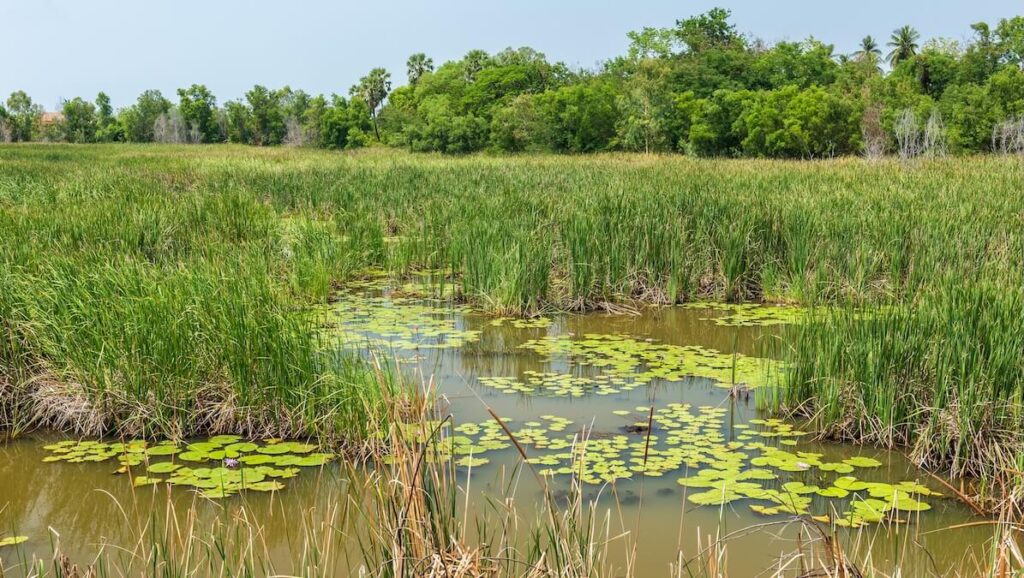
Wetlands are among the most efficient natural systems on Earth. They act like filters, sponges, and habitats all at once—cleaning water, storing carbon, and reducing flood risks.
Unfortunately, a large percentage of the world’s wetlands has already been lost. Restoring them offers one of the highest environmental returns.
Modern restoration techniques include reconnecting rivers to floodplains, rewetting dried peatlands, and adding sediment to help coastal marshes keep pace with rising sea levels. For example, peatland restoration in northern Europe helps reduce carbon emissions while improving biodiversity.
Wetlands support species such as frogs, fish, and migratory birds, while also improving water quality for nearby communities.
Heavy engineering for stubborn problems
Desalination With Renewable Energy
Desalination removes salt from seawater or brackish water, making it usable for drinking or agriculture. The most common method, reverse osmosis, pushes water through membranes under high pressure.
When powered by renewable energy like solar or wind, desalination becomes more environmentally friendly. This is especially important in dry coastal regions, such as parts of the Middle East or Australia.
However, desalination still requires careful management. Waste brine (highly concentrated saltwater) must be handled properly to avoid harming marine ecosystems. Because of these challenges, desalination is best used where water scarcity is severe and other options are limited.
Air Pollution Capture and Carbon Removal
Carbon capture and direct air capture (DAC) focus on removing carbon dioxide (CO₂) from industrial emissions or directly from the air. These technologies are especially important in industries like cement and steel, where emissions are difficult to eliminate.
Direct air capture (DAC) works by pulling CO₂ from the atmosphere using chemical processes. It sounds futuristic, but it is already being tested in real facilities.
However, these systems are still expensive and operate at relatively small scales compared to global emissions. That’s why they are considered important—but not yet dominant—solutions in environmental protection.
Microplastic Filtration Systems
Microplastics—tiny plastic particles often smaller than 5 millimeters (0.2 inches)—are now found in rivers, oceans, and even drinking water. Filtration systems aim to capture these particles before they reach natural ecosystems.
Advanced wastewater treatment plants can remove more than 98% of microplastics, which is a significant improvement. Some newer technologies also target microfibers released from washing synthetic clothes.
However, filtration alone is not enough. Microplastics originate from many sources, including packaging and textiles, so preventing pollution at the source is still essential.
Special-case and emerging solutions
Oil Spill Cleanup Through Bioremediation
Bioremediation uses naturally occurring microorganisms to break down oil pollution. These microbes consume hydrocarbons and gradually convert them into less harmful substances.
This method is often used after the main cleanup—such as removing oil with skimmers or barriers. It works best in oxygen-rich environments where microbes can thrive.
However, it is relatively slow and depends heavily on local conditions like temperature and nutrient availability. That’s why it is considered a supporting technique rather than a primary solution.
Atmospheric Water Generation
Atmospheric water generation (AWG) creates water from air. It typically works by cooling air below its dew point so water condenses, or by using materials that absorb moisture and then release it.
This can be useful in emergency situations, remote locations, or areas with limited infrastructure. For example, AWG systems can provide drinking water during disasters or in isolated communities.
But the technology has limitations. It requires energy and works best in humid environments. In dry climates, water production can drop dramatically—sometimes by more than 80%.
Because of this, AWG is best seen as a backup or specialized solution rather than a large-scale answer to global water challenges.