
The ocean covers more than 70% of Earth’s surface, yet it is under increasing pressure from pollution, overfishing, and climate change. Protecting it requires more than awareness—it requires smart, effective technologies that help us observe, protect, and restore marine ecosystems.
The most impactful solutions today are not just experimental ideas. They are already being used in real-world conditions—from fish farms in Norway to coral restoration projects in the Caribbean. These technologies are ranked here based on how much they currently help nature, not just their future potential.
Sustainable Aquaculture
Sustainable aquaculture is the farming of fish, shellfish, and seaweed in a way that minimizes environmental harm. Instead of relying only on wild fishing, which can deplete ocean populations, aquaculture produces seafood in controlled systems.
Modern systems often use Recirculating Aquaculture Systems (RAS), where water is filtered and reused. For example, salmon or tilapia can be raised in tanks where water quality, oxygen, and waste are carefully managed.
Seaweed farming is another important part of aquaculture. Seaweeds grow quickly, absorb carbon dioxide (CO₂), and improve water quality by removing excess nutrients.
This matters because it reduces pressure on wild fish populations. Shellfish like oysters and mussels even clean the water as they grow—one oyster can filter up to 190 liters (50 gallons) of water per day.
In places like Norway, Canada, and Southeast Asia, sustainable aquaculture is already providing food for millions while reducing environmental impact.
River Plastic Interception Systems
Most ocean plastic does not start in the ocean—it comes from rivers. River interception systems are designed to stop this waste before it reaches the sea.
These systems often use floating barriers that guide trash into collection points. Some include conveyor belts powered by solar energy that lift waste out of the water.
For example, a single system can capture up to 100,000 kilograms (220,000 pounds) of waste per day under ideal conditions. Since a relatively small number of rivers carry most ocean plastic, targeting these locations is extremely effective.
This approach protects coastal ecosystems, prevents harm to marine animals, and improves water quality for nearby communities.
Cities in Asia, Africa, and Europe are increasingly adopting these systems, showing that prevention is often more effective than cleanup.
Ocean Cleanup Technologies
Even with prevention, millions of tons of plastic are already in the ocean. Cleanup technologies aim to remove this existing pollution.
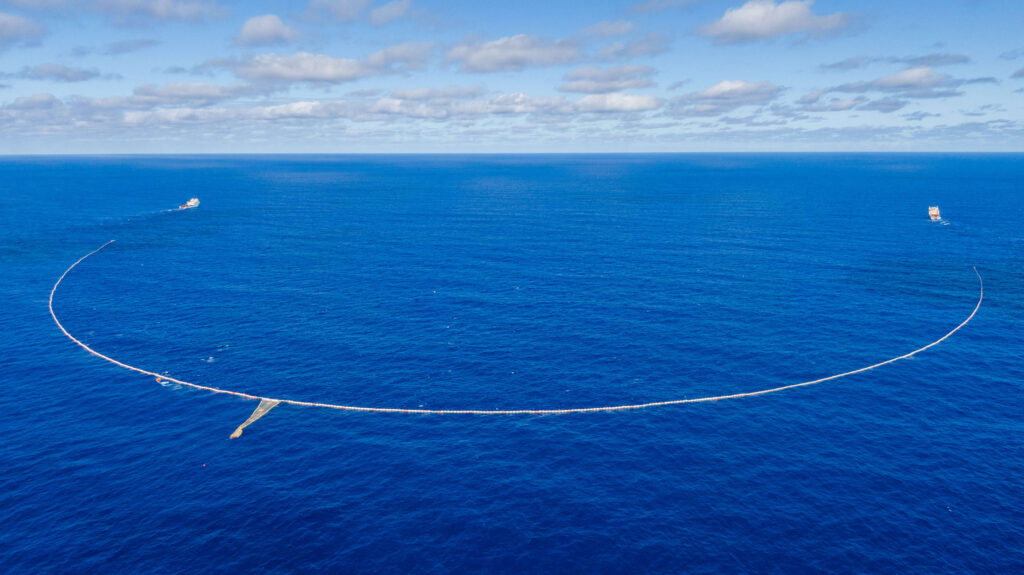
Some systems use large floating barriers that gather plastic using ocean currents. Others, like smaller “seabins,” operate in ports and marinas, collecting debris continuously.
These technologies reduce harm to marine life such as turtles, seabirds, and fish that can ingest or become entangled in plastic. They also help prevent plastics from breaking down into microplastics.
However, cleanup alone is not enough. It works best when combined with prevention systems and better waste management.
Still, removing existing pollution is essential—every kilogram (2.2 pounds) removed is one less threat to marine ecosystems.
Coral Reef Restoration (Coral Farming and Artificial Reefs)
Coral reefs are among the most biodiverse ecosystems on Earth, but they are rapidly declining due to warming oceans and pollution.
Restoration projects grow corals in underwater nurseries and then transplant them onto damaged reefs. These nurseries can hold thousands of coral fragments, which are later reattached using safe materials.
One innovative method, called microfragmentation, cuts corals into tiny pieces so they grow up to 50 times faster than normal.
Artificial reefs—often made from concrete or 3D-printed materials—also provide surfaces where new corals can grow.
This work is critical because reefs support fish populations, protect coastlines from waves, and provide livelihoods for millions of people.
In regions like the Caribbean and Australia’s Great Barrier Reef, restoration efforts are already helping ecosystems recover.
Marine Ecosystem Monitoring (AI and Satellites)
Understanding the ocean is the first step to protecting it. Modern monitoring uses satellites, sensors, and artificial intelligence (AI) to track changes in marine environments.
Satellites can detect ocean temperature, algae blooms, and even illegal fishing activity. AI systems analyze this data to identify patterns that humans might miss.
Underwater, autonomous sensors and floats collect data on temperature and salinity down to depths of about 2,000 meters (6,560 feet). These systems help scientists understand climate change and predict weather patterns.
This technology allows for faster responses to environmental threats, such as coral bleaching or illegal fishing. It also helps governments enforce conservation laws more effectively.
In simple terms, monitoring turns the ocean from an unknown space into a measurable, manageable system.
Ocean-Based Carbon Removal
The ocean already absorbs about 25% of global carbon dioxide emissions, making it a powerful natural climate regulator.
Coastal ecosystems like mangroves, seagrasses, and salt marshes—often called “blue carbon” systems—store large amounts of carbon in their soils. Protecting and restoring these habitats is one of the most effective natural climate solutions.
New technologies are also being developed. For example, large-scale seaweed farming can capture carbon, and some systems aim to store this biomass in deep ocean layers.
Other approaches use chemical processes to remove CO₂ from seawater, allowing it to absorb more carbon from the atmosphere.
However, many of these methods are still experimental and must be carefully tested to avoid unintended ecological impacts.
For now, protecting natural ocean ecosystems remains the most reliable way to support carbon removal.