Nested Questions Logo

What Are Animals Talking About—and Can AI Help Us Understand Them Better?

My closest encounters with what looks like animals “talking” usually happen in our garden. It is also where animal communication first became something I wanted to understand. When I work outside, I sit quietly enough to fade into the background, happily spying on the animals.

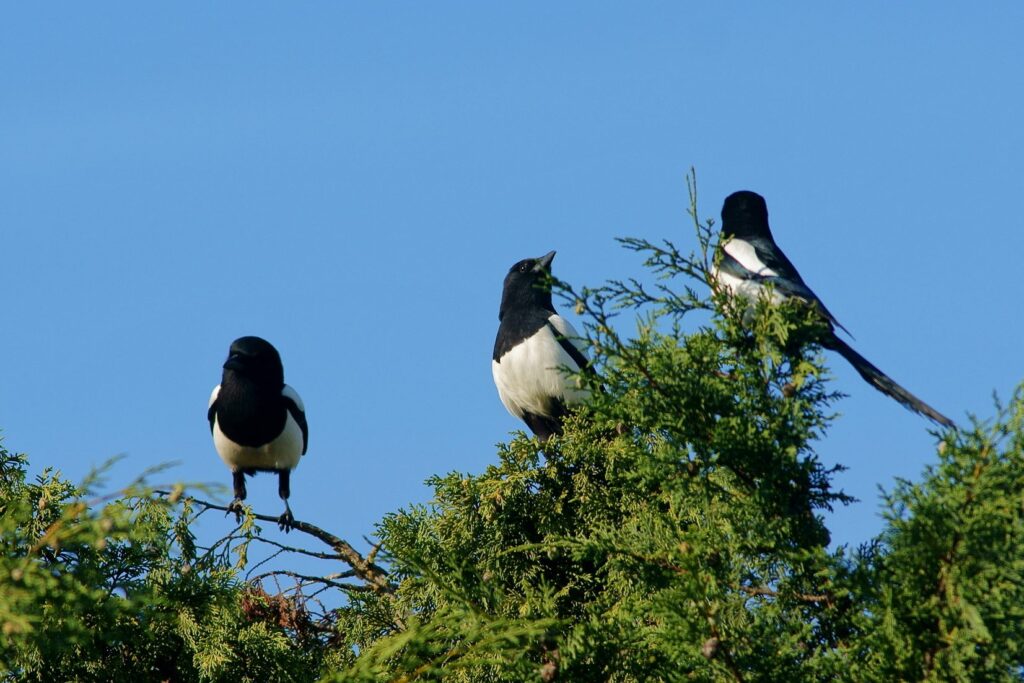
Then come the chattiest of our tree-dwelling neighbors: the magpie family.

One day I was on the hammock with my son, hugging him while he told me about his day at kindergarten. The magpies arrived and started one of their noisy exchanges, repeatedly cutting into his story. Irritated, he finally asked, “Can you tell the magpies to stop talking? It’s very rude.”

Apparently kindergarten had taught him that interrupting is bad manners.

But it was the word talking that caught my attention. He does not normally use it for our cat or dogs. For the magpies, though, it came naturally. To him, they were talking—and, rather annoyingly, talking over him.

That left me with some questions: When animals pass information to one another, when does that count as communication? And when, if ever, does communication become language? How much of animal communication have scientists really decoded?

There is another reason I became curious. For years my husband, who is fascinated by new technologies, has been convinced that AI may eventually help us understand animal communication.

So another big question behind this article is: Can AI really help us understand animal communication?

Here, I focus on animals communicating naturally with one another. I don’t cover attempts to teach animals human language or artificial communication systems, which are a different subject.

My son’s sweet, naive comment was what finally triggered my curiosity enough to turn these questions into this article.

Three Eurasian magpies (Pica pica) perched at the top of a conifer against a clear blue sky
“Pica pica gathering tree tops 1” by Peter Trimming, licensed under CC BY 2.0, via Wikimedia Commons.

How does information pass between animals — and when is an animal really "saying something"?

Information moves between animals almost constantly, but only part of that movement is communication. A useful way to sort out what counts as communication is to picture a ladder with five rungs. On Rung 1, information simply leaks out of an animal that is busy doing something else. On Rung 5 sits human language. As you climb, the animal has more and more control over what gets sent — and it looks more and more like the animal is saying something. The climb is a gradual slope rather than a single step, which is why the point where “saying something” begins is genuinely blurry.

Rung 1: information that just leaks out

Start with the kind of event that is not communication at all. A mouse rustling through dry leaves as it forages at night is not communicating with an owl. That owl is hunting the mouse by listening for exactly that rustling sound. The mouse is making a noise as it goes, and the owl is simply listening in. A leak like this is called a cue: information that escapes incidentally, as a by-product of some activity other than communication. Nothing has been sent. Cues still matter, because they are often the raw material for signals. A signal can get started out of a cue. Animals are already watching some body feature, or some action, of another animal as a cue. Then that other animal develops a slightly exaggerated version of the feature, or performs a slightly enhanced version of the action. That exaggerated feature, or that enhanced action, is where a signal begins.

Rung 2: communication, and the signal inside it

Communication is the whole event, not just the thing sent. It is the transfer of information from one animal to another in a way that affects behavior and the survival or breeding success of one or both of them. It has three parts: a sender, a signal, and a receiver who does something in response. The signal is only the middle part. Unlike a cue, a signal is produced specifically to give information to receivers.

Ants show the whole event plainly. A worker that finds food lays a chemical trail along the ground on her way back to the nest. Other workers then follow that marked trail out to the food on their own. Sender, signal, receiver, response — the full loop.

A signal also has to travel from the sender to the receiver, and it can travel by any of several routes. Each route is called a channel. A channel is not a step up the ladder — it is a property of the signal, one of the physical ways a signal can cross the gap. Animals monitor cues carried by sound, light, chemicals in their surroundings, electric fields, movement in the surrounding water or air, and touch. Every one of those six has also been recruited to carry signals by at least some animals. One example of each is enough here:

  • Sound. Male Cassin’s finches sing to attract females.Nested question
  • Chemicals. The ant trail just described is a chemical signal, laid on a surface rather than released into the airNested question
  • Light and color. Male fireflies emit repeated flashes of light to attract mates, and the pattern of long and short flashes differs from species to species.Nested question
  • Touch. Many birds and mammals groom or preen one another, which serves to confirm friendly bonds or relative rank within a group.Nested question
  • Movement of water or air. In some crickets that do not chirp, a puff of air is the signal itself: they fan air at each other with their wings during courtship and fights, and other crickets of the same species feel the puffs.Nested question
  • Electric fields. Knifefishes and elephantfishes vary how fast they pulse and the shape of each electric pulse. They use these changes to handle territory defense, fights, rank, courtship, and keeping a foraging school together. Air conducts electricity so poorly that electric signaling among animals is limited to water.Nested question

Many signals also combine channels, so an animal may be sending on two of them at once.Nested question

One oddity is worth a mention. A surprising number of animals can detect the Earth’s magnetic field, yet as of 2011 no animal had been shown to use magnetism to signal to another.

Rung 3: meaning

Rung 3 is referential meaning: the signal gives listeners information about a particular thing out in the world, rather than only broadcasting the sender’s own mood or condition.

One of the best-studied cases is the vervet monkey (Chlorocebus pygerythrus) of the Kenyan savanna, which has distinctive alarm calls for different kinds of danger. When researchers played a recording of the leopard alarm with no predator anywhere near, the monkeys still ran into the trees.

Two things need saying about what a result like that does and does not establish. The leopard alarm goes with a leopard, and listeners react as though a leopard were there. Scientists are deliberately not claiming that the monkey means “leopard” when it calls.Nested question

Rung 4: signals the animal varies

Rung 4 is the flexible signal: a signal the animal changes in order to convey different information.

Rung 3 and Rung 4 are easy to confuse, so it is worth being blunt about the difference. They are two separate properties of a signal, and they answer two different questions. Referential asks one question: does the signal carry information about a specific thing out in the world? Flexible asks a different one: can the animal vary the signal to convey different things? The vervet monkey is the example for the first question. It has separate calls for a leopard, for an eagle, and for a snake, and the meaning comes from which of those calls it gives. The honeybee is the example for the second question. She performs one kind of dance and alters it, and the alterations are what carry the different information. So a flexible signal is not a more advanced grade of referential signal. The two are different properties, and the question each one settles is different.

The honeybee waggle dance is a clear example of a flexible signal. A returning forager dances on the honeycomb. The direction of her waggling run, and how long the run lasts, both shift according to where the food she found is sitting. One dance form, many different messages.

Ants have a less obvious flexible signal of their own. Workers that follow a trail and find plenty of food reinforce the trail chemical on the way home. Workers that find little food, or find the food source used up, mark less or not at all, and the trail fades away.

The thread running through the whole ladder: control rises, gradually

Notice what has been creeping upward alongside meaning. At the bottom, nothing is chosen at all — the mouse’s rustle is not the mouse’s decision. A little higher, some signals are fixed. The red, white, and blue coloration on the head of an adult male mandrill (Mandrillus sphinx) stays fixed and on display for his entire life. A male wild turkey carries a similar set of colors on fleshy ornaments on his head. He can deflate many of those ornaments when he is not displaying to females or confronting a rival. The two animals wear nearly the same colors, and their control over those colors is the exact opposite. The turkey can deflate his ornaments and turn his display down. The mandrill has no such off switch — his colors are on for his whole life.

One clear piece of evidence that an animal has such a switch is the audience effect: senders adjusting their signaling depending on who is likely to be around. Roosters are less likely to give food calls when hens are absent. Yellow mongooses give alarm calls only when others of their own kind are nearby. Fork-tailed drongos feed in the canopy and routinely call when a predator appears overhead. For predators on the ground they rarely call at all — unless ground-feeding pied babblers are in their mixed flock of several bird species. When those babblers are there, the drongos do call. All three cases show the same pattern: the animal is more likely to signal in some company and less likely to signal in other company. That is control, and control is something you can watch and count.

Now put the vervet monkeys beside those three cases, because the contrast between the vervets and those three cases is the most important idea on the whole ladder, and the easiest one to blur.

What we can see is the listeners’ side. The vervet result described at Rung 3 is a good example. The monkeys’ reaction can be watched, filmed and counted, and it shows the listeners drawing a correct conclusion about the world.

What we cannot see is the caller’s side. The caller may be trying to inform the others, or may simply be making a sound that the others have learned to read. From the outside those two possibilities look identical: one monkey calls, and the rest go up the trees. Watching the listeners does not separate them, and neither does playing the call back, however carefully.

So control and intent are not equally knowable. Control is observable: you can watch whether an animal sends a signal or withholds it, whether it varies that signal, and you can count what it does. Intent is not observable in the same way. Evidence from watching behavior shows what animals do, not what they understand while doing it, so it cannot settle what the calls mean to the animals themselves.

Rung 5: language, in one paragraph

Language sits at the top, and it is built differently. Three of its hallmarks are enough to show why. The first is that its units carry specific meanings: a word means a particular thing. The second is that those words are arbitrary. A word generally does not resemble the thing it stands for. The word for a dog is dog in English, Hund in German, and chien in French, and none of those words sounds like a dog. The third is displacement: meanings about the past, the future, or distant places can be encoded and understood, not just meanings about what is here and now. You can describe a meal you ate a decade ago, or a mountain you have never visited. No other species has been shown to possess language as a whole, although many share important components of it. So, on present evidence, language appears to be uniquely human.

So when is an animal really saying something? The ladder gives no single rung where saying something starts. What it gives instead is a rising line: from a leak the animal cannot help, to a signal it cannot switch off, to a signal it can withhold when nobody useful is listening, to a signal it reshapes to fit what it has found. By the time you reach the honeybee’s dance or the drongo’s selective alarm, “saying something” feels like a fair description of what the animal is doing. Whether it feels that way to the animal is a separate question, and one that watching behavior does not settle.

Sources

  1. Bradbury, Jack W., and Sandra L. Vehrencamp — Principles of Animal Communication, 2nd edition, Sinauer Associates, 2011 — Ch. 1 “Signals and Communication”; Ch. 4 “Light and Visual Signal Production”; Ch. 7 “Short Range Modalities”; Ch. 8 “Decisions, Signals, and Information”; Ch. 14 “Environmental Signals”; Ch. 15 “Communication Networks”
  2. Rubenstein, Dustin R., and John Alcock — Animal Behavior, 11th edition, Sinauer Associates / Oxford University Press, 2019 — Ch. 2 “The Integrative Study of Behavior”; Ch. 8 “Principles of Communication”
  3. Fitch, W. Tecumseh — The Evolution of Language, Cambridge University Press, 2010 — Ch. 1 “Language from a biological perspective”; Ch. 4 “Animal cognition and communication”
  4. Rendall, D., “Aping Language: Historical Perspectives on the Quest for Semantics, Syntax, and Other Rarefied Properties of Human Language in the Communication of Primates and Other Animals”, Frontiers in Psychology 12:675172, 2021
Elephants, crickets, spiders and baleen whales all send messages with sound: through air, through water and through solid ground. Baleen whales are one of the two main whale groups; the other is the toothed whales. Sound is pressure moving through matter. Its speed depends on what it is moving through: about 344 meters per second (1,129 feet per second) in air, about 1,500 meters per second (4,900 feet per second) in water, and about 5,100 meters per second (16,700 feet per second) along a bar of steel. Whether the sound travels through air, water or solid material, the delay between sender and receiver is usually milliseconds.

Elephants are one long-distance case. Female elephants can recognize up to 100 close and distant relatives by the low “rumble” contact calls those relatives make — contact calls being the kind animals use to keep in touch with their group. They can still recognize these relatives at ranges of up to 3 kilometers (1.9 miles).

Even one widespread species can sound different from place to place. The Eurasian magpie (Pica pica) has a rattling “chatter” call — the call it makes most often throughout the year. A 2011 study compared the four-syllable chatter calls of sericea, the magpie subspecies found in Korea and Japan. The study covered seven locations: five on the South Korean mainland, plus two island sites, Jeju in Korea and Saga in Japan. The calls differed measurably across those seven locations. Island birds differed from mainland birds. On the mainland, northern birds differed from southern ones. Overall, the magpies at Saga were the most distinctive of the seven groups of birds. What these call differences mean to the magpies themselves has not been demonstrated.

Sound also travels through solid ground, and a surprising range of animals send signals that way. Fiddler crabs, snakes, rodents and elephants all signal at the surface of the earth. Ground signals usually travel as ripples running along the surface. Low frequencies fade more slowly than high ones. Most animals signaling at a surface favor the lowest frequencies their bodies can detect. In dry sand, the band of frequencies that carries best is 300 to 400 hertz, meaning 300 to 400 vibrations per second. Elephants appear able to pick up these very low-frequency surface ripples from kilometers away.

Some animals build themselves an instrument. A calling cricket vibrates its wings, but wings on their own make a weak low call. The air the wings push on one side slips around the body and cancels most of the low notes on the other side. That matters, because low notes are the ones that travel farthest. Tree crickets fix that problem by chewing a hole in a leaf and calling with their bodies in the hole. The leaf blocks the short way around, so far less of the sound cancels itself, and the cricket’s low notes come out at a reasonable volume.

Other crickets dig their instrument instead. The short-tailed cricket (Anurogryllus muticus) digs a horn-shaped hollow in the ground and sits inside it. Echoes off the walls turn the hollow into a directional sound source. Mole crickets go further. They build a horn at the ground surface, and a narrow tunnel connects that horn to a bulb-shaped chamber underneath.

Spiders signal on a structure they built themselves. Signals travel along spider webs, and spiders can build a web whose sound-carrying properties suit them. In a typical orb web, signals seem to travel best as lengthwise vibrations in the spoke threads. Carried this way, all frequencies travel about equally well up to 9 to 10 kilohertz, meaning 9,000 to 10,000 vibrations per second.

The deep ocean holds a layer called the SOFAR channel — short for sound fixing and ranging — where sound travels more slowly than in the water above and below it. Sound that starts to stray out of the layer is bent back into it instead of escaping, so it can carry extraordinarily far. In tropical and warmer temperate oceans the channel typically begins 600 to 1,200 meters (about 2,000 to 3,900 feet) down. Whether any animal uses it to communicate is unsettled. It has been suggested that baleen whales could use the SOFAR channel, but as of 2011 most baleen whales appeared to call from much shallower water, 20 to 40 meters (66 to 131 feet) down.

Sound feels like the obvious way to send a message, because people are born into a world where sound communication is a dominant activity. But producing a useful sound signal presents significant hurdles. Most animals do without sound communication altogether.

Sources

  1. Bradbury, J.W. & Vehrencamp, S.L., Principles of Animal Communication, 2nd ed., Sinauer Associates, 2011 — Chs 2, 3, 6, 13
  2. Lee, S., Lee, S., Nam, H.-Y. & Choe, J.C., “Geographic variation in the acoustic signals of black-billed magpies (Pica pica) in South Korea and Japan”, Journal of Ecology and Field Biology 34(2):167–174, 2011

Jumping spiders, peacocks, quail, fiddler crabs, fireflies and squid all signal by being looked at. Animals use three very different mechanisms to generate light signals.

  • Pigments. A pigment soaks up some wavelengths of light and lets the rest come back. The color you see is whatever the pigment did not absorb.
  • Structured surfaces. Microscopic structures reflect certain wavelengths back rather than absorbing them.
  • Light the animal makes itself. Some animals generate their own light, which is called bioluminescence.

On top of those three ways of making color and light, animals also combine body orientations, postures, gestures and movements into visual signals.

Fixed markings are one kind of visual signal. Males of different species of jumping spiders in the genus Habronattus wear strikingly different head and face markings. The metallic color of the eyespots in a peacock’s tail comes from a square array of microscopic rods of melanin, a group of dark pigments, in the feather. That array reflects light back rather than soaking it up. Males with brighter eyespots have higher mating success. Those precisely built arrays are easily disrupted by poor condition or a heavy parasite load.

Posture carries messages without any color change at all. Male Gambel’s quail (Callipepla gambelii) raise the feathered crest on their heads during aggressive encounters. Dominant birds hold the crest erect and tipped forward. Subordinate males flatten it down and point it backward.

Movement can be a whole conversation. At low tide, each male fiddler crab (Uca annulipes) advertises himself and his burrow to females by waving his single, greatly enlarged claw. When a female goes to inspect one male’s burrow, the other males cluster around and match both the rate and the timing of their waving to his. This matched waving brings the males no advantage in avoiding predators or in attracting extra females. Instead, it emerges from the competition between neighboring males.

Then there is self-made light. In firefly beetles, the males emit repeated flashes to attract mates. The pattern of long and short flashes is specific to each species, which keeps mating within the species. Males of one firefly species, Photinus carolinus, go further and synchronize their flashes with each other. Crustaceans called ostracods court with light too. Males of the Caribbean species Vargula annecohenae display to females at sunset by squirting small packets of light-producing chemical into the water. In Vargula ostracods, a courting male swims a corkscrew path and then spirals upward. As he swims, he puffs the light-producing chemical out through nozzles near his mouth. Females that are not lit up watch him and follow.

Squid and octopus show the most sophisticated color change used for signaling. Squid and octopus change color with chromatophores, which are small many-celled organs. Each chromatophore is a pouch of brown, red or yellow pigment. Muscle fibers radiating out from the pouch pull it open, under the animal’s own nervous control. By expanding different-colored chromatophores in combination, the animal runs through a variety of colors in rapid succession. It uses those color patterns in courtship, in aggression and in holding a group together.

Visual signals are limited by range and by line of sight. In clear air, a large object that contrasts with its background can be picked out at about 6 kilometers (3.7 miles). In dusty, humid or foggy air, that distance drops to roughly 50 meters (165 feet). In very clear ocean water, the maximum viewing distance is around 60 meters (200 feet), and it is usually much less in fresh water. Anything opaque between the sender and the receiver blocks the signal outright, because light cannot bend around objects the way sound can.

Sources

  1. Bradbury, J.W. & Vehrencamp, S.L., Principles of Animal Communication, 2nd ed., Sinauer Associates, 2011 — Chs 1, 4, 5, 8
  2. Rubenstein, D.R. & Alcock, J., Animal Behavior, 11th ed., Sinauer/Oxford University Press, 2019 — Ch. 8 “Principles of Communication”
  3.  

Elephants, moths, rabbits, sea anemones and ants all send chemical messages. Chemical signaling is the oldest method of communication there is. A chemical that carries a message between members of the same species is called a pheromone. Some pheromones, called primers, change the receiver’s body chemistry slowly over time. Others, called releasers, produce an immediate response: approach, retreat, freezing, or some other recognizable movement or posture.

The same molecule can turn up in wildly unrelated animals. A chemical called (Z)-7-dodecenyl acetate is a main sex-attractant ingredient for the Asian elephant. It is also a main sex-attractant ingredient for about 140 species of owlet moth.

Some chemical messages are aimed at the very young. Mother rabbits (Oryctolagus cuniculus) produce a mammary pheromone that attracts their pups and guides them to suckle.

Some chemical messages are aimed at the neighbors. When the colonial sea anemone Anthopleura elegantissima is wounded, it releases a small, quickly evaporating alarm pheromone from its tissue. The anemones next to it pull back sharply.

Ants run some of the most elaborate chemical signaling systems. Ant trail pheromones can be a single chemical, a simple blend of two or three chemicals, or a complex mixture of up to 14 components. How long a trail pheromone lasts is matched to what the species needs. Pharaoh ants (Monomorium pharaonis) mark a trail branch that no longer leads anywhere useful with a long-lived repellent. They mark a branch that does lead somewhere useful with a short-lived attractant. Pharaoh ant trails also branch off the main trail at a standard 60-degree angle. Because of that fixed angle, a worker who loses the trail and finds it again can tell which way is home.

Chemical messages carried through air or water share one limitation: they are slow. Odor molecules have to travel the whole distance themselves. Either a current of air or water carries them along, or they drift on their own from where they are concentrated toward where they are not. So the typical delay between sender and receiver runs to seconds, minutes or even days. Molecules left to drift on their own move through water roughly ten thousand times more slowly than through air. So a moth signaling for a mate releases its scent slowly and keeps releasing it for several hours. That gives distant moths time to catch the scent and fly toward the source.

Sources

  1. Bradbury, J.W. & Vehrencamp, S.L., Principles of Animal Communication, 2nd ed., Sinauer Associates, 2011 — Chs 6, 14

Zebras, buffalo, chimpanzees, flies and ants all send messages by making contact. Touch is probably the most widespread sense there is. But touch signals work only when the sender and the receiver are actually touching. So they show up in the situations where animals are already close: fighting, courting, greeting and grooming. Touch also registers faster than sight or smell. A touch deforms the sense receptor directly. It does not need the chain of chemical reactions that vision and smell require. So in most animals, nerve responses to touch fire 10 to 100 times faster than responses to light or to chemicals.

Contests are one place touch shows up. The early phases of a fight are usually handled by displays at a distance: visual, sound, scent or electrical displays. Touch becomes common as the fight escalates. Mountain zebras (Equus zebra) challenge each other by laying their heads on the opponent’s shoulders and pressing down. Once a fight is settled, the loser may make a submissive gesture that also uses touch. A subordinate African buffalo (Syncerus caffer) lowers its head and places it gently under the belly, or between the rear legs, of a dominant animal. A chimpanzee (Pan troglodytes) calms a dominant animal by gently touching the dominant animal’s genitals.

Courtship runs the same way. It opens with signals that work at a distance and then moves to contact. Mediterranean fruit flies, or medflies (Ceratitis capitata), court with the fine filaments dangling from their antennae. The male faces the female and rocks his body. As he rocks, he uses his own antenna filaments to spread hers outward. If she accepts this, he moves behind her to mate. Female harvester ants (Pogonomyrmex) send the opposite message, just as physically. When a male mounts a female that is not receptive to mating, she produces a buzzing vibration. The vibration travels straight through the points where her body touches his, and he dismounts.

Greeting uses touch as well. Ants, bees, wasps and termites rhythmically tap a new arrival’s antennae or body with their own antennae. The tapping tells the insects doing it who has turned up. It also tells the newcomer that it has been noticed and assessed. An elephant greets a familiar elephant by putting the tip of its trunk into the other elephant’s mouth.

Then there is grooming one another. Grooming is perhaps the most widespread of all the touch behaviors that hold a group together. Grooming strips parasites and debris off the groomed animal. It also reaffirms a friendly bond, or a difference in rank, between the two animals. And it gives the groomer a chance to inspect the scent on the other animal’s body.

Touch can even carry directions. Some ants recruit nestmates to newly found food by tapping them with their antennae and forelegs. These ants then lead the recruits to the food. On the way, the leading ants stay close enough to the recruits to keep physical contact.

Sources

  1. Bradbury, J.W. & Vehrencamp, S.L., Principles of Animal Communication, 2nd ed., Sinauer Associates, 2011 — Ch. 7 “Short Range Modalities”

By shoving the water or air around them hard enough that a nearby animal feels the shove. A fin beat or a wing flick does not just make a sound. It also pushes the water or air itself, and an animal close by can feel that push directly. Signaling by moving water or air works only over a very short range. For a typical fish the useful reach is only one to two body lengths.

What the receiving animal picks up is not a steady push. It is a difference in movement between two separate points in the water or air. One patch of water or air moves, or speeds up, differently from another patch nearby. To pick up that difference, an animal has to sample the water or air in two or more places at the same time.

Fish and water-dwelling amphibians do this with the lateral line. The lateral line is a straight or curved row of movement detectors running along the body. Each detector, called a neuromast, is a cluster of sensory cells capped by a blob of jelly that moves when the water moves past. Squid and cuttlefish carry similar rows of detectors. Some insects, crickets among them, use hairs instead. A cricket has two cerci, a pair of projections at its rear end. Each cercus carries about 1,000 hairs that respond to air currents. Different hairs respond to currents coming from different directions.

Some of what the lateral line and the cricket’s hairs pick up is a genuine signal. In certain crickets that do not chirp, the moving air is itself the signal. Those crickets fan small puffs of air with their wings during courtship and during fights, and other crickets of the same species feel those puffs with their cerci. Several kinds of fish use tail beating or fin fanning as movement signals when they fight and when they court. Schooling fish, squid, and cuttlefish read the movements of their neighbors this way. They use that information to hold their spacing and keep the group together.

Signaling by moving water or air has one strange feature. A sound is gone from any given spot the moment it passes. But a moving animal leaves a wake, and a wake lingers. Swirls can stay in the water for several minutes after even a small fish has swum by.

Sources

  1. Bradbury, J.W. & Vehrencamp, S.L., Principles of Animal Communication, 2nd ed., Sinauer Associates, 2011 — Ch. 7 “Short Range Modalities”

A small set of fish. Electric fields do not travel well enough between land animals to be useful for signaling. So electric signaling happens in water. In fresh water, the fish that signal this way include the South American knifefishes, the African elephantfishes, a single African species called the frankfish, and several kinds of catfish. In the sea, skates appear to signal electrically too.

The body equipment for electric signaling has two halves. The sending half is an electric organ. In fish, the electric organ is usually built from modified muscle cells. In skates and elephantfishes, the electric organ sits in the narrow stretch of tail between the body and the tail fin. The frankfish and most knifefishes use body muscles running from just behind the gills to the tip of the tail. The receiving half is a set of electroreceptors. Knifefishes, elephantfishes and the frankfish all ended up with a similar receptor type tuned to the fast, high-frequency part of an electric discharge. Elephantfishes went further and grew a separate receptor for communicating with each other, called the knollenorgan. The knollenorgan is usually 10 to 20 times more sensitive than the receptor elephantfishes use for finding objects.

One fact shapes everything else about how these fish signal. Knifefishes (apart from electric eels), elephantfishes and the frankfish give off electric discharges continuously. They do this because they use those discharges to feel out the objects around them in dark or muddy water. So the only way these fish can communicate with electric discharges is to alter the pattern they are already producing — the rate of the pulses, the shape of the pulses, or both. They do exactly that, in several ways: sudden brief speed-ups called chirps, gradual speed-ups and slow-downs, repeated rises and falls called warbles, and short silences. These changes in the discharge pattern are used to defend territory, to fight, to settle dominance, to court, and to keep a foraging school together.

Identity information is often important to these fish. Territorial species benefit from knowing an intruder’s species, sex and individual identity. More social species benefit from knowing age, sex and rank. Knifefishes, elephantfishes and the frankfish encode that information by varying the discharge rate, the pulse shape (called the waveform), or both. Where many species live side by side, differences in waveform help sort species and sex apart. In some species, the waveform appears to be distinctive enough to identify the individual fish.

One example shows the trade-off involved. In some pulse knifefishes, such as Brachyhypopomus pinnicaudatus, and in elephantfishes such as Marcusenius macrolepidotus, males remodel their electric organs as they mature. As a result, each male discharge lasts much longer than a female’s. The long pulse carries lower frequencies. So females can recognize a male from farther away. The long pulse also makes the male easier for predatory electric eels and catfish to find and attack.

There is a crowding problem too, and a fix for it. When two of these fish are close, their discharges can smear together. So both wave species and pulse species shift their discharge rates to reduce the overlap. This adjustment is called the jamming avoidance response.

Sources

  1. Bradbury, J.W. & Vehrencamp, S.L., Principles of Animal Communication, 2nd ed., Sinauer Associates, 2011 — Ch. 7 “Short Range Modalities” and Ch. 1

A great many — more than was once realized. A channel is one of the routes a signal can travel by, such as sound, sight or smell. When an animal recruits more than one channel into a single display, that display is called a multimodal signal. Combining channels increases the number of distinct messages the animal can build. Two broad patterns show up. Courtship displays in many backboned animals mix a visual part with a sound part. The signals of insects, spiders and water-dwelling animals without backbones often mix a visual part with a smell part. Some of these signals add sound as well.

Peacock spiders are a good place to see two channels working at once. A male of the Australian peacock spider Maratus volans unfurls a fan from under his abdomen. The fan looks like the tail of a male peacock. He aims it at a watching female and waves his legs in an intricate, coordinated dance. While he is doing all that, he also shakes his abdomen back and forth to produce vibrations. In a series of lab experiments, a research group led by Damian Elias found that both the visual part and the vibration part mattered to whether a female chose a male and whether he mated. Even so, females were more likely to mate with males that spent more of the display time on the visual part. One proposed explanation is that combining channels lets a female decide faster and more reliably. Deciding faster and more reliably may matter because many peacock spider species often turn up in the same places.

The barn swallow (Hirundo rustica) combines a different pair of channels. Male barn swallows communicate with both males and females using song and the patch of red color on the chest. One channel is heard and one is seen, and both are aimed at both sexes.

Why use two channels instead of one? There are two current explanations, and no settled choice between them. In the first explanation, each channel may carry different information, so the receiver learns more from the pair than from either alone. In the second explanation, each channel may carry the same information independently. Then one channel still gets through when the other is drowned out by noise or garbled by a mistake. Combining channels is not free, either. To start with, the animals involved need the right equipment for sending and detecting signals in more than one channel. And coordinating the parts of a display may take nervous-system wiring that a single-channel signal never needs.

Sources

  1. Rubenstein, D.R. & Alcock, J., Animal Behavior, 11th ed., Sinauer/Oxford University Press, 2019 — Ch. 8 “Principles of Communication”
  2. Bradbury, J.W. & Vehrencamp, S.L., Principles of Animal Communication, 2nd ed., Sinauer Associates, 2011 — Chs 1 and 8
  3.  

The experiment showed that three different alarm calls set off three different responses, with no predator present to prompt those responses. It was revised because no other team reproduced the original finding for decades, and when researchers went back to it in 2013 and 2015, it did not hold up in the form it was first reported.

The study was published in 1980. Robert Seyfarth, Dorothy Cheney and Peter Marler recorded the alarm calls that vervet monkeys in the Kenyan savanna give when leopards, eagles and snakes are present. They then played those recordings back with no predator anywhere near, so nothing but the sound could account for what the monkeys did. The monkeys responded differently to each call. A leopard alarm sent them into the trees. An eagle alarm made them look up or run for cover. A snake alarm made them look down, or walk toward the source of the sound. Each call carried something different about the kind of predator, and the listeners acted on the difference. The 1980 study became the textbook example of an animal call carrying a meaning.

The revision came much later. No other study reproduced the 1980 findings for decades. Later work reported in 2013 and 2015 went back to them and revised them. Seyfarth and Cheney, two of the original researchers, later concluded with colleagues that the meaning of these alarm calls bears little resemblance to the meaning of human words. What lets a listening monkey pick a fitting response, they concluded, is the difference in sound between the calls, possibly together with the surrounding situation. That is a smaller claim than the one the 1980 report was taken to make. The calls still guide what listeners do, but as sounds a monkey interprets in the situation at hand, rather than as words for leopard, eagle and snake.

The correction has a great deal of ground to cover. By the end of 2020, the 1980 paper had been cited almost 1,500 times. It was cited at a higher rate after 2000 than before. So the original story kept spreading while the evidence behind it was being reworked. It could be some time before news of the revision reaches all the different fields where the original version took hold.

Sources

  1. Rendall, D., “Aping Language: Historical Perspectives on the Quest for Semantics, Syntax, and Other Rarefied Properties of Human Language in the Communication of Primates and Other Animals”, Frontiers in Psychology 12:675172, 2021
  2. Rubenstein, D.R. & Alcock, J., Animal Behavior, 11th ed., Sinauer/Oxford University Press, 2019 — Ch. 8 “Principles of Communication”
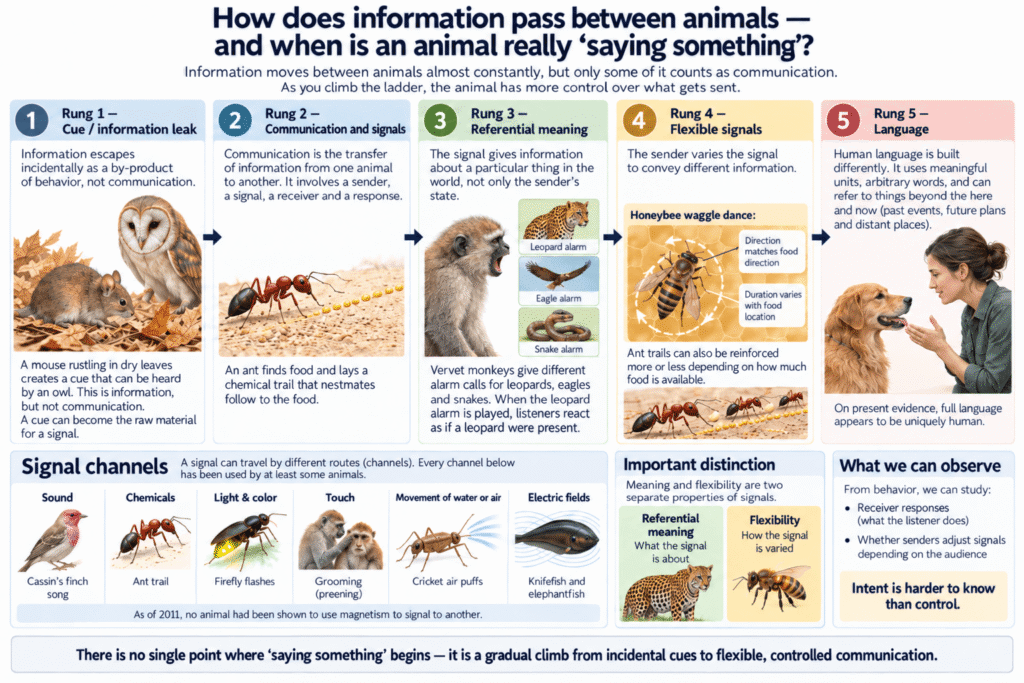
Five-stage diagram showing how animal information progresses from incidental cues to signals, meaning, flexibility, and human language.
Original diagram created by the author with AI assistance to illustrate the article’s cited information; not reproduced from another source.

Do any animals have language?

No animal communication system studied so far has been shown to be language in the full sense. Several animals have individual pieces of language. Researchers still disagree about exactly where the line between communication and language should be drawn. One thing a full language lets you do is make up brand-new sentences and understand ones you have never heard before. So a speaker can say things nobody has ever said.

Since 1960, one of the most influential ways to draw the line between communication and language has been a checklist. In 1960 the linguist Charles Hockett listed 13 “design features” of language. They include having words with specific meanings, and being learned rather than inherited. Many of Hockett’s 13 features now need major revision.

One ability, complex vocal learning, shows how unevenly the pieces of language are spread among animals. Complex vocal learning means changing the sounds you produce because of what you have heard, rather than only using the calls you were born with. Copying a sound you hear is one way to do it. Humans depend on complex vocal learning. A child learns the words of the language spoken around her by listening and copying. Many birds, whales and seals share this ability. As of 2010, complex vocal learning had not been found in chimpanzees, or in any other non-human primate. No non-human primate has been observed spontaneously producing even a word of the local human language. Some parrots, by contrast, pick up spoken words without being taught. Chimpanzees are our nearest cousins. So on complex vocal learning, we have more in common with a parrot than with chimpanzees.

Humpback whales show vocal learning at work in the wild. Male humpbacks sing during the breeding season, and at any one time and place every breeding male sings the same song. That shared song keeps changing, typically by about 40 percent in a year. The males change with it together, so the population’s song this year is not the song it sang last year. Humpback song is one of the least disputed cases of a learned song: the whales are copying one another rather than singing something they were born knowing. Off eastern Australia, the humpbacks’ song once changed quickly to match a very different song from Australia’s west coast. The change apparently came after a few whales moved from one coast to the other. As of 2010, changes like these in humpback song were among the clearest evidence available that animals have cultures.

Other species hold other pieces, and the pieces are design features from Hockett’s list. These are features animals turn out to share with human language. Two of them show how scattered the sharing is.

One is duality of patterning, which means building meaningful units out of meaningless ones. Chickadees and chestnut-crowned babblers combine sound elements that mean nothing on their own, building calls that do specific jobs. Human languages build words out of meaningless sounds in much the same way.

Another is displacement, communicating about something that is not here and now. A honeybee dances to tell her hive-mates where to find food that none of them can see.

Marmosets and elephants add a less settled case: they use calls that seem to pick out particular members of their group.

No animal other than humans has been shown to have language in its full human form, and different species turn out to hold different pieces of it. No other animal has been shown to do what humans do: fold all of these pieces into one system flexible enough to express any thought at all.

Sources

  1. Fitch, W.T., The Evolution of Language, Cambridge University Press, 2010 — Introduction, Ch. 1, Ch. 4, Ch. 6 and Ch. 9
  2. Pleyer, M., Perlman, M., Lupyan, G., de Reus, K. & Raviv, L., “The ‘design features’ of language revisited”, Trends in Cognitive Sciences 30(7):611-631, 2026 (online 2025) — main text, Box 1, Box 2
  3. Rubenstein, D.R. & Alcock, J., Animal Behavior, 11th ed., Sinauer/Oxford University Press, 2019 — Ch. 2

Hockett’s list has 13 features. Most of them turn out to be far more common among animals than he expected. Charles Hockett was an American linguist. In 1960 he broke language into a list of parts, so that other species could be checked against the list.

Here are the 13 design features:

  1. Vocal-auditory channel — language travels by voice and ear.
  2. Broadcast transmission — anyone close enough can hear what is said.
  3. Rapid fading — the sound fades fast, so it does not clog the airwaves.
  4. Interchangeability — any speaker can also be a listener.
  5. Total feedback — speakers hear everything they say.
  6. Specialization — the signal works on the listener’s senses and mind, not by raw physical force like a push or a bite.
  7. Semanticity — some units, such as words, have specific meanings.
  8. Arbitrariness — those meanings are mostly arbitrary: a word does not have to resemble what it means.
  9. Discreteness — each thing said differs from every other by at least one distinct feature.
  10. Displacement — you can talk about the past, the future, or things far away.
  11. Productivity — new sentences can be made up and understood.
  12. Duality of patterning — meaningless sounds combine into meaningful words, and words combine into sentences.
  13. Cultural transmission — languages are learned, not inherited.

Hockett expected the first nine features to be shared with other animals. He treated the last four as the key steps toward full human language.

Some of the features have since needed correcting, because of what is now known about human language itself. Hockett treated language as spoken. But sign languages are full languages too. And words that resemble what they mean turn out to be common in languages, both spoken and signed.

So how useful was the checklist? The checklist shaped the study of animal communication far more than it shaped linguistics. Researchers are still revising the checklist more than six decades later. As for how many of the features animals have, most of the 13 have now been found in one animal or another. But no animal has been shown to have language in its full human form. The features are spread across different species rather than gathered in any one.

Sources

  1. Fitch, W.T., The Evolution of Language, Cambridge University Press, 2010 — Introduction; Ch. 1, Table 1.1
  2. Pleyer, M., Perlman, M., Lupyan, G., de Reus, K. & Raviv, L., “The ‘design features’ of language revisited”, Trends in Cognitive Sciences 30(7):611-631, 2026 (online 2025) — main text

Because a sound that changes what another animal does can pay for itself. A signal lasts in evolution when it usually helps both sides: the sender sends because the receiver responds, and the receiver responds because responding is usually worth it.

The work those signals do sorts into a few broad kinds.

  • Settling disputes without a fight. Most species carry a range of signals for conflicts over food, mates and space, usually with more signals for aggression than for backing down. In many cases those signals settle the dispute, and the fight never happens.
  • Finding and courting a mate. Both sexes presumably want signals that show the species and sex of a possible mate, and that honestly show readiness to breed, so mating can go ahead efficiently.
  • Holding a group together. Animals that live in groups signal to stay together, to coordinate movement, and to organize the things they do as a group.
  • Warning about a predator. An alarm signal is given by one animal to warn the others nearby that it has detected a predator.
  • Announcing food. Food signals tell other foragers that food has been found, and sometimes where it is and how good it is.

Notice how that list is built. Every item is named for the job the signal does — the situation it is used in, and what it achieves there. That is one natural way a species’ signals get sorted, and it works well, because both the situation and the listener’s response can be watched, counted and tested. Play the sound, and see what the listeners do.

But that gives you the job a call does, not the thought behind it. Some alarm calls send listeners fleeing for cover — that tells you what the call is for. It does not tell you whether the caller meant to warn anyone, or what the sound stands for in the animal’s own mind. What a call is for can often be measured. What it stands for in the animal’s own mind, mostly, cannot.

Sources

  1. Bradbury, J.W. & Vehrencamp, S.L., Principles of Animal Communication, 2nd ed., Sinauer Associates, 2011 — Ch. 1 “Signals and Communication”; Ch. 11 “Conflict Resolution”; Ch. 12 “Mate Attraction and Courtship”; Ch. 13 “Social Integration”; Ch. 14 “Environmental Signals”
  2. Rendall, D., “Aping Language: Historical Perspectives on the Quest for Semantics, Syntax, and Other Rarefied Properties of Human Language in the Communication of Primates and Other Animals”, Frontiers in Psychology 12:675172, 2021 — Abstract; “Why Are Semantics and Syntax Not Manifest in Primate Communication?”

How has the technology for studying animal communication changed over time — and what was the biggest breakthrough?

The tools for studying animal communication fall into two groups. Group A records the raw material. Group B makes sense of what was recorded. The biggest breakthrough, the sound spectrograph, came from Group B.

Group A — tools that record the raw material. These capture a signal and keep it. Working out what it means is a separate job.

  • Writing it down. Before sound recording, the only record was a description. Bird songs were written as words that imitated the sound, or as notes on a musical staff. One 1925 rendering of the corn bunting’s song reads “Tic-tic-tic-tic-a-tee’ze.” A written version works as a memory aid, but it is not suitable as a scientific description.
  • Sound recording. Recording kept the sound itself instead of a description. Portable magnetic tape recorders, from the 1950s, made it possible to collect wildlife recordings all over the world in a systematic way.Nested question
  •  On-animal recording tags. A recorder small enough to ride on an animal’s body records the animal’s calls and movements at the same time. So each sound comes with a record of what the animal was doing when it calledNested question

Group B — tools that make sense of what was recorded. These turn a recorded signal into something that can be measured, tested or sorted.

  • The sound spectrograph. It turns a recorded call into a kind of graph called a spectrogram. Time runs from left to right along the bottom. Frequency — how high or low the sound is — runs from bottom to top. Differences in color or darkness show where the sound’s energy sits at each moment.Nested question
  • The playback experiment. Researchers record an animal’s call. Then they play it through a loudspeaker to other animals. They do this at a moment when whatever normally causes the call, such as a predator, is not there. If the listeners still react as though the predator were there, the reaction comes from the sound alone.Nested question
  • Computer analysis. This is where AI enters the story. Earlier computer methods simply measured sound, for example by breaking a call into its separate frequencies. Machine learning, a form of AI, came later. In its most common form, machine learning learns to recognize calls from example recordings that people have labeled; other methods find patterns in recordings nobody has labeled. It now identifies species by their calls with close to human accuracy. The spectrograph and the playback experiment do not use AI; only machine learning does. So far, the main job of machine-learning software has been finding who is calling. That job is now changing toward working out what the callers are sayingNested question

So which mattered most? Sound recording, the spectrograph and the playback experiment were all real turning points. Playback made meaning testable. But the spectrograph was the real breakthrough. It was the first instrument that let researchers plot a communication signal continuously, frequency against time, and measure it. Together with the tape recorder, it opened the study of bird song much as the first microscope opened a new world of organisms.

Sources

  1. Baker, M.C., “Bird Song Research: The Past 100 Years”, Bird Behavior 14:3-50, 2001 — Abstract; “Developments of Methods to Describe Bird Vocalizations”
  2. Zsebők, S., “Listening forward: emerging roles of bioacoustics in ecology, evolution, and conservation”, Biologia Futura 77(3):425-441, 2026 — “Historical roots”; “Machine learning and AI”; “Conclusions”
  3. Bradbury, J.W. & Vehrencamp, S.L., Principles of Animal Communication, 2nd ed., Sinauer Associates, 2011 — Ch. 2 “Sound and Sound Signal Production”
  4. Rubenstein, D.R. & Alcock, J., Animal Behavior, 11th ed., Sinauer/Oxford University Press, 2019 — Ch. 8 “Principles of Communication”
  5. Johnson, M.P. & Tyack, P.L., “A digital acoustic recording tag for measuring the response of wild marine mammals to sound”, IEEE Journal of Oceanic Engineering 28(1):3-12, 2003 — Abstract — free copy
  6. Kettle, R., “Natural History”, ch. 11 of Sound Archives: A Guide to their Establishment and Development, International Association of Sound and Audiovisual Archives — §1 Introduction
  7. Goodfellow, I., Bengio, Y. & Courville, A., Deep Learning, MIT Press, 2016 — Ch. 1 “Introduction”
Sound recording made the sound itself the record. Once a call could be stored, it could be replayed and examined long after the animal had gone quiet.

The earliest known animal recording was made by Ludwig Koch in Germany in 1889. It was of a captive bird called a shama, and it was made on a wax cylinder. The earliest recordings of wild birds were probably of a song thrush and a nightingale. Cherry Kearton made them in England in 1900, also on wax cylinder. The pioneers who followed cut their recordings directly onto discs. They were Koch himself, working in Germany, Belgium and Britain; Carl Weismann in Denmark; and A. R. Brand, Paul Kellogg and A. A. Allen in the United States. Recording onto discs needed bulky, awkward equipment, which greatly held the work back.

Albert R. Brand made his money on the New York Stock Exchange through a kind of trading called arbitrage. He quit that trading months before the 1929 stock-market crash. In 1930 he took up ornithology, the study of birds, at Cornell University in the United States, under the supervision of Arthur A. Allen. Brand recorded bird songs onto movie film and transferred the sounds to phonograph records. He had a Fox-Movietone film recorder altered so it could pick up the higher frequencies of bird song. Reading a film recording back was tedious work. The sound sat on the film as tiny lines running across the edge of the strip. Brand examined these lines under a low-power microscope. The speed of the film was known. So counting the lines per unit of time gave a figure in cycles per second, meaning vibrations per second. From those figures he could draw a graph of a song. Pitch ran up one axis, and the length of notes and silences ran along the other. In 1935 he published the first visualizations of songs taken from a film soundtrack. He eventually recorded the voices of more than 300 species. Brand was persistent. Once, working with A. O. Gross of Bowdoin College in Maine, he used short-wave radio to send the calls of Leach’s petrel (Oceanodroma leucorhoa) from Kent Island. The calls went to his sound truck on Grand Manan Island, 3 miles (about 4.8 kilometers) away.

Magnetic tape recording devices were invented during those same years. Fritz Pfleumer took out the first patent on audiotape in 1929. In 1935 a German electronics company produced a tape recorder and player called the magnetophon. The following year, the magnetophon was used to make the first public tape recording, of the London Philharmonic orchestra at Ludwigshafen. What changed the scale of field work was the portable magnetic tape recorder of the 1950s. It made it possible to collect wildlife recordings all over the world in a systematic way. Two other inventions helped: the parabolic (dish-shaped) reflector and the gun microphone.

Recordings then began to pile up into collections open to anyone with a serious use for them. Paul Kellogg and his colleagues built a collection at Cornell that became the Library of Natural Sounds, the first wildlife sound archive in the world. By 1980 the Library of Natural Sounds held about 40,000 tape recordings of some 4,000 species, mostly birds, from all over the world.

Sources

  1. Baker, M.C., “Bird Song Research: The Past 100 Years”, Bird Behavior 14:3-50, 2001 — “Developments of Methods to Describe Bird Vocalizations”
  2. Kettle, R., “Natural History”, ch. 11 of Sound Archives: A Guide to their Establishment and Development, International Association of Sound and Audiovisual Archives — §1 Introduction

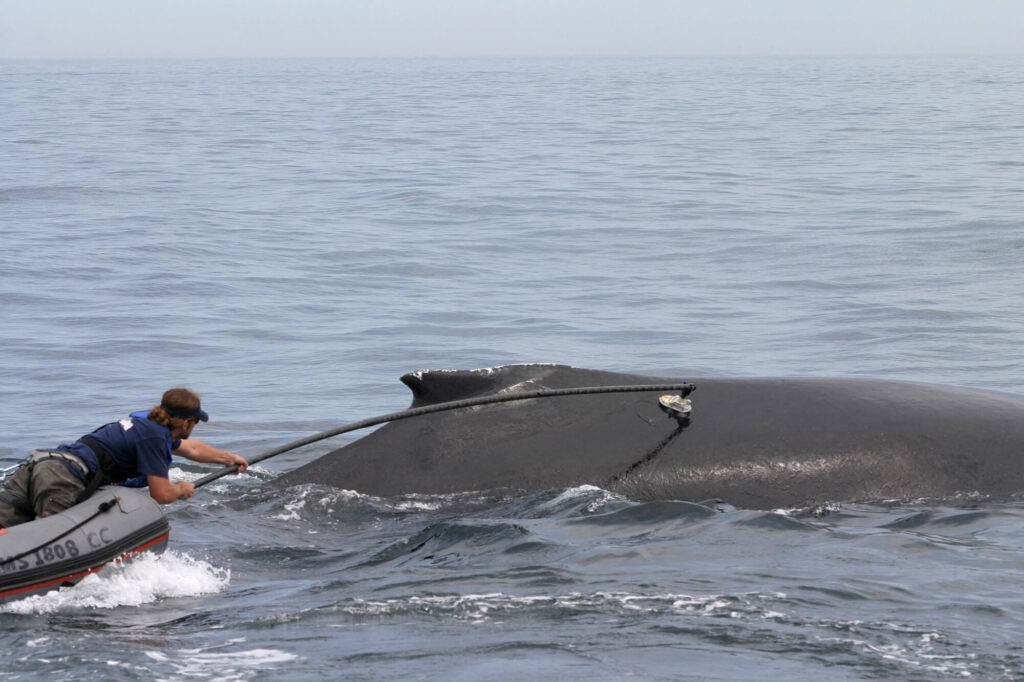
On-animal recording tags are recorders that travel on an animal’s body, rather than sitting in the water nearby. On whales, the tags are held on by suction cups. A tag is either placed from a boat with a long pole, or pressed on by a drone. Putting the microphone on the animal matters. An underwater microphone in open water tells you that a call happened. A tag helps tell you which animal made the call and what that animal was doing at the time. Tags like these are not only for animals at sea. Miniature microphones have been fitted to collars and small backpacks on small land mammals. One study used collar microphones to record whole days of calling by wild chipmunks.

One such tag is the DTAG, short for digital acoustic recording tag. Mark Johnson and Peter Tyack developed it in 1999 at the Woods Hole Oceanographic Institution in the United States. The DTAG has a built-in hydrophone, which is an underwater microphone. It also carries sensors that track which way the animal’s body is pointing. The whole DTAG is about a liter (roughly a quart) in volume, and it weighs 500 grams (1.1 pounds) dry. The DTAG’s sensors track the animal’s orientation in three dimensions. They do it quickly and finely enough to capture individual tail strokes. The sound and the sensors record in step with each other. So the timing between a call and a movement can be worked out precisely. Each time a DTAG is put on an animal, it records for up to 12 hours.

The DTAG’s attachment was deliberately made non-invasive, to disturb the tagged animal as little as possible. At least two suction cups are needed to hold the tag rigidly enough for its sensors to track the animal’s orientation accurately. The tag was placed on the whale from a 12-meter (about 39-foot) carbon-fiber pole. The pole rested in an oarlock on the front (bow) of a boat and stuck out over the water. This setup let the operator reach the whale’s back without leaning out over its tail. Suction cups tend to leak and let go within hours. So the attachment carries a small pump that keeps the suction in the cups. The pump is driven by the pressure changes of the whale’s own dives. The attachment also carries a deliberate release. A nickel-chromium wire seals a valve in each air line. When a clock circuit signals, the wire corrodes away in seawater.

A newer open-source tag for sperm whales was described in 2025. It sticks on with four soft silicone suction cups, which do not pierce the skin. It carries three underwater microphones that record in step with one another. Three microphones matter rather than two. With only two microphones, the timing method used to find the direction of a sound cannot tell apart two possible angles. The two angles sit mirrored on either side of the line joining the two microphones. A third microphone removes that left-or-right confusion. The three-microphone design is intended to help pull apart the calls of whales calling over each other. In the tests reported in 2025, the direction-finding was tried on a loudspeaker rather than on whales. The 2025 tag can be put on from a boat with a long pole, or flown out by drone. The drone is a small racing drone, waterproofed and made to float. It comes down and presses the tag onto the whale’s back in a single tap.

Sources

  1. Johnson, M.P. & Tyack, P.L., “A digital acoustic recording tag for measuring the response of wild marine mammals to sound”, IEEE Journal of Oceanic Engineering 28(1):3-12, 2003 — Abstract; §I Introduction; §II Tag design — free copy
  2. Vogt, D.M., DelPreto, J., Salino-Hugg, M., Cummings, M.R., Bell, M.A., Kenny, A., Malkin, P., Hernandez, A.M., Wright, A.L., Duncan, M.A., Davidsen, M.R., Grewal, K., Ahuja, S., Ostrom, K., Garcia, M., Shahviri, P., Weeraratna, C., Zink, H., Pagani, S., Meyer, G., Diamant, R., Rus, D., Gruber, D.F., Gero, S. & Wood, R.J., “An open-source bio-logger for studying cetacean behavior and communication”, PLoS One 20(12):e0337093, 11 December 2025 — Abstract; §4.3 Suction cups; §6.2 Deployment; §7.3 Audio directionality; §10 Conclusion
  3. Zsebők, S., “Listening forward: emerging roles of bioacoustics in ecology, evolution, and conservation”, Biologia Futura 77(3):425-441, 2026 — “The digital and computational revolution”


A sound spectrograph is a machine that turns a sound into a picture you can measure. Scientists and engineers at Bell Telephone Laboratories developed it around the time of the Second World War. One of its first purposes was to help with wartime code breaking.

The picture the spectrograph draws is called a spectrogram. A note that slides from a higher frequency to a lower one appears as a band sloping down the page. A rough, noisy burst, with many frequencies sounding at once, appears as a smear. The whole sound is laid out where the eye can compare one part with another.

Seeing sound this way changed what researchers could do. Bird song had been described in words and written in musical notes for centuries. The spectrograph let researchers measure the fine structure of a signal instead of relying on the ear alone. Ornithologists, the scientists who study birds, took up the spectrograph fast. In 1954, W. H. Thorpe used spectrograms to lay out the stages by which a young chaffinch learns its song.

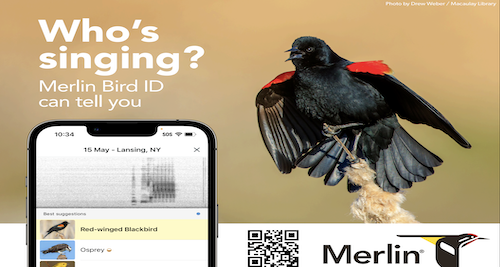
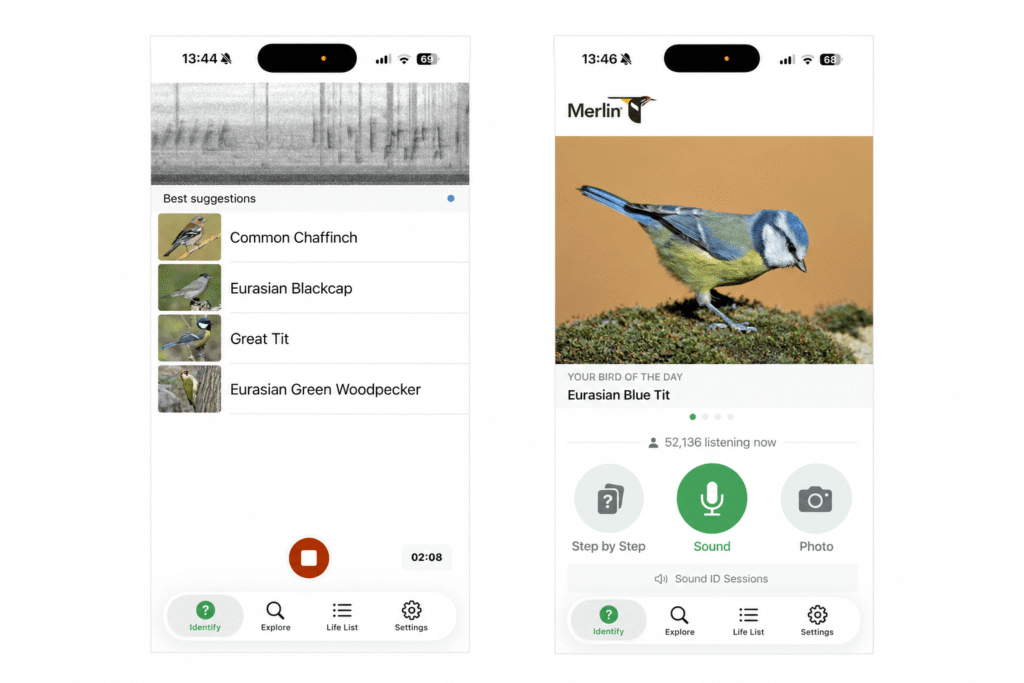
Author’s note: When you identify a bird by its sound in the Merlin Bird ID app, you are watching a spectrograph at work — the app shows the sound as a spectrogram while it listens.

Sources

  1. Baker, M.C., “Bird Song Research: The Past 100 Years”, Bird Behavior 14:3-50, 2001
  2. Zsebők, S., “Listening forward: emerging roles of bioacoustics in ecology, evolution, and conservation”, Biologia Futura 77(3):425-441, 2026
  3. Bradbury, J.W. & Vehrencamp, S.L., Principles of Animal Communication, 2nd ed., Sinauer Associates, 2011 — Ch. 2 “Sound and Sound Signal Production”

A playback experiment tests what a call means to the animals that hear it. Researchers have used playback for a long time to explore what animal signals do and mean. The playback study that became the textbook example of meaning in an animal call was published in 1980.

The signal played back is usually a sound recorded from an animal, such as a call. Researchers play the recording through a loudspeaker to other members of the same species, in the place where those animals live. Then they watch how the animals respond.

The key is timing. The call is played at a moment when whatever normally causes the call is absent. An alarm call, for instance, is normally given when a predator appears. Suppose researchers play the alarm call with no predator around. If the listeners still react as though a predator were there, the reaction comes from the sound alone. The reaction shows what the call tells the listeners.

The most common kind of playback experiment is called passive playback. It uses fixed recordings and broadcasts them at random times set in advance. Researchers then measure how the animals move, where they look, and whether they call back. Passive playback is also called non-interactive, because the recording never changes in response to what the animals do. In interactive playback, by contrast, the broadcast is adjusted to the animal’s replies. In a 2023 study in Southeast Alaska, researchers played a single recorded humpback whale contact call, known as a “whup.” A contact call is the kind animals use to keep in touch with their group. They timed the broadcasts to answer the calls of an adult female humpback known as Twain. For 20 minutes, Twain called back, taking turns with the broadcasts. The researchers describe their results as preliminary.

The textbook example is the 1980 vervet monkey experiment, which used exactly that timing. The alarm calls were recorded while a leopard, an eagle or a snake was present. They were then played back with no predator anywhere near, so any reaction had to come from the sound of the call.

Sources

  1. Rubenstein, D.R. & Alcock, J., Animal Behavior, 11th ed., Sinauer/Oxford University Press, 2019 — Ch. 8 “Principles of Communication”
  2. McCowan, B., Hubbard, J., Walker, L., Sharpe, F., Frediani, J. & Doyle, L., “Interactive bioacoustic playback as a tool for detecting and exploring nonhuman intelligence: ‘conversing’ with an Alaskan humpback whale”, PeerJ 11:e16349, 2023
  3. Rendall, D., “Aping Language: Historical Perspectives on the Quest for Semantics, Syntax, and Other Rarefied Properties of Human Language in the Communication of Primates and Other Animals”, Frontiers in Psychology 12:675172, 2021
  4. Bradbury, J.W. & Vehrencamp, S.L., Principles of Animal Communication, 2nd ed., Sinauer Associates, 2011 — Ch. 13 “Social Integration”; Ch. 15 “Communication Networks”

Computers analyze animal sound at this scale with machine learning, a form of AI. In the usual approach, the software learns what a call looks like from example recordings that people have labeled. Then it scans hours of audio for the same pattern.

Computers became necessary because of the sheer amount of sound now being recorded. Recorders can run on their own for very long stretches. Self-running recorders, called autonomous recording units, now sit in habitats from forests to coral reefs. They record continuously with nobody present. In the ocean, recorders anchored to the seafloor are left in place for months or even years before being collected. People also upload their own recordings to citizen-science platforms, websites where members of the public share data for research. Vast amounts of this recorded sound come unlabeled. Machine-learning software can now work through thousands of hours of these recordings with little human help. It can pick out which species are calling, how many calls there are, and even clues about behavior. Software that finds the start and end of each sound automatically now exists. Even so, as of 2025, cutting a field recording into its separate sounds is commonly still done by hand. A person draws boxes around each sound on a spectrogram.

One such tool is a type of machine learning called a convolutional neural network. It treats a spectrogram, which is a picture of a sound, the way image software treats a photo. It learns patterns straight from the labeled examples, instead of from rules someone wrote in advance. Convolutional neural networks now identify species by their calls with close to human accuracy. Across many studies, their accuracy is between 89 and 97 percent. The exact figure depends on how the spectrogram is drawn.

A trained network can also be reused instead of built from scratch. A system already trained on a large collection of bird sound can be adjusted with a small amount of new material. It can then be put to work on a new habitat, on new species, or even on a different group of animals. In practice, as few as 20 to 30 labeled examples per category may be enough for a respectable result. BirdNET, free software that identifies birds by their calls, is built on a convolutional neural network.

So far, these computer methods have mainly found and labeled calls. In other words, they have worked out who is calling. Working out what the animals are saying is where the field is heading.

Sources

  1. Zsebők, S., “Listening forward: emerging roles of bioacoustics in ecology, evolution, and conservation”, Biologia Futura 77(3):425-441, 2026
  2. NOAA Fisheries (Greater Atlantic Region), “Passive Acoustic Technologies”
  3. Wood, C.M., Kahl, S., Rahaman, A. & Klinck, H., “The machine learning-powered BirdNET App reduces barriers to global bird research by enabling citizen science participation”, PLOS Biology 20(6):e3001670, 2022
  4. Goodfellow, I., Bengio, Y. & Courville, A., Deep Learning, MIT Press, 2016 — Ch. 1 “Introduction”
  5. Robinson, D., Miron, M., Hagiwara, M., Weck, B., Keen, S., Alizadeh, M., Narula, G., Geist, M. & Pietquin, O., “NatureLM-audio: an Audio-Language Foundation Model for Bioacoustics”, The Thirteenth International Conference on Learning Representations (ICLR 2025), Poster — §1 Introduction
  6. Kershenbaum, A., Akçay, Ç., Babu-Saheer, L., Barnhill, A., Best, P., Cauzinille, J., Clink, D., Dassow, A., Dufourq, E., Growcott, J., Markham, A., Marti-Domken, B., Marxer, R., Muir, J., Reynolds, S., Root-Gutteridge, H., Sadhukhan, S., Schindler, L., Smith, B.R., Stowell, D., Wascher, C.A.F. & Dunn, J.C., “Automatic detection for bioacoustic research: a practical guide from and for biologists and computer scientists”, Biological Reviews 100(2):620-646, 2025 — §II “What is automatic detection”; §V “A Practical Guide to Automatic Detection”
Researcher in a small boat uses a long pole to attach a suction-cup tag to a surfaced humpback whale.
Researchers attach a temporary suction-cup tag to a humpback whale to collect movement and acoustic data. Photo: NOAA Fisheries, Permit #775-1600-10. Public domain.
Two Merlin Bird ID app screens: a live spectrogram with suggested species including Common Chaffinch and Great Tit, and the app home screen with a Eurasian Blue Tit as bird of the day
A live spectrogram in the Merlin Bird ID app (Cornell Lab of Ornithology) during sound identification. Screenshot captured by the author.

How much of animal communication have scientists actually decoded — including what AI has newly revealed?

Less than you might expect. For this comparison, animal communication can be examined at four related levels: recurring patterns, broader structure, meaning, and syntax. These are not four separate and equal parts of language: pattern is a general descriptive term, while syntax is one particular kind of linguistic structure. Progress across them is very uneven. Scientists have identified many patterns and mapped substantial structure in a few species. Far fewer signals have been experimentally connected to specific meanings, and evidence for human-like syntax remains sparse and contested. As of 2026, computer models had therefore decoded mainly patterns and structure, not meaning or syntax.Nested question

Patterns are where much of the recent progress lies. Software has revealed previously undescribed features in sperm-whale codas,Nested question evidence that mouse ultrasonic callsNested question may form a continuum rather than separate types, receiver-specific information in marmoset and elephant calls,Nested question and previously unclassified orca calls.

Structure has been mapped in considerable detail for a few species. Sperm-whale codas,Nested question for example, vary along four features that combine to produce a much larger repertoire than previously recognized. However, the researchers explicitly studied how the codas are constructed, not what they mean.

Meaning has been decoded in far fewer cases. The honeybee waggle danceNested question conveys information about the direction and distance of a resource. Vervet monkey alarm calls produce different responses associated with different dangers, although their original interpretation as word-like signals was later scaled back. Under one proposed set of criteria, the dolphin signature whistle currently provides the strongest case for a name-like call. Claims about meaning generally require behavioral evidence, such as controlled playback experiments, rather than recordings alone.

Syntax remains the least securely established of the four. A critical 2021 review concluded that evidence for word-like semantics and syntax in animals’ natural communication was sparse and weak.

So scientists have made substantial progress in finding patterns and describing structure. A limited number of signals have been connected experimentally to particular information or responses, but AI has not yet translated a natural animal communication system, and evidence for word-like meaning and human-like syntax remains limited.

Sources

  1. Rendall, D., “Aping Language: Historical Perspectives on the Quest for Semantics, Syntax, and Other Rarefied Properties of Human Language in the Communication of Primates and Other Animals”, Frontiers in Psychology 12:675172, 2021
  2. Sharma, P., Gero, S., Payne, R., Gruber, D.F., Rus, D., Torralba, A. & Andreas, J., “Contextual and combinatorial structure in sperm whale vocalisations”, Nature Communications 15:3617, 2024
  3. Jaakkola, K., King, S.L. & Bruck, J.N., “Do animals use names? Conceptual and empirical criteria”, Trends in Cognitive Sciences, Opinion, online 22 July 2026 — “Conceptual criteria for names”; “Common marmosets”; “Concluding remarks”; Table 1 and footnote d
  4. Goffinet, J., Brudner, S., Mooney, R. & Pearson, J., “Low-dimensional learned feature spaces quantify individual and group differences in vocal repertoires”, eLife 10:e67855, 2021 — Abstract; Results
  5. Rutz, C., Bronstein, M., Raskin, A., Vernes, S.C., Zacarian, K. & Blasi, D.E., “Using machine learning to decode animal communication”, Science 381(6654):152-155, 2023 — free copy
  6. Rubenstein, D.R. & Alcock, J., Animal Behavior, 11th ed., Sinauer/Oxford University Press, 2019 — Ch. 8 “Principles of Communication”
  7. Zsebők, S., “Listening forward: emerging roles of bioacoustics in ecology, evolution, and conservation”, Biologia Futura 77(3):425-441, 2026 — “Challenges and future directions”
  8. Alcantara, M. & Andrews, K., “Can we talk to the animals? The ethics of using machine learning to decode animal communication”, Topoi, 2026 — §2.1

In short: a pattern is anything that recurs in recordings, structure is how a signal system is built, meaning is what a signal does to the animal that hears it, and syntax is combining words into larger meaningful wholes. Mixing these four words up makes the research sound either more or less impressive than it is.

A pattern is the loosest of the four: something that recurs in the recordings, a sound or sequence that turns up again and again. Software can find a pattern without knowing what it is for. Finding patterns is what these programs are good at, and what they have produced is mostly patterns rather than meanings.

Structure is more specific. Working out the structure of a signal system means three things: what the separate units are, how those units combine into longer sequences, and which animal answers which other animal. Sperm whales, for example, exchange click patterns, both taking turns and overlapping one another. That observation is structure.

Meaning is the hard one. The meaning of a signal is what it does to the animal that hears it. A recording on its own does not show that effect. Meaning has to be worked out by observation and experiment. Researchers broadcast a signal and check whether the animal responds differently, and fittingly, to signals from different situations. For example, a listener flees from an alarm call, or approaches or calls back to a contact call, the kind animals use to keep in touch with their group.

Here is the distinction the whole subject turns on. Picture a page of writing in a script you cannot read. You can count the marks, note which marks follow which, and see which writer answers which other writer. All of that is structure. You can have every bit of that structure and still know nothing about what the writing says. What the writing says is meaning.

Syntax is narrower again: combining separate words into larger meaningful wholes. As of 2010, whether animals combine words this way remained highly contested.

Sources

  1. Sharma, P., Gero, S., Payne, R., Gruber, D.F., Rus, D., Torralba, A. & Andreas, J., “Contextual and combinatorial structure in sperm whale vocalisations”, Nature Communications 15:3617, 2024 — Results; “Limitations”
  2. Yovel, Y. & Rechavi, O., “AI and the Doctor Dolittle challenge”, Current Biology 33(15):R783-R787, 7 August 2023 — “What would it take for AI to talk with animals?”
  3. Fitch, W. Tecumseh, The Evolution of Language, Cambridge University Press, 2010 — Ch. 4 “Animal cognition and communication”
  4. Rutz, C., Bronstein, M., Raskin, A., Vernes, S.C., Zacarian, K. & Blasi, D.E., “Using machine learning to decode animal communication”, Science 381(6654):152-155, 14 July 2023 — free copy
  5. Alcantara, M. & Andrews, K., “Can we talk to the animals? The ethics of using machine learning to decode animal communication”, Topoi, 2026
  6. Goffinet, J., Brudner, S., Mooney, R. & Pearson, J., “Low-dimensional learned feature spaces quantify individual and group differences in vocal repertoires”, eLife 10:e67855, 2021 — Abstract
  7. Bradbury, J.W. & Vehrencamp, S.L., Principles of Animal Communication, 2nd ed., Sinauer Associates, 2011 — Ch. 13 “Social Integration”

The waggle dance is how a honeybee tells her hive-mates where food is: how far away it lies and in which direction. It was decoded by watching bees dance through the glass wall of a hive, and then checking which feeder newly arriving bees flew to.

A forager that has found a good patch of flowers dances on the vertical surface of the honeycomb, in the complete darkness of the hive. Other workers gather around and follow her. If the food is fairly close — say within 50 meters (55 yards) of the hive — she performs a round dance. If it lies farther off, she performs a waggle dance instead. The part that carries the information is the waggle run: a straight walk across the comb with her abdomen shaking from side to side. How long the waggle run lasts tells the other bees how far to fly. Roughly every extra 75 milliseconds of waggling stands for another 100 meters (about 330 feet) from the hive. Distances up to about 10,000 meters (6.2 miles) are encoded this way. Direction comes from the angle of the run. Outside the hive, a bee steers by the sun. Inside the dark hive, the dancer uses gravity instead. The angle between her waggle run and straight up the comb matches the angle between the food and a line from the hive to the sun. A run pointing straight up means fly toward the sun. A run 20 degrees to the right of vertical means fly 20 degrees to the right of the sun.

It took Karl von Frisch years of experiments to decode the dance. He marked individual bees with dots of paint and trained them to visit feeding stations stocked with strong sugar solution. Then he watched their dances through the glass walls of an observation hive. The dances changed in predictable ways with the distance and direction of the feeder. The key test came next. He trained scout bees to one feeding station. Seven feeders were spread around it, all stocked with equally attractive sugar water, and he collected the new bees that turned up at them. Most of the new bees arrived at the feeder in line with the station the scouts had been visiting. A matching test did the same for distance. Scouts were trained to a feeder 750 meters (about 820 yards) from the hive. Far more new bees were caught at the two feeders nearest that distance than at any other feeder. Von Frisch shared the 1973 Nobel Prize with Konrad Lorenz and Niko Tinbergen.

The waggle dance is a well-worked-out case of meaning in an animal signal. Its parts map onto the direction and distance of food. The dance is not the whole message, though. There is some evidence that the bees following a dancer also learn the odor of the food from her body, touching her where that odor is most intense: at her mouthparts and hind legs.

Sources

  1. Rubenstein, D.R. & Alcock, J., Animal Behavior, 11th ed., Sinauer/Oxford University Press, 2019 — Ch. 8 “Principles of Communication”
  2. Dugatkin, L.A., Principles of Animal Behavior, 4th ed., University of Chicago Press, 2020 — Ch. 13 “Communication”, §”Honeybees and the Waggle Dance”; Ch. 9 “Kinship”, Interview with Dr. Francis Ratnieks
  3. Fitch, W.T., The Evolution of Language, Cambridge University Press, 2010 — Ch. 2

Possibly. Of all the animal calls proposed as names, the dolphin signature whistle makes the strongest case, but the question is not closed. A 2026 review applied one recently proposed set of tests for what counts as a name. Under those tests, it concluded that bottlenose dolphins (Tursiops species) currently provide the strongest case to date.

What the evidence shows:

  • Each bottlenose dolphin develops its own signature whistle, set apart by the whistle’s pattern of rising and falling pitch.
  • People can match whistles to the right dolphin by eye on a spectrogram (a picture of a sound), with an average accuracy of 94.5% when choosing among 20 possible dolphins.
  • Dolphins produce not only their own signature whistles but other dolphins’ whistles too.
  • A dolphin that hears a copy of its own whistle played back calls straight back, and does not respond that way to other whistles. Computer-made whistles give the same pattern of results, even with the cues of the calling dolphin’s voice stripped out. So the pitch pattern itself appears to be what matters.

What is less certain: the evidence is clearer on two points, that a whistle picks out one individual and that caller and listener share its meaning. On whether the whole dolphin community shares that meaning, the evidence is only suggestive.

Sources

  1. Jaakkola, K., King, S.L. & Bruck, J.N., “Do animals use names? Conceptual and empirical criteria”, Trends in Cognitive Sciences, Opinion, online 22 July 2026 (open access, CC BY-NC-ND) — “Conceptual criteria for names”; “Bottlenose dolphins”; “Concluding remarks”; Table 1 and footnote d

A lot about how sperm whale calls are built, and very little yet about what they mean. Sperm whales communicate in codas. A coda is a short burst of clicks, generally under two seconds long, that whales in a group trade with one another.

What could be decoded is how the calls are built. A 2024 study worked through 8,719 codas recorded off the Caribbean island of Dominica. The study found that a coda varies along four features, and that the four features combine freely:

  • Rhythm — the pattern of spacing between the clicks.
  • Tempo — how long the whole coda lasts.
  • Rubato — a gradual stretching or shrinking of coda length across a run of codas from one whale.
  • Ornamentation — an extra click added at the end of a coda.

Rhythm and tempo were already known. Rubato and ornamentation were newly identified. Whales trading codas were shown to sense and act on all four features. Because the four features combine, the number of distinct codas comes out at nearly ten times what was previously believed. Before the 2024 study, researchers already knew that some codas reveal which whale is calling. Almost everything else about the coda system was unknown.

What could not be decoded is what the codas mean. The 2024 study looked at how codas are built, not at what they mean. It offered no account of what any coda means. It also ran no playback experiments, in which recorded calls are played to animals to see how they respond. The researchers say that working out meaning will need interactive playback experiments with whales in the wild, in which the broadcast is adjusted to what the animal does.

Sources

  1. Sharma, P., Gero, S., Payne, R., Gruber, D.F., Rus, D., Torralba, A. & Andreas, J., “Contextual and combinatorial structure in sperm whale vocalisations”, Nature Communications 15:3617, 2024 (open access, CC BY) — Abstract; “Results and discussion”; Table 1 Glossary; “Limitations”
  2. McCowan, B., Hubbard, J., Walker, L., Sharpe, F., Frediani, J. & Doyle, L., “Interactive bioacoustic playback as a tool for detecting and exploring nonhuman intelligence: ‘conversing’ with an Alaskan humpback whale”, PeerJ 11:e16349, 2023 (open access, CC BY) — Discussion

That mouse squeaks may not come in separate types at all. Mice make ultrasonic calls: squeaks too high-pitched for human ears to hear.

In a 2021 study, researchers gave spectrograms of the calls (pictures of each sound) to a machine-learning program. The program worked out its own description of each call, instead of using a short list of measurements chosen by people. The program’s description captured more of the information in each call than the hand-picked measurements did.

When the calls were arranged by the program’s description, they did not appear to fall into separate types. Instead, the mouse calls spread across a continuous range. In this respect they sat closer to random noise than to zebra finch song, which does form clear groups. This result challenges a common assumption that mouse calls come in distinct types. That assumption is built into software used to sort mouse calls.

The authors also noted limits to their conclusion. Whether a set of sounds truly falls into groups cannot be answered definitively. And mice might still hear the range of calls as separate categories. One of the scientists who reviewed the study before publication disagreed that the calls form a continuous range.

Sources

  1. Goffinet, J., Brudner, S., Mooney, R. & Pearson, J., “Low-dimensional learned feature spaces quantify individual and group differences in vocal repertoires”, eLife 10:e67855, 2021 (open access, CC BY) — Abstract; Introduction; Results; Discussion; eLife decision letter
  2. Bradbury, J.W. & Vehrencamp, S.L., Principles of Animal Communication, 2nd ed., Sinauer Associates, 2011 — Ch. 2 “Sound and Sound Signal Production”, Figure 2.9 “The acoustic spectrum”

Maybe. Marmosets and elephants both appear to use calls aimed at particular individuals. But as of 2026 the evidence is mixed, and in neither species has anyone yet found the part of the call that would work as the name.

In the marmoset case, a machine-learning program matched contact calls, known as phee calls, to the marmoset each call was aimed at. It did better than chance, though only modestly. Marmosets were also more likely to respond to calls previously aimed at them than to calls aimed at other marmosets.

The elephant case runs the same way. A machine-learning program matched African elephant rumbles to the elephant each rumble was aimed at. It did better than chance, though with relatively low accuracy. Elephants responded more strongly to rumbles previously aimed at them than to rumbles aimed at other elephants.

Three things keep the marmoset and elephant cases from counting as names. First, software did the sorting, and nobody has yet identified which features of the call carry the “name.” Second, no evidence has been put forward that the call stands for the individual in the animal’s mind. Third, another explanation fits, at least for marmosets. A caller that partly copies a call it has heard would produce the same results.

So these are name-like calls, not established names.

Sources

  1. Jaakkola, K., King, S.L. & Bruck, J.N., “Do animals use names? Conceptual and empirical criteria”, Trends in Cognitive Sciences, Opinion, online 22 July 2026 (open access, CC BY-NC-ND) — Highlights; “Common marmosets”; “African elephants”; “Partial vocal matching”; Table 1 and footnotes b and c; “Concluding remarks”

What are the limits of using AI to decode animal communication — and could some signals remain untranslatable?

AI is very good at one part of decoding animal communication: finding patterns in huge amounts of recordings. It can pick out which species or which individual is calling, count calls, catch clues about behavior, and even generate new calls in the same style. The patterns it finds give researchers ideas about what signals might do, and those ideas can then be tested in experiments. What AI cannot do on its own is tell what the patterns mean. Five limits stand in the way.

  1. Naming the situation. To connect a call with a meaning, people label the situation each call was made in. They can only label situations that humans have names for. This means the AI can only link calls to the kinds of meaning people already thought to look for.
  2. Checking the results. The software latches onto anything that happens to line up in the data. Many times it has picked up background noise instead of the signal. So every group of calls the software finds is only a hypothesis until that group is tested on the animals, for example with a playback experiment. In many cases the animals give no clear response that can be measured. A finding may then never be confirmed or ruled out.
  3. Missing channels. Animals signal through sound, sight, touch, smell and electric fields, often several at once. Some of that signaling lies beyond human senses. Software fed only on sound misses the rest. If a played-back call draws no reply, the missing piece might be a scent that was never recorded. Even the honeybee waggle dance probably carries touch and sound cues about the food that the eye misses. So AI may be working on only part of a message.
  4. Uneven data. Most of this software remains heavily dependent on recordings people have already labeled. These labeled recordings are spread unevenly across animal groups and regions. Software trained in one place can also struggle in a different habitat, on a different recorder, or against a different background of noise. This means the software works best for well-recorded species and places, and less well for the rest.
  5. What animals do not talk about. In 2023, the researchers Yossi Yovel and Oded Rechavi argued that we probably cannot ask about anything a species does not signal about. For example, if cats do not discuss their feelings with each other, we could never ask a cat how it feels. They add that animal signals probably also cover things wholly alien to us. If they are right, some meanings lie outside anything humans can label.

These limits are not all of one kind. Uneven data is the practical one: more recordings, from more places, would ease it. Missing channels look practical too, since more kinds of data could be recorded. But it is not yet clear which kinds would be needed. Yovel and Rechavi count that gap among the obstacles they consider built in, because what we fail to record follows from the limits of our own senses. As Yovel and Rechavi see it, the rest are built in: naming the situation a call was made in, checking what the software finds, and the fact that animals may not signal about the things we would want to ask them. And a single signal can run into several of these limits at once — made in a situation people have no name for, drawing no response anyone can measure, carried partly through a channel nobody records, and coming from a species with few recordings.

So could some signals remain untranslatable? Possibly. Yovel and Rechavi hold that the built-in obstacles would not vanish even if the power of AI grew a millionfold. They make that argument about talking with animals. The argument applies to decoding only if the same obstacles carry across. Still, much is unknown, and some species may yet prove to communicate in richer ways than anything shown so far.

Sources

  1. Yovel, Y. & Rechavi, O., “AI and the Doctor Dolittle challenge”, Current Biology 33(15):R783-R787, 7 August 2023 — “What would it take for AI to talk with animals?”, the three obstacles, “Some examples”, and the conclusion
  2. Zsebők, S., “Listening forward: emerging roles of bioacoustics in ecology, evolution, and conservation”, Biologia Futura 77(3):425-441, 2026 — “Field methods and recording technologies”; “Applications from individuals to planetary scale”; “Challenges and future directions”
  3. Rutz, C., Bronstein, M., Raskin, A., Vernes, S.C., Zacarian, K. & Blasi, D.E., “Using machine learning to decode animal communication”, Science 381(6654):152-155, 14 July 2023 — free copy

How are AI, machine learning and deep learning related — and how do they work with this information to understand what animals say?

AI, machine learning and deep learning nest inside one another. AI is the broadest idea: getting computers to behave intelligently. Some AI involves no learning at all. People type facts in by hand, and the computer reasons from those facts with logical rules. Machine learning is the kind of AI that gets its own knowledge by finding patterns in raw data, instead of being handed the facts. Deep learning is a kind of machine learning that builds complicated ideas out of simpler ones, layer on layer. For example, a system can recognize a person in a photo by combining edges into corners and outlines, and then combining those corners and outlines into the figure of a person.

Given enough recordings of animal sounds, these methods are put to work in a few ways:

  • Learning from labeled examples. People label recordings: this is a robin, this is an alarm call. A machine-learning program then learns which features of the sound predict each label. This is how species-identification tools work.
  • Finding patterns without labels. Other programs sort unlabeled recordings on their own. The aim is to discover which call types an individual animal, a group or a population uses. The mouse-call study by Jack Goffinet and colleagues worked this way.
  • Learning from huge mixed collections. Self-supervised deep learning needs neither labeled recordings nor anyone deciding in advance which features of a sound matter. It is the basis of foundation models: large models trained once and then used for many tasks. NatureLM-audio, from the Earth Species Project, is one.
  • Linking sound to context. Some methods combine different kinds of data: the sounds, the animals’ movements, who is calling, and what is happening around the callers.

Which of these methods is most useful? Machine learning is now central to computer analysis of animal sound, especially for identifying species. For understanding what animals tell each other, researchers writing in 2023 pointed to self-supervised deep learning as of interest. They also judged that methods linking sounds to behavior and context seem especially promising. Whichever method is used, what the software produces is patterns. Those patterns still have to be tested on the animals themselves.

Sources

  1. Goodfellow, I., Bengio, Y. & Courville, A., Deep Learning, MIT Press, 2016 — Ch. 1 “Introduction”, including Figures 1.2 and 1.4
  2. Rutz, C., Bronstein, M., Raskin, A., Vernes, S.C., Zacarian, K. & Blasi, D.E., “Using machine learning to decode animal communication”, Science 381(6654):152–155, 14 July 2023 — free copy
  3. Zsebők, S., “Listening forward: emerging roles of bioacoustics in ecology, evolution, and conservation”, Biologia Futura 77(3):425–441, 2026 — “Machine learning and AI: Current innovations”
  4. Goffinet, J., Brudner, S., Mooney, R. & Pearson, J., “Low-dimensional learned feature spaces quantify individual and group differences in vocal repertoires”, eLife 10:e67855, 2021 — Abstract; Introduction
  5. Robinson, D., Miron, M., Hagiwara, M., Weck, B., Keen, S., Alizadeh, M., Narula, G., Geist, M. & Pietquin, O., “NatureLM-audio: an Audio–Language Foundation Model for Bioacoustics”, The Thirteenth International Conference on Learning Representations (ICLR 2025), Poster — Abstract; author affiliations

Who is leading the research on AI and animal communication — and what have they actually achieved?

Research on AI and animal communication is spread across several organizations, including these:

  • Project CETI (the Cetacean Translation Initiative) works on what sperm whales say to one another. So far it has mapped how the whales’ click calls are built. It has also built an open-source recording tag that rides on a whale’s back. It has not yet worked out what the calls mean. Finding that meaning is what the project is working towardNested question
  • The Earth Species Project builds AI meant to work across many kinds of animal at once, rather than building a separate program for each group of animals. Its program NatureLM-audio listens to an animal recording and answers plain-language questions about that recording. A person can ask, for example, which species is calling, or whether more than one animal can be heardNested question
  • The Cornell Lab of Ornithology, with Chemnitz University of Technology in Germany, builds BirdNET, which names the bird species behind a recorded call and is free to use.Nested question
  • The Coller Dolittle Prize, run by Tel Aviv University in Israel with the Jeremy Coller Foundation, offers an award of US$100,000 for work on understanding and communicating with animals, and awarded it in 2025 and again in 2026.Nested question

Sources

  1. Rutz, C., Bronstein, M., Raskin, A., Vernes, S.C., Zacarian, K. & Blasi, D.E., “Using machine learning to decode animal communication”, Science 381(6654):152–155, 2023 — pp. 152–153, author affiliations and “large collaborative initiatives” — free copy
  2. Vogt, D.M., DelPreto, J., Salino-Hugg, M., Cummings, M.R., Bell, M.A., Kenny, A., et al., “An open-source bio-logger for studying cetacean behavior and communication”, PLOS One 20(12):e0337093, 2025 — Abstract; §2.1 Bio-loggers; §6.2 Deployment
  3. Sharma, P., Gero, S., Payne, R., Gruber, D.F., Rus, D., Torralba, A. & Andreas, J., “Contextual and combinatorial structure in sperm whale vocalisations”, Nature Communications 15:3617, 2024 — Abstract; §Limitations
  4. Robinson, D., Miron, M., Hagiwara, M., Weck, B., Keen, S., Alizadeh, M., Narula, G., Geist, M. & Pietquin, O., “NatureLM-audio: an Audio–Language Foundation Model for Bioacoustics”, The Thirteenth International Conference on Learning Representations (ICLR 2025), Poster — Abstract; Fig. 1; §1 Introduction; §4 BEANS-Zero
  5. BirdNET, K. Lisa Yang Center for Conservation Bioacoustics, Cornell Lab of Ornithology, and Chair of Media Informatics, Chemnitz University of Technology — “About BirdNET”
  6. Wood, C.M., Kahl, S., Rahaman, A. & Klinck, H., “The machine learning–powered BirdNET App reduces barriers to global bird research by enabling citizen science participation”, PLOS Biology 20(6):e3001670, 2022 — Abstract
  7. Coller Dolittle Prize for Two-way Inter-species Communication, Jeremy Coller Foundation in partnership with Tel Aviv University, Israel — Home page
  8. Coller Dolittle Prize — 2025 winner and finalists
  9. Coller Dolittle Prize — 2026 winner and finalists

Project CETI is a nonprofit working to understand what sperm whales say to one another. It is based in New York, in the United States, and on the Caribbean island of Dominica, where its field work happens. Sperm whales communicate in codas: short bursts of clicks that they trade back and forth. Those codas are what the project studies.

The project has two published results worth setting out. The first is a map of how codas are built. Researchers working with the project found that codas vary along four features, and that those features combine. Because the features combine, the number of distinct codas is far larger than previously believed. That map covers structure, not meaning. The second result is a recording tag worn by whales, called the CETI Bio-Logger. The tag’s designs, build details and code are published free, so any research group can build one or improve on it. The tag has already ridden on sperm whales off Dominica, staying attached through deep dives.

The project is now working on the meaning of the codas, which the map leaves open. The researchers who made the map say that finding meaning will need playback experiments with wild whales.

Sources

  1. Vogt, D.M., DelPreto, J., Salino-Hugg, M., Cummings, M.R., Bell, M.A., Kenny, A., et al., “An open-source bio-logger for studying cetacean behavior and communication”, PLOS One 20(12):e0337093, 2025 — Abstract; §1 Introduction; §8 Experimental results: Sperm whale deployments
  2. Sharma, P., Gero, S., Payne, R., Gruber, D.F., Rus, D., Torralba, A. & Andreas, J., “Contextual and combinatorial structure in sperm whale vocalisations”, Nature Communications 15:3617, 2024 — Abstract; §Limitations
  3. Project CETI, “About”
  4. Alcantara, M. & Andrews, K., “Can we talk to the animals? The ethics of using machine learning to decode animal communication”, Topoi, 2026 — §1 Introduction; §2 Why Think Animals Might have Something to Translate

The Earth Species Project is a research group in Berkeley, California, in the United States. It builds AI tools meant to study animal communication across many species at once. Its main tool is NatureLM-audio, released in 2024. NatureLM-audio is a foundation model: one large model trained on a broad mix of data and then used for many different jobs, instead of a separate small model for each job. It was trained on animal sounds, human speech and music together. The hope is that what it learns from speech and music carries over to animal sounds, where recordings that people have already labeled with what is in them are much scarcer.

Using NatureLM-audio means giving it a recording and typing a question in plain language, and the model types an answer back. The question can be which species is making this sound, whether this is a song or a plain call, or whether more than one animal can be heard.

Its results so far are mixed. On a set of standard tests it had not been trained for, NatureLM-audio outperformed the four other systems it was compared with on most of those tests. It was also given species it had never heard before, and asked to answer with each species’ full scientific classification. It named the right species about a third of the time: far better than chance, and still wrong two times out of three. The model, its code and its test set are all released openly, so anyone can run the model, check its results, or try to beat them.

Sources

  1. Robinson, D., Miron, M., Hagiwara, M., Weck, B., Keen, S., Alizadeh, M., Narula, G., Geist, M. & Pietquin, O., “NatureLM-audio: an Audio–Language Foundation Model for Bioacoustics”, The Thirteenth International Conference on Learning Representations (ICLR 2025), Poster — Abstract; Fig. 1; §1 Introduction; §4 BEANS-Zero; §7.2 and §7.3 Results; Tables 2, 3 and 5
  2. Rutz, C., Bronstein, M., Raskin, A., Vernes, S.C., Zacarian, K. & Blasi, D.E., “Using machine learning to decode animal communication”, Science 381(6654):152–155, 2023 — p. 152 affiliation 4; p. 153 — free copy

BirdNET is free software that identifies which bird species is calling from its sound. Two groups make it jointly: the K. Lisa Yang Center for Conservation Bioacoustics at the Cornell Lab of Ornithology in the United States, and the Chair of Media Informatics at Chemnitz University of Technology in Germany.

On the phone app, you record a few seconds of sound, and the app sends the clip to a BirdNET server along with the date, time and place. A species name comes back, with a score for how sure the software is. You can then tell the app whether it named the bird correctly. The recordings are kept for research, and anything that identifies the person who made them is removed.

BirdNET began with birds of North America and Europe and now covers more than 6,000 species worldwide. Because it asks for nothing but a phone and a few seconds of sound, it drew far more people than a project built for experienced birdwatchers. In 2020 the app had more than three times as many participants as eBird, the Cornell Lab’s older checklist project.

Sources

  1. Wood, C.M., Kahl, S., Rahaman, A. & Klinck, H., “The machine learning–powered BirdNET App reduces barriers to global bird research by enabling citizen science participation”, PLOS Biology 20(6):e3001670, 2022 — Abstract; “The BirdNET App”; “Removing barriers to citizen science”
  2. BirdNET, K. Lisa Yang Center for Conservation Bioacoustics, Cornell Lab of Ornithology, and Chair of Media Informatics, Chemnitz University of Technology — “About BirdNET”
  3. BirdNET, K. Lisa Yang Center for Conservation Bioacoustics, Cornell Lab of Ornithology — home page
  4. Technische Universität Chemnitz (Chemnitz University of Technology), “Legal notice” — provider identification

The Coller Dolittle Prize is an annual award of US$100,000 for work toward understanding and communicating with other species. Tel Aviv University in Israel runs it together with the Jeremy Coller Foundation. Its organizers drew on the Turing test, asking the same kind of question about other species: can software hold an exchange with one?

The 2025 challenge prize went to Laela Sayigh, for finding that wild dolphins share whistle types other than each dolphin’s own signature whistle. The 2026 challenge prize went to Julie Elie, for work on decoding the “language” of zebra finches, which are songbirds.

Above the annual award sits a much larger prize: either a US$10 million investment or a US$500,000 cash prize. That larger prize is reserved for a team that achieves two-way communication with another species. No winner of that larger prize has been announced. The organizers’ own account of the timing is not consistent: the prize pages name winners of the 2025 and 2026 challenges, while the prize’s home page says the first annual prize will be awarded in 2027. Entries for the 2027 challenge close on September 30, 2026.

Sources

  1. Coller Dolittle Prize for Two-way Inter-species Communication, Jeremy Coller Foundation in partnership with Tel Aviv University, Israel — Home page
  2. Coller Dolittle Prize — 2025 winner and finalists
  3. Coller Dolittle Prize — 2026 winner and finalists

  4. Rubenstein, D.R. & Alcock, J., Animal Behavior, 11th ed., Sinauer/Oxford University Press, 2019 — Ch. 2 “The Integrative Study of Behavior”

What is the future of AI and animal communication — how might it help us understand animals?

There is no settled forecast. What can be said is what researchers are aiming at, and what they say stands in the way.

The aim has shifted. For years, AI software was aimed at a sorting job: working out which species, or which individual, is making a sound. That software is now described as moving on from asking “who is calling” toward uncovering what the callers are saying and why that matters. Two predicted advances follow from this shift. Decades of stored recordings could be used to track how a population’s calls and songs change over time, drifting slowly, converging on a shared form, or in some cases being replaced wholesale. And the sounds an animal makes could be compared with its genes, to find genes linked to song learning.

Leading bird-call software, such as BirdNET, performs well. But it needs a dedicated classifier trained for each target group of animals. A classifier is a program that sorts calls into categories. The Earth Species Project’s NatureLM-audio is a model built to work across many species at once. With animals it had never heard, it has shown what has been described as promising generalization. That is a step in recognizing those animals, not in reading what they say.

What would prove that an animal signal has really been decoded? Two tests are already in use. The first is replication: a finding has to hold when another team tests it again. The 1980 vervet monkey alarm-call result, long the textbook case, did not pass that test. The second test is strict, and was set out in 1993. A call counts as pointing at something in the world only if it draws appropriate responses from listeners who have no supporting context to help them. That bar appears to have been applied more loosely since. Analyzing large archives of recordings, on its own, is judged unlikely to achieve breakthroughs in decoding what signals do. What machine-learning methods can do is reveal patterns. Those patterns may inform hypotheses about what signals do. Those hypotheses may in turn inform the design of controlled experiments. The software narrows the search; the test still has to be run on the animals themselves.

And meaning may not emerge from this pattern-finding. As of 2026, models of animal signals have identified patterns rather than meanings. A viable translation of any nonhuman animal’s natural communication system is still described as far off. Even so, a 2023 assessment expects the leap in AI to yield a better understanding of animal communication. The same assessment holds that some obstacles are built in: naming the situation a signal belongs to, and deciding what counts as a response. Those obstacles would not vanish even if the power of AI grew a millionfold — an argument the assessment’s authors make about talking with animals.

Sources

  1. Zsebők, S., “Listening forward: emerging roles of bioacoustics in ecology, evolution, and conservation”, Biologia Futura 77(3):425-441, 2026 — “Conclusions: listening forward”; Table 2 “Future directions in bioacoustics research across ecological scales”; “Applications from individuals to planetary scale”
  2. Robinson, D., Miron, M., Hagiwara, M., Weck, B., Keen, S., Alizadeh, M., Narula, G., Geist, M. & Pietquin, O., “NatureLM-audio: an Audio–Language Foundation Model for Bioacoustics”, The Thirteenth International Conference on Learning Representations (ICLR 2025), Poster — Abstract; §1 Introduction; §2 Related Work; §8 Conclusion
  3. Rendall, D., “Aping Language: Historical Perspectives on the Quest for Semantics, Syntax, and Other Rarefied Properties of Human Language in the Communication of Primates and Other Animals”, Frontiers in Psychology 12:675172, 2021 — §The Vervet Alarm Call Story; §Semantics and Syntax in Primate Communication
  4. Rutz, C., Bronstein, M., Raskin, A., Vernes, S.C., Zacarian, K. & Blasi, D.E., “Using machine learning to decode animal communication”, Science 381(6654):152-155, 14 July 2023 — pp. 153-154 and the figure caption “Using multimodal data and experiments to understand animal signals” — free copy
  5. Yovel, Y. & Rechavi, O., “AI and the Doctor Dolittle challenge”, Current Biology 33(15):R783-R787, 7 August 2023 — the concluding section, R786-R787
  6. Alcantara, M. & Andrews, K., “Can we talk to the animals? The ethics of using machine learning to decode animal communication”, Topoi, 2026 — §2.1 Animal Translation Using AI

Is it ethical to record animals and play sounds back to them — and are there rules for how far researchers should go?

There is no single yes or no, and no one global rulebook. Recording animals and playing signals back to them are ordinary parts of animal-behavior science. Written rules cover both activities: national laws, which differ sharply between countries, and guidelines from scientific societies. The sources reviewed turned up no rules written specifically for AI-assisted work with animal signals.

Listening is the gentler of the two activities. A recorder left in a forest or lowered into the ocean collects sound with no person present. Even so, round-the-clock recording has been described as a kind of acoustic surveillance. Current guidance on such recorders asks researchers to keep disturbance to a minimum. The guidance also asks them to test two things before putting a recorder out: whether the recorder is really needed, and whether the intrusion it causes is in proportion to what the study needs.

Playback carries more risk. In a playback experiment, a recorded signal is broadcast to living animals. Three risks of playback have long been flagged. The sound can distress the listeners. Playback can also wear away the signal’s meaning. Animals that keep hearing a sound may get used to it, and then fail to respond when the real signal comes. And playback can damage the standing of the animal whose voice is played. If one individual’s recordings are played too often, its group may start to ignore that animal.

AI makes all three risks sharper. An AI model may produce a call that scientists cannot confidently interpret, so nobody knows what is being broadcast. The model may produce a voice that belongs to no known individual animal, so the broadcast is not really a playback of anything. And testing an AI model means broadcasting to animals far more often, and in a wider range of situations, than a careful traditional study would. One worry was raised in 2023: broadcasting calls to wild humpback whales before those calls are understood could accidentally change how whales sing across a whole ocean basin.

Two scientific societies — the Association for the Study of Animal Behaviour (ASAB) and the Animal Behavior Society — jointly publish Guidelines for the ethical treatment of nonhuman animals in behavioural research and teaching, revised in 2026. The guidelines add to the laws of the country where the work is done rather than replacing those laws. The journal Animal Behaviour uses the guidelines to judge the papers it receives, and university and institute ethics committees use them before approving a project.

So how far may researchers go? The guidelines are general in scope, because behavioral research spans so many species and methods. Researchers must weigh the knowledge a study is likely to gain against the harm it could do — to the animals studied, to their wider population, and to the ecosystem around them. Playback can itself be the gentler choice. Where researchers would otherwise stage an encounter between live animals, the guidelines ask them to consider models of animals or recorded sound instead. In 2023, researchers working on AI decoding called for best-practice guidelines and laws, saying the ethical issues must be dealt with directly, not as an afterthought.

Sources

  1. Alcantara, M. & Andrews, K., “Can we talk to the animals? The ethics of using machine learning to decode animal communication”, Topoi, 2026 — §2; §3.1 Traditional Research Ethics; §3.2 Ethical Issues in Developing Animal Translations
  2. ASAB Ethical Committee/ABS Animal Care Committee, “Guidelines for the ethical treatment of nonhuman animals in behavioural research and teaching”, Animal Behaviour 231 (2026), article 123421 — introduction; “Aggression, Predation and Intraspecific Killing”
  3. Zsebők, S., “Listening forward: emerging roles of bioacoustics in ecology, evolution, and conservation”, Biologia Futura 77(3):425-441, 2026 — “Ethical, data-sharing, and societal issues”
  4. Rutz, C., Bronstein, M., Raskin, A., Vernes, S.C., Zacarian, K. & Blasi, D.E., “Using machine learning to decode animal communication”, Science 381(6654):152-155, 14 July 2023 — p. 154 — free copy
  5. Badihi, G. et al., “A call for CARE in animal behaviour: an holistic ethical research framework”, Animal Behaviour 231 (2026), article 123428 — Abstract; “Introduction”

So was my son wrong? Less than adults usually assume. The magpies outside were passing real information to one another, and once a signal is shaped for a listener, “talking” is not a foolish word for it. Language is the higher bar, and no animal has been shown to clear it: no other animal folds all the pieces into one flexible system.

How much has been decoded? A few signals, in a few species. What has grown much faster is the map of how signals are built, which is not the same as knowing what they mean.

And my husband’s optimism? Half earned. The machines have found real structure nobody had described before, in whale clicks, in mouse squeaks, in calls that seem aimed at one animal. Meaning is the part they cannot reach alone, and that still takes an experiment with the animals themselves.

The magpies are still interrupting. We still do not know what they are saying.

This article was created through research, curiosity, and a deep love for understanding animals by Niloofar Moharrami for Nested Questions.

Friends & Family Pet Food Company Logo

This company develops pet food products (treats and supplements) formulated with cultivated meat, prioritising nutrient optimisation and digestibility for cats and dogs. It positions cultivated meat as a way to improve the underlying protein 

source in pet foods, not simply replicate commodity meat inputs. 

Its technology is animal-cell cultivation in bioreactors, with the company describing cultivated meat production of muscle/fat/connective tissue outside the animal and then assembling it into pet-food products. It also notes co-development with partners, including cultivated meat and fish, which implies a broader species roadmap than single-protein treat brands. 

Commercial stage: it reports regulatory approval in Singapore for cultivated pet food (approval issued by Singapore’s Animal & Veterinary Services, per its own news update), positioning Singapore as an early market for its products. 
Availability: it states production and market entry in Singapore with an initial product set; real-world availability depends on its local manufacturing and retail partnerships, which are still emerging. 
Timeline and regions: Singapore is the clear initial region; expansion would require additional regulatory approvals and manufacturing scale, and no firm multi-country timeline is confirmed in the sources cited. 

https://friendsandfamily.pet/

BioCraft Logo

This company develops cultivated “mouse meat” (and other small‑prey species lines) as a pet-food ingredient, aligning with cats’ and dogs’ ancestral prey profiles. Its target customers include pet food manufacturers seeking stable, safe protein inputs and

differentiated premium products, with an emphasis on cats as an early fit for mouse-based proteins. 

The technology is animal-cell cultivation: it develops cell lines (e.g., mouse, rabbit, chicken) and grows biomass in bioreactors, focusing on meat composition optimised for pet nutrition rather than replicating an entire animal carcass. Public-facing materials emphasise that it is not plant-based and is grown from animal cells. 

Commercial stage: 2025 coverage described regulatory registration steps enabling EU pet-food ingredient sales and partnerships with manufacturers to develop high‑cultivated-content products (e.g., cat food with very high cultivated share). 
Availability: positioned for EU ingredient commercialisation via manufacturers rather than direct consumer brand dominance; product reach depends on partner production. 
Timeline and regions: EU market entry has been highlighted via Austrian/EU registration narratives; broader rollouts depend on partner manufacture and scaling milestones rather than a single public launch date. 

 https://www.biocraftpet.com/

Meatly Logo

This company produces cultivated chicken as an ingredient for pet food, with early commercialisation in dog treats (e.g., small “bites”) rather than full dog meals. The strategy targets pet owners who want “real meat” nutrition without slaughter, and it

leverages the pet-food channel as a faster regulatory and consumer-acceptance pathway than human food in the UK. 

Its technology cultivates chicken cells (sourced from a single egg-derived sample, per reporting) in bioreactors and blends cultivated meat with other ingredients to make treat products. Media coverage of its UK approval also discusses how early products may contain only a fraction of cultivated meat as a proof of concept while scale and costs improve. 

Commercial stage: UK regulators approved cultivated meat for pet food use (with Meatly as the approved producer), and limited-release treats went on sale in February 2025 at a specific retailer location. 
Availability: available in the UK via limited release (not nationwide mass distribution), with the company stating ambitions to expand as production scales. 
Timeline and regions: UK is the active market; broader expansion depends on regulatory pathways in other jurisdictions and scale-up, with media reporting suggesting multi‑year scaling horizons rather than immediate ubiquity. 

Official website: https://meatly.pet/

Kraig Biocraft Laboratories Loho

This company develops recombinant spider silk fibres (e.g., “dragon silk” branding appears in public materials) targeting high-performance textile and industrial fibre applications. Its market is materials users seeking exceptional strength/toughness attributes and

proprietary fibre performance. 

Unlike fermentation-first spider silk firms, it is known for genetic engineering approaches involving biological production systems that can express spider silk proteins at scale (often discussed via engineered silkworm lines in public narratives about the company). The underlying goal is to produce spider-silk proteins with repeatable yields and fibre quality suitable for industrial supply. 

Commercial stage: its public communications in 2026 emphasise production ramp-up steps and infrastructure expansion, but such announcements are not the same as large-volume, open-market textile availability. 
Availability: not sold as a mainstream consumer clothing brand; availability is best viewed as material supply and industrialisation progress. 
Timeline and regions: US-based operations and production programmes are ongoing; scaling is programme-based rather than a single consumer “launch date.” 

 https://www.kraiglabs.com/

AMSilk Logo

This company produces biotech silk protein materials sold as fibres/yarns and also as formulations for medical and consumer goods. Its target markets include textiles, performance materials, and biomedical applications where biocompatibility and 

customisable properties are valued. It’s technology produces “man-made proteins” (spider-silk–inspired) and turns them into multiple material formats; this is generally achieved through industrial biotechnology (including fermentation-based protein production) followed by downstream material processing (spinning, formulation). 

Commercial stage: it operates as an industrial supplier rather than only an R&D lab, with ongoing commercial operations and productisation across multiple formats. 
Availability: available as B2B materials (fibres/formulations) rather than consumer single-brand garments. 
Timeline and regions: as a European producer with multiple industrial relationships, expansion is material-application driven rather than tied to one “launch day.” 

Official website: https://www.amsilk.com/

BOLT Threads Logo

This company has developed recombinant spider-silk proteins (Microsilk) for textile applications, positioning biofabricated silk as a premium alternative material for apparel and fashion supply chains. Its target market has been fashion brands

and material innovators seeking distinct performance and sustainability narratives. 

Its technology uses fermentation to produce spider-silk–like proteins, which are then processed into fibres/yarns. This allows production without spiders and with control over protein properties and fibre processing, fitting the broader synthetic biology materials playbook. 

Commercial stage: it has historically been collaboration-driven with pilots and limited releases rather than mass commodity fibre supply, reflecting typical scale constraints in fermentation textile proteins. 
Availability: largely through partner projects and limited runs. 
Timeline and regions: scaling depends on fermentation capacity economics and downstream textile processing; timelines are not fixed in public sources and should be treated as partnership-contingent. 

 https://boltthreads.com/

Spiber Logo

This company produces “brewed protein” materials, including spider-silk–inspired fibres, targeting apparel and performance textiles where premium material properties and sustainability claims can justify early adoption. It has repeatedly been 

positioned as one of the most advanced commercial actors in biofabricated silk-like fibres for fashion collaborations. 

The core technology is fermentation-based production of silk proteins (rather than farming spiders): engineered microbes produce silk-like proteins that are then spun/processed into fibres and textiles. This is “cell-based” in the microbial-factory sense, producing an animal‑inspired protein without needing spider farming or spider cells. 

Commercial stage: the company is in active commercial collaboration mode (capsule collections / limited fashion runs are typical in this sector), but broad mass-market penetration remains limited by manufacturing scale and cost. 
Availability: products are typically available through partner brands and limited drops rather than commodity fabric channels. 
Timeline and regions: growth is tied to partnership pipelines and capacity expansion; public sources emphasise collaborations and production ramp rather than fixed universal launch dates. 

Official website: https://spiber.inc/

VitroLabs Logo

This company pioneered cell-cultivated leather positioning and raised significant funding to build pilot production for “real leather without raising and slaughtering animals.” Its target market was (and remains via its IP) premium fashion and materials 

users seeking authentic leather properties with reduced animal and land impacts. 

Its process has been described as taking a one-time cell collection and growing those cells in a nutrient-rich environment to create leather material. This is classic cultivated-materials framing: scale cell growth, manage matrix formation, then finish the material with standard leather finishing workflows. 

Commercial stage: it was acquired by Faircraft (assets acquisition reported in 2025), and therefore should be viewed as an IP/asset base contributing to Faircraft’s scale-up rather than a standalone operating company driving an independent go-to-market in 2026. 
Availability: no evidence of broad commercial leather products under its own brand; activity has shifted into the acquiring company’s scale-up programme. 
Timeline and regions: any market impact is now tied to Faircraft’s industrialisation timelines and partnerships. 

 https://www.vitrolabsinc.com/

QORIUM Logo

The company is developing biologically real leather produced from a small number of animal cells, aiming to deliver uniform, premium hides for fashion, automotive and other leather-intensive sectors. The target market is performance leather users who also

want reduced environmental impact and improved supply consistency. 

Its technology is cultivated leather: grow cow-derived cells and guide them to form leather material without raising or slaughtering animals. Public descriptions frame it as “biologically identical” leather made from a few cells, implying a tissue engineering process that builds the relevant collagen-rich matrix for leather finishing. 

Commercial stage: it received significant investment (reported in late 2025) aimed at commercialisation, including Dutch government-backed investment via Invest-NL. 
Availability: not documented as broadly on the consumer market; expected near-term activity is partner sampling and supply-chain qualification. 
Timeline and regions: Europe (especially the Netherlands) is the operational centre; commercial rollout depends on scaling and brand adoption rather than a single public launch date. 

 https://www.qorium.com/

AIRCRAFT Logo

This company targets premium leather goods with “real leather grown in a lab,” with early showcases including luxury-style accessories (e.g., handbags) as proof-of-material quality. The target market is fashion and luxury, where material

consistency, traceability, and ethical narratives can command early premiums. 

Its approach is tissue engineering for leather: grow leather-like material in vitro using a small number of cells and material-science methods to recreate key properties of hide. This typically centres on cultivating dermal/skin cells and managing extracellular matrix formation so the material behaves like leather during finishing and manufacturing. 

Commercial stage: it raised a Series A (reported in 2024) and then acquired strategic assets of VitroLabs in 2025 to accelerate industrialisation, signalling consolidation toward scale. 
Availability: there is no evidence of broad retail leather-goods availability; activity is still best described as prototype-to-pilot material supply for select fashion partners. 
Timeline and regions: timeline is tied to scaling material output and partner adoption; no fixed “mass market” date is confirmed in public sources. 

 https://www.faircraft.bio/

LGL Logo

This company aims to supply “100% lab-grown leather” for applications that value authenticity and performance (including luxury and potential industrial applications). It has also pursued high-visibility demonstrations (such as unusual “heritage” leather narratives) to draw

 attention to the platform and potential partnerships. 

Its process is described as cultivated leather without scaffolds or synthetic additives, implying a tissue engineering route where cells generate the material structure intrinsically. This kind of claim suggests a focus on reproducing the fibrous network and feel of leather by controlling cell growth and matrix deposition rather than relying on external textile scaffolds. 

Commercial stage: it is developed under BSF Enterprise and has announced partnerships (e.g., with major bioprocess suppliers) as part of industrialisation. 
Availability: not broadly available as consumer goods; activity is best characterised as material development, partner sampling and scale-up. 
Timeline and regions: UK-based scale-up is the centre of gravity; timeline depends on technical scale and partner uptake rather than declared retail launch windows. 

https://lab-grown-leather.com/

IntegriCulture Logo

While not a mainstream food “egg” brand, this company is relevant to cultivated eggs because it has commercialised cell-cultured ingredients derived from avian biology—specifically, it has marketed cell-cultured “egg” components 

(e.g., Cellament) for applications such as cosmetics and ingredient markets. This represents an adjacent but genuine animal-cell-culture “egg-derived” product pathway. 

Its approach uses animal cell culture as a platform: cultivate cells under controlled conditions and harvest produced biomolecules (an approach that can translate across species and products). In this framing, “eggs” are less about replicating fried eggs and more about harnessing egg-linked cell systems to produce functional biomaterials. 

Commercial stage: the company describes its cell-cultured ingredient product line as commercial/for sale in non-food markets, which is materially ahead of most “cultivated egg for food” ambitions that remain dominated by precision fermentation. 
Availability: available as an ingredient product in non-food channels (e.g., cosmetics), not as a consumer food egg. 
Timeline and regions: the company’s egg-linked offerings are already marketed for non-food use; expansion into food-grade egg products would require distinct regulatory work not evidenced as a confirmed near-term launch in the cited sources. 

 https://integriculture.com/

Onego Bio Logo

This company’s core product is ovalbumin (the main egg-white protein) marketed as a functional ingredient (“Bioalbumen®”) for industrial food applications that currently rely on egg whites. The target customers are food manufacturers 

seeking egg-white functionality with improved supply stability. 

Its technology uses precision fermentation (not animal cell culture): the company’s spinout materials describe a scalable fermentation process using a fungal production organism (reported as Trichoderma reesei in EU project materials) to produce ovalbumin. This is a “bioidentical protein” strategy—make the key egg protein rather than recreate the whole egg. 

Commercial stage: reporting and public materials describe progress toward regulatory readiness in the US (including “no questions” style correspondence discussed in industry coverage), alongside facility siting plans in the US for scale-up. 
Availability: no broad retail “egg” product is documented; the commercial path is ingredient supply. 
Timeline and regions: the US is a key near-term market focus (scale-up facility planning), while other regions depend on local novel-food regulatory processes. 

 https://www.onego.bio/

The EVERY Company Logo

This company produces egg proteins (especially egg-white proteins) without chickens, targeting food manufacturers who need the functional properties of egg (foaming, binding, emulsification) in products like beverages, baked goods, and 

prepared foods. It positions itself as an ingredient supplier rather than a consumer “egg carton” brand. 

Its technology is precision fermentation: microbes are engineered to express egg proteins, which are then purified and sold as functional ingredients. This approach addresses the main “hard part” of eggs for industry—protein functionality—without needing to replicate the entire egg structure at first. 

Commercial stage: recent reporting highlights additional fundraising aimed at scaling manufacturing capacity, reflecting a move from proof-of-concept into supply scaling. 
Availability: egg proteins are sold as B2B ingredients, meaning availability is typically “inside” partner products rather than sold directly as fresh eggs at retail. 
Timeline and regions: expansion depends on regulatory status by country (for novel proteins) and on fermentation capacity; reporting focuses on scaling rather than announcing specific consumer retail launch dates. 

 https://every.com/

Opalia Logo

This company’s goal is whole milk (and broader dairy) made from mammary cells, targeting consumers who want conventional dairy functionality without cows. Its roadmap is explicitly “dairy without compromise”: match core dairy 

performance while changing the production process. 

Its technology is mammary-cell cultivation: isolate cells from the mammary gland/udder, cultivate them in bioreactors, and harvest milk components produced by those cells. Public materials describe serum-free progress as a key enabling step, which is central to both ethics and cost. 

Commercial stage: external reporting describes commercial partnerships aimed at 2026–2027 product launch collaboration windows (e.g., via distribution partners), but this is still ahead of broad consumer availability. 
Availability: not presently documented as on-shelf retail; activity remains development and partnership-led scale-up. 
Timeline and regions: the 2026–2027 period is cited in partnership framing, but launch timing remains conditional on scale and regulatory/market readiness. 

 https://www.opaliafoods.com/

Wilk Logo

This company is focused on cell-based milk components (especially milk fats/lipids) and has demonstrated “hybrid” dairy prototypes such as yoghurt that incorporate cultured milk fat. Its target markets span infant nutrition (breast 

milk components) and conventional dairy categories where fat is a key value driver. 

Its approach uses mammary cell culture to produce milk ingredients: cells are cultivated outside the animal to generate specific components (notably fats) that can then be blended into finished foods. Reporting on its yoghurt prototype emphasised that the cultured component was milk fat, suggesting a phased approach (start with high-value components rather than full “whole milk” replication at scale). 

Commercial stage: company materials and external profiles have described commercialisation expectations around 2026, but this should be read as aspirational until confirmed by product-market announcements and regulatory acceptance in specific jurisdictions. 
Availability: there is no clear evidence of broad retail availability; outputs remain at prototype / development / partnership stages in the cited sources. 
Timeline and regions: the most concrete public milestones are prototype demonstrations and investment/partnership narratives; country-by-country launch timelines are not firmly established in the cited materials. 

 https://wilkismilk.com/

New Culture Logo

This company targets mozzarella—especially pizza mozzarella—as the lead wedge product, aiming to replicate stretch, melt, and browning performance in foodservice settings before wider retail expansion. It positions the product for mainstream pizza consumers by focusing on chef 

 adoption and measurable performance rather than novelty alone. 

The technology uses precision fermentation to make animal-free casein (the key protein driving cheese’s functional behaviour), which is then formulated into mozzarella-style cheese. This is a protein-first strategy: solve the “casein problem” to make dairy-like cheese rather than relying solely on plant fats/starches. 

Commercial stage: reporting in 2025 described regulatory and labelling processes in California and a planned foodservice introduction via Pizzeria Mozza, reflecting a staged launch approach. 
Availability: no confirmed ongoing public menu presence at scale is documented in the sources above; the company describes strong pre-launch demand rather than broad retail availability. 
Timeline and regions: Los Angeles foodservice is the repeatedly cited first market, with retail described as a later phase; exact timing remains subject to regulatory and production milestones. 

 https://www.newculture.com/

Standing Ovation Logo

The company’s flagship output is casein protein intended to unlock high-performance cheese and dairy functionality (melt, stretch, mouthfeel) while reducing reliance on animal farming. Its target market is primarily food manufacturers—especially dairy

 incumbents—who can integrate casein into familiar product lines if cost and regulation align. 

Its approach uses precision fermentation with proprietary microorganisms and a notable circular feedstock idea: producing caseins by using whey streams as inputs. This “whey-to-casein” framing has been positioned as both sustainability and cost leverage, particularly in partnership with dairy companies that already generate whey co-products. 

Commercial stage: in 2025, Bel Group announced industrial-scale production validation with this company, indicating progress beyond lab/pilot runs and toward manufacturable supply. 
Availability: despite industrial-scale runs, casein still needs regulatory greenlights and the right economics to appear broadly in consumer products; public company communications suggest US market entry as early as 2026, which remains conditional. 
Timeline and regions: the most concrete near-term region in public communications is the US (pending regulatory/partner decisions), while Europe is constrained by novel food approvals and slower pathways. 

 https://standing-ovation.co/

Those Vegan Cowboys Logo

Its product focus is dairy-identical casein designed to power cheese (and other casein-dependent applications like chocolate and sports nutrition) with melt, stretch and structure closer to conventional dairy than many plant-based cheeses. The commercial 

 target is primarily B2B: supply casein into existing dairy-style manufacturing workflows. 

The technology is microbial fermentation producing casein (precision fermentation), positioning casein as the “structural” protein that enables high-performance cheese behaviour. Public commentary and reporting highlight the plan to integrate into existing dairy systems, which is central to scaling and adoption. 

Commercial stage: late‑2025 reporting describes fresh funding and a pathway toward US regulatory readiness (often discussed in terms of self-affirmed GRAS positioning) with a stated ambition for US market entry during 2026. 
Availability: no mainstream retail availability is documented yet; the company is still bridging regulatory and industrial scale-up steps. 
Timeline and regions: the US is framed as the first major target market; timelines in Europe are longer due to regulatory pathways and are not guaranteed by public sources. 

 https://thosevegancowboys.com/

Perfect Day Logo

This company produces animal-free whey proteins (as an ingredient platform) used to make dairy-style products such as milk, ice cream, cream cheese, and more—primarily by supplying ingredient partners rather than owning the entire consumer 

consumer brand relationship. It historically used consumer brands to demonstrate market viability but has since reoriented toward B2B ingredient supply. 

The technology is precision fermentation: engineered microbes produce bioidentical whey proteins, which are purified into functional ingredients (e.g., its ProFerm line) designed to behave like dairy proteins in formulations. This approach is typical of fermentation-led “real animal protein without the animal” strategies. 

Commercial stage: reporting describes a strategic shift away from its consumer brand portfolio toward B2B operations, and ongoing efforts to expand manufacturing capacity (including a reported facility timeline in India). 
Availability: earlier consumer products using its proteins were sold in the US and elsewhere, but multiple industry sources describe a pullback/discontinuation wave in animal-free dairy retail even as B2B ingredient work continues. 
Timeline and regions: a cited manufacturing plan forecasts initial operations at a Gujarat facility in the second half of 2026 with ramp-up into 2027, which should be treated as company-guided timing subject to execution risk. 

 https://perfectday.com/

Formo Logo

This company sells animal-free cheese alternatives and is progressing toward dairy products that incorporate dairy-identical proteins; it is also publicly working on an egg substitute, but its retail footprint so far is strongest in cheese-style products. Its current products include spreads and 

soft cheese formats distributed through mainstream retail channels in Germany and Austria. 

Its approach blends fermentation strategies: it has marketed products made via micro-fermentation (e.g., fungi-derived proteins) while also positioning precision fermentation as a route to bioidentical milk proteins (notably casein) for higher-performance “real cheese” behaviour. This hybrid technology stack reflects a pragmatic “sell now, scale next-gen proteins next” commercial pattern. 

Commercial stage: the European Investment Bank reported financing to expand production and noted that products were already distributed via major retailers/wholesalers since September 2024. 
Availability: animal-free cheese products are available in Germany and Austria via retail distribution (per EIB reporting). 
Timeline and regions: its next-gen, dairy-identical protein products (precision-fermented casein lines) have been framed as scaling targets rather than already-widespread retail items; timelines are therefore directional. 

 https://eatformo.com/

Imagindairy Logo

This company makes animal-free milk proteins intended for use across dairy categories (milk, yoghurt, cheese, ice cream), primarily as B2B ingredients that established food companies can use to bring “cow-free dairy” to market.Public communications

highlight collaboration with major food groups to place finished products into consumer channels. 

The technology is precision fermentation: engineered microbes produce dairy proteins (including beta‑lactoglobulin / whey proteins), which can then be formulated into consumer dairy products that mimic conventional sensory and functional properties. The company also highlights regulatory readiness, including US regulatory correspondence (“no questions” style outcomes) for relevant proteins. 

Commercial stage: reporting in 2025 described Strauss Group launching a CowFree range using this company’s proteins, indicating a pathway to consumer products through a large incumbent. 
Availability: Israel appears to be the clearest near-term market for finished products made with its proteins (via partner launches), while other regions depend on partner decisions and regulatory routes. 
Timeline and regions: timelines outside Israel are not stated as firm dates in the cited sources; expansion is best interpreted through partner activity and regulatory milestones rather than fixed launch promises. 

 https://imagindairy.com/

Remilk Logo

This company produces “cow-free” dairy proteins for milk and dairy beverages, and has moved beyond pilots into branded consumer products through partnership with established dairy manufacturers. Its initial consumer-facing focus includes

drinking milk (including barista-style milk for cafés) and flavoured varieties, targeting mainstream dairy consumers through familiar SKUs. 

The technology is precision fermentation: genetically programmed microbes produce specific dairy proteins (notably whey proteins), which are then formulated into finished dairy products that aim to match conventional milk characteristics while avoiding cows. Its partner-led product strategy highlights how ingredient suppliers can reach consumers via existing dairy distribution networks. 

Commercial stage: it announced a launch with Gad Dairies, with products rolling out in cafés/restaurants and then major retail chains starting January 2026. 
Availability: available in Israel via foodservice rollouts (late 2025) and retail expansion (from January 2026), per multiple reports and the launch release. 
Timeline and regions: the company has been publicly linked to further geographic ambitions beyond Israel, but firm timelines outside Israel vary by market and regulatory pathway. 

 https://www.remilk.com/

Avant Meats cultivated seafood company

This company has been associated with cultivated fish products aimed at Asian culinary use-cases, including high-value and culturally specific seafood items (e.g., fish maw), positioning itself in a niche where conventional supply has ecological 

and cost volatility. Its product strategy has typically been described as moving from tastings to foodservice-first commercialisation, then retail later. 

Public descriptions outline a fish cell cultivation process: fish cells placed in nutrient-rich culture, expanded in bioreactors, then assembled into tissues and larger pieces suitable for the target product format. These descriptions align with the broader cultivated seafood technical pathway and its scale-up bottlenecks (media cost, bioreactor throughput, and tissue formation). 

Commercial stage: as of February 2026, major local reporting said a Singapore research arm (Avant Proteins) was winding up due to liabilities, while other reporting indicated some corporate activity remained—so the operational status is best described as restructuring / consolidation rather than clear expansion. 
Availability: no confirmed broad consumer availability is documented; past timelines (e.g., “by 2025”) should be treated as outdated given the reported wind-down. 
Timeline and regions: near-term market entry is uncertain; any future launch would depend on financing, regulatory progress, and operational restructuring outcomes. 

: https://www.avantmeats.com/

Finless Foods cultivated seafood company

Its long-term product goal is cell-cultured tuna (often framed around bluefin tuna) for food markets that are under sustainability pressure. The company has also engaged in plant-based offerings historically, but its stated long-term focus remains 

seafood starting with tuna. 

Its technology is fish cell cultivation: proliferating fish cells in culture and translating that biomass into tuna-like food products. Public-facing materials highlight starting with tuna because of demand and wild-catch pressure, implying an R&D focus on cell lines, media, and product formulation suited to tuna applications. 

Commercial stage: its public site frames cell-cultured tuna as the long-term target and implies ongoing development and regulatory work. 
Availability: no confirmed consumer availability for its cell‑cultured tuna is documented; any market presence has been primarily through earlier non-cultured product lines and R&D communications rather than a cultivated tuna retail launch. 
Timeline and regions: no current, definitive launch date is stated in the sources above; progress should be treated as development-stage until formal approvals and release announcements occur. 

 https://finlessfoods.com/

Umami Bioworks cultivated seafood company

This company has positioned itself as both a cultivated-seafood developer and a bioplatform provider, working across seafood product development and broader marine bio-innovation. It has also expanded its footprint into Europe via operations in Wageningen 

to support R&D and ecosystem partnerships. 

A major strategic change was a merger with Shiok Meats (reported as completed in 2024), which broadened capability into crustaceans such as shrimp/prawn alongside finfish. This kind of portfolio implies multiple cell types (fish and crustacean) and product formats, with scale-up hinging on bioprocess efficiency and food-grade manufacturing. 

Commercial stage: the public narrative is closer to platform-building and partnerships than open market sales; the company’s European expansion also signals a longer-horizon strategy toward scalable cultivated seafood manufacturing pathways. 
Availability: no confirmed routine consumer availability is documented in mainstream retail/foodservice. 
Timeline and regions: timelines are not presented as firm dates in public sources; progress is framed through ecosystem scale-up moves and partnerships rather than declared launch windows. 

https://umamibioworks.com/

BlueNalu cultivated seafood company

This company is developing cultivated finfish products (notably high-value species such as bluefin tuna cuts) with a target market that begins in premium channels and expands as capacity grows. Public updates emphasise deliveringsashimi-grade

and culinary-grade products for foodservice and strategic distributors. 

Its platform is described as cell-cultured seafood production, with the company also highlighting food-safety systems and third-party certification pathways as it approaches market readiness. Independent coverage has described its intent to navigate multiple regulatory jurisdictions and to build partnerships for future distribution. 

Commercial stage: as of early 2026, reporting describes new funding aimed at scale-up and commercialisation while the company awaits regulatory approvals, and cites regulatory engagement beyond the US (including submissions/engagement in Singapore and participation in UK initiatives). 
Availability: no confirmed consumer retail availability is documented; it remains in pre‑approval / pre‑launch phases. 
Timeline and regions: the company’s near-term launch sequencing remains dependent on regulators; public statements focus on dossier progress and partnerships, not fixed launch dates. 

 https://www.bluenalu.com/

WILDTYPE cultivated seafood company

This company’s lead product is sushi-grade cultivated salmon, aimed squarely at raw and “chef-forward” applications (sashimi, crudo, ceviche-style dishes) where product quality and storytelling can support early adoption. It has been positioned as a

andmark for cell-cultivated seafood entering real menus rather than remaining limited to private tastings. 

Its process, described publicly, cultivates salmon cells under controlled conditions to create a fish “cut” suitable for raw preparation. Media coverage also notes that the final product can incorporate non-fish ingredients to achieve target texture/handling properties, but the core seafood component is cultivated salmon tissue. 

Commercial stage: the FDA issued a “no questions” letter (completion of its consultation) for the salmon product, marking a major regulatory milestone for US cultivated seafood. 
Availability: it has been publicly served at Kann in Portland, with reporting indicating additional restaurant expansion rather than immediate retail distribution. 
Timeline and regions: the US is the active market for early menu placements; broader rollout pace is tied to production scaling and additional venue partnerships. 

 https://www.wildtypefoods.com/

Prima Logo

This company was formed through consolidation: cultivated foie gras pioneer Gourmey acquired cultivated chicken producer Vital Meat and the combined entity operates under the PARIMA name. Its portfolio spans cultivated chicken (for mainstream 

poultry formats) and cultivated duck (used for foie gras-style products), targeting premium foodservice first. 

Its technical platform is described as scalable cell cultivation with complementary strengths from the merger, combining avian cell capability and larger bioreactor infrastructure. Public filings and consortium updates also describe the cultivated duck product as the basis for cultured foie gras, implying the use of duck cells expanded in controlled bioprocess systems and then processed into the target texture and flavour profile. 

Commercial stage: it announced Singapore regulatory approval for its cultivated chicken, making it (per multiple reports) the first European company to obtain human-food cultivated meat approval anywhere. 
Availability: Singapore is the only clearly documented approved market for its cultivated chicken so far; public materials emphasise regulatory clearance more than large-scale retail distribution. 
Timeline and regions: the earlier Gourmey dossiers include EU/UK/US/Singapore/Swiss submissions for cultivated duck; EU progress has been reported as ongoing evaluation with timelines extending into 2026 depending on requests for additional information. 

 https://parima.bio/

SuperMeat Logo

Its core product focus is cultivated chicken for human food, with a long-running emphasis on building an end-to-end platform that can reach commercial pricing and volumes. The company has signalled European ambitions, positioning chicken as the 

first product category where cultivated meat may reach meaningful consumer penetration. 

The company describes growing chicken directly from cells, implying avian cell lines expanded in bioreactors and processed into edible poultry products. Public communications highlight the broader industry’s push toward serum-free processes and bioprocess innovations to reduce unit cost and improve scalability. 

Commercial stage: late‑2025 reporting describes additional funding targeted at accelerating a European launch pathway, alongside partnerships intended to support industrialisation. 
Availability: no confirmed broad consumer availability is documented; activities appear to remain in pre‑launch commercialisation steps. 
Timeline and regions: external reporting frames a 2026-era market ambition, but this remains subject to regulatory decisions and scale-up outcomes (so should be treated as directional rather than guaranteed). 

 https://supermeat.com/

Eat Vow Logo

This company has taken a deliberately premium culinary route, commercialising cultivated meat first as “new” gourmet items (including pâté/foie-gras-style products) derived from Japanese quail cells. Its target market is high-end foodservice where

novelty and price points can better match early production economics. 

The company describes starting from animal cells and cultivating them, then combining the cultivated component with chef-recognisable ingredients to reach specific taste/texture goals. Media reporting also describes its bioreactor-led production platform and the strategic choice to lean into luxury rather than “chicken nugget” commodity categories initially. 

Commercial stage: regulators in Australia (via Food Standards Australia New Zealand) approved its products for sale, and reporting indicates menu rollouts in Australian fine dining shortly after approval, complementing earlier Singapore availability for its quail-based offerings. 
Availability: described as available in Singapore through high-end venues and expanding through Australian restaurants post-approval (not mass retail). 
Timeline and regions: near-term focus is approved markets (Singapore, Australia/NZ); other regions (notably the US) remain contingent on regulatory filings and review timelines. 

 https://www.eatvow.com/

Good Meat Logo

This cultivated-meat brand focuses on cultivated chicken products, with early commercial strategy spanning limited foodservice and select retail experiments. A notable example is its “hybrid” retail product concept that used a small cultivated-chicken 

 fraction blended with plant proteins to reduce cost while still delivering cultivated-meat value. 

Its technology is cultivated poultry cell culture: grow chicken cells in controlled conditions and process into edible formats, with the practical near-term reality that some products may be blended for supply and cost reasons. Reporting and company statements around Singapore retail highlighted the “3% cultivated” formulation choice as a cost and scalability strategy rather than a final-state target. 

Commercial stage: it was first to receive cultivated-meat approval in Singapore and later became one of the first to have full USDA approval for cultivated chicken in the US. 
Availability: Singapore availability has been intermittent, with local reporting describing production pauses and the shutdown status of certain planned facilities during 2024. 
Timeline and regions: Singapore remains a key approved market on paper, but actual supply depends on production decisions; US availability has also been narrow and is best treated as limited-release rather than “nationwide launch” at this stage. 

 https://www.goodmeat.co/

Upside Foods Logo

The company’s public flagship is cultivated chicken intended for human consumption, initially showcased via controlled, high-end tasting contexts rather than mass retail. It targets consumers looking for “real meat” sensory properties with a new 

 production method, and it has been positioned as one of the first movers in US cultivated poultry approvals. 

At a high level, its technology follows the canonical cultivated-meat pathway: starting with animal cells, expanding them in nutrient media, and growing biomass in bioreactors before processing into food formats. Sector reporting around its US safety pathway highlights FDA evaluation for product safety followed by USDA oversight for facility and production in the US system. 

Commercial stage: it received a key FDA green light for cultivated chicken in 2022, and the two‑agency US framework (FDA + USDA) is central to its route to market. 
Availability: investigative reporting noted that early public restaurant availability had paused by early 2024, illustrating how limited and stop‑start early releases can be even after approvals. 
Timeline and regions: the company has the core US clearances, but broad availability remains dependent on scaling and on a shifting policy landscape (including state-level restrictions in parts of the US). 

 https://www.upsidefoods.com/

Bio.Tech.Foods. Logo

This company is a cultivated-protein developer associated with large-scale ambitions via its corporate backing and facility buildout, positioning cultivated meat as an eventual commercial product rather than only pilots. Public reporting has described

it as part of a strategy by major conventional-protein groups to hedge and expand into cultivated protein. 

Its approach, as described publicly, centres on growing animal cells in controlled bioprocess environments and scaling via dedicated facilities. The company has described operating a pilot plant and pursuing a larger manufacturing unit to reach commercial production capacity. 

Commercial stage: Reuters reported construction of a lab-grown meat factory in Spain linked to the company, with earlier expectations of production start timelines that were ambitious and subject to change. 
Availability: there is no widely documented consumer availability in mainstream retail/foodservice as of early 2026, consistent with EU regulatory timelines for cultivated meat. 
Timeline and regions: EU market entry is inherently tied to novel food processes; until authorisations are granted, timelines remain provisional even when facilities are built. 

 https://biotech-foods.com/

Ivyfarm Technologies

Its product focus is cultivated beef in minced formats (e.g., burger mince), aiming for conventional meat eaters and mainstream food channels once regulation permits. The company positions cultivated mince as a pragmatic first step because it can fit 

existing recipes and supply chains more easily than early whole‑cut tissues. 

The company states it uses cultivated‑meat technology originating from University of Oxford to grow “real mince meat,” implying bovine cell cultivation followed by food-grade processing into mince. Like other cultivated mince strategies, the key technical challenges are cost‑effective media, robust cell lines, and scalable bioreactors rather than complex tissue scaffolding. 

Commercial stage: it has been publicly engaged with the UK’s regulatory environment and the Food Standards Agency as that regulator develops and streamlines safety assessment processes for cell‑cultivated foods. 
Availability: not available for general sale; it remains constrained by the UK’s pre‑market authorisation requirements. 
Timeline and regions: the FSA has publicly stated cultivated meat could be sold in the UK “within a few years” depending on assessments; individual company timelines (including this company’s) are therefore best treated as indicative until dossiers are accepted and reviewed. 

 https://ivy.farm/

Hoxton Farms Logo

This company’s lead product is cultivated pork fat positioned as a drop‑in ingredient to improve flavour, aroma, juiciness, and cooking performance in both hybrid meats and other foods where animal fat functionality matters. The core target 

market is B2B (food manufacturers and brands) that can incorporate small inclusion rates to create meaningful sensory upgrades without requiring “100% cultivated” products immediately. 

Its technology narrative centres on cultivating pig fat cells in bioreactors, combined with modular manufacturing ideas intended to improve cost and scalability. The company frames the product as “cultivated fat” rather than complete muscle cuts, reflecting a strategic focus on the parts of meat that deliver disproportionate sensory value. 

Commercial stage: it has publicly stated it submitted its first regulatory dossier to the Singapore Food Agency in late 2025 for cultivated pork fat commercialization in Singapore. 
Availability: no open retail availability is indicated; the product remains in pre‑market/regulatory and partner-development steps. 
Timeline and regions: Singapore is positioned as an early target market pending approval; broader markets would follow additional submissions, and specific dates are not assured in public materials. 

 https://hoxtonfarms.com/

Mosa Meat Logo

The company is best known for cultivated beef intended for familiar minced-beef applications (e.g., burgers) as well as cultivated beef ingredients such as fat that can improve flavour and performance in blended products. Its “replace beef 

with beef” positioning is aimed at conventional beef consumers, with early commercialisation expected to start in tightly scoped formats rather than broad commodity beef substitution. 

Its public technical materials describe a standard cultivated-meat pathway: taking bovine cells, providing nutrients and controlled conditions (e.g., an oxygen- and temperature-controlled bioprocess), multiplying cells at scale, and then forming them into beef products. It also highlights growth media designed without animal components, aligning with sector-wide cost and scale priorities. 

Commercial stage: as of early 2025, it was reported to have submitted a cultivated-food dossier to the EU’s novel food system (often discussed as a key “first mover” step toward EU-wide authorisation). 
Availability: no broad public retail availability is documented; the company remains in the regulatory-and-scale-up phase. 
Timeline and regions: the immediate timing depends on EU and other regulators’ assessments; public reporting centres on dossier progress rather than firm shelf dates. 

 https://mosameat.com/

Mission Barns Logo

Its initial commercial products focus on cultivated pork fat as the flavour-and-mouthfeel driver, blended into end foods such as meatballs and other “hybrid” formats that combine cultivated fat with plant protein. The target market is mainstream meat eaters via familiar formats, with a near-term emphasis on foodservice 

and partner distribution rather than direct-to-consumer manufacturing. 

From a technology standpoint, the U.S. Food and Drug Administration describes the product as made by growing pork fat cells (the FDA’s public update specifies pork fat cells grown in a controlled environment), after which the ingredient proceeds through the US regulatory pathway that also involves United States Department of Agriculture oversight before marketing. 

Commercial stage: the FDA completed its pre‑market consultation for the cultivated pork fat in March 2025, and the company states it received USDA clearance (grant of inspection and label sign‑off) in July 2025, enabling lawful US sales subject to the relevant controls. 
Availability: any sales are, by design, limited and partner-led at this stage; the company frames initial entry as a controlled introduction rather than broad supermarket distribution. 
Timeline and regions: the US is the primary near‑term market (it has the needed federal clearances), with scaling dependent on production economics and partner rollouts rather than a single guaranteed nationwide “launch date”. 

 https://missionbarns.com/

Aleph Farms Logo

The company’s flagship food product is a cultivated beef “steak” format marketed under its Aleph Cuts label, positioned for premium dining and “whole‑cut” applications rather than only minced products. Public communications emphasise an initial 

restaurant-led introduction in its home market, with additional geographies targeted via regulatory submissions and commercial partners. 

Technically, it grows beef from cow cells in controlled bioprocess conditions (bioreactors) and aims for structured tissue (“steak”) rather than only dispersed cells; like many whole‑cut approaches, this generally requires a tissue-structuring method (e.g., scaffolding or matrix support) to achieve bite and form. Israel’s regulatory dossiers and reporting around the product describe cultivated beef derived from cow cells and produced via cellular agriculture. 

Commercially, it received Israeli regulatory approval (reported as a “no questions” style determination by Israel’s health authorities) but the path to routine consumer access still depends on manufacturing inspections and commercial rollout choices. 
Availability: no mass retail presence is publicly documented; the company has discussed limited initial launches and then broader scaling. 
Timeline and regions: it has filed Thailand’s first cultivated-meat application (with local partners), with external reporting indicating an ambitions-based mid‑2026 clearance window (not guaranteed). 

Octopus The Ocean’s Intelligent Invertebrate book cover

Octopus: The Ocean’s Intelligent Invertebrate by Jennifer A. Mather, Roland C. Anderson, and James B. Wood is a comprehensive natural history of one of the ocean’s most fascinating creatures. The book examines octopus anatomy, sensory systems, camouflage abilities, problem-solving skills, and complex behaviors, presenting them as highly intelligent invertebrates rather than simple marine animals.Drawing on decades of marine biology research, the authors explore topics such as 

learning and memory, habitat use, predator-prey interactions, reproduction, and the evolutionary position of cephalopods. Through detailed observations and scientific studies, the book highlights how octopuses challenge traditional assumptions about intelligence in invertebrates. Combining rigorous research with engaging narrative, it provides a strong biological foundation for understanding these extraordinary animals and their role in marine ecosystems.

Are We Smart Enough to Know How Smart Animals Are book cover with leopard

Are We Smart Enough to Know How Smart Animals Are? by Frans de Waal explores the evolution of intelligence across species and challenges the assumption that human cognition is the ultimate benchmark for measuring animal minds. Drawing on decades of research in primatology and animal behavior, de Waal presents evidence of problem-solving, empathy, cooperation, communication, and social awareness in species ranging from apes and dolphins to birds and octopuses.

The book moves through key themes such as the history of intelligence testing in animals, the problem of human-centered bias in cognition research, social intelligence and empathy, tool use and innovation, self-awareness, and the evolutionary roots of cooperation. De Waal also critiques experimental designs that underestimate animal abilities and argues for a more biologically grounded approach to studying minds across species.

Blending scientific rigor with accessible storytelling, the book invites readers to rethink what intelligence really means and to recognize the rich cognitive lives of nonhuman animals.

An Introduction to Animal Behaviour book cover sixth edition

An Introduction to Animal Behaviour (Sixth Edition) by Aubrey Manning and Marian Stamp Dawkins is a widely respected textbook that examines how and why animals behave the way they do. Grounded in evolutionary biology, the book explores key topics such as natural selection, learning, communication, social behavior, reproduction, and cooperationThe authors combine classical research with modern developments in behavioral science, presenting clear explanations supported by real-world 

examples from a wide range of species. With its balanced approach to theory, experimentation, and ecological context, the book provides a strong scientific foundation for students and readers seeking a deeper understanding of behavior as an adaptive biological process.

 
Marine Biology (Twelfth Edition) by Peter Castro & Michael Huber Cover

Marine Biology by Peter Castro and Michael Huber is a widely used undergraduate textbook that provides a thorough and accessible introduction to the biology of the oceans. The book examines marine organisms within the context of their physical, chemical, and geological environments, helping readers understand how ocean systems function as interconnected ecological networksStructured around core scientific principles, the text covers topics such as oceanography 

fundamentals, marine biodiversity, evolutionary adaptations, population dynamics, and ecosystem interactions. It also addresses pressing environmental issues, including climate change, overfishing, habitat destruction, and ocean acidification, linking biological concepts to real-world conservation challenges.

Known for its clear explanations, detailed illustrations, and strong integration of scientific research, the 12th edition incorporates updated data and recent discoveries in marine science. By combining foundational theory with contemporary case studies, Marine Biology serves as both an academic resource for students and a valuable reference for anyone seeking a deeper understanding of life beneath the ocean’s surface.

Flight of the Ospreys BBC podcast cover

Flight of the Ospreys is a BBC audio series that traces the extraordinary migratory journey of ospreys as they travel thousands of miles between breeding and wintering grounds. Blending wildlife storytelling with scientific insight, the podcast follows 

individual birds tracked by satellite, revealing the challenges they face across changing landscapes, open oceans, and international borders.

Through expert commentary from ornithologists, conservationists, and field researchers, the series explores osprey biology, migration behavior, and the conservation efforts that have helped this once-threatened raptor recover in parts of the UK. Listeners gain insight into how modern tracking technology allows scientists to monitor flight routes, survival rates, and habitat use in unprecedented detail.

By combining personal bird narratives with ecological context, Flight of the Ospreys transforms migration data into a compelling natural history story. It offers both an emotional and scientific perspective on one of nature’s most awe-inspiring journeys — the seasonal flight of a bird that connects continents.

https://www.bbc.co.uk/programmes/m001ddnd

Tracking the Planet BBC Podcast Cover

Tracking the Planet is a BBC World Service podcast that investigates how satellites, data science, and emerging technologies are reshaping the way we monitor and understand the Earth. The series explores how scientists track climate change, deforestation, 

ocean health, wildlife populations, and other environmental shifts using increasingly sophisticated global observation systems.

Through interviews with researchers, environmental experts, and technology specialists, the podcast explains how real-time data and space-based monitoring tools are influencing conservation strategies, disaster response, and climate research. Episodes highlight both the scientific breakthroughs and the global challenges involved in interpreting and applying vast streams of environmental data.

By combining investigative storytelling with accessible scientific explanation, Tracking the Planet offers listeners a deeper look at how technology is helping humanity measure — and respond to — planetary change.

https://www.bbc.co.uk/programmes/m001x54g

Uncaged podcast cover with Emily Knight at zoo entrance

Uncaged with Emily Knight is a BBC podcast that examines the urgent challenges facing wildlife and ecosystems in a rapidly changing world. Hosted by conservation advocate Emily Knight, the series explores topics such as species protection, habitat loss,

 rewilding, climate change, and the ethical dimensions of conservation. Through interviews with scientists, conservationists, policymakers, and campaigners, the podcast highlights both the scientific foundations and the human stories behind environmental action.

Rather than presenting nature as distant or abstract, Uncaged focuses on real-world conservation efforts and the difficult decisions involved in protecting biodiversity. Episodes often address the balance between economic interests, community livelihoods, and ecological responsibility, offering listeners a nuanced perspective on modern environmental debates.

By combining research-driven discussion with accessible storytelling, Uncaged encourages informed engagement with conservation issues. It is well suited for listeners who want to understand not only why biodiversity matters, but also how science, policy, and society intersect in the effort to safeguard the natural world.

https://www.bbc.co.uk/programmes/m001ddfp

Overheard at National Geographic Podcast Cover

Overheard at National Geographic is an award-winning podcast that takes listeners behind the scenes of National Geographic’s most fascinating stories. Hosted by National Geographic storytellers and editors, the show explores unexpected

discoveries, fieldwork adventures, and the human moments that unfold during scientific and journalistic expeditions around the world.

Each episode dives deeper than a typical article, revealing how researchers, photographers, and correspondents uncover new insights about wildlife, archaeology, climate science, space exploration, and diverse cultures. Listeners hear firsthand accounts of challenges in the field, surprising twists in investigations, and the curiosity-driven questions that spark groundbreaking stories.

Blending rigorous reporting with immersive storytelling, Overheard at National Geographic transforms global exploration into engaging, narrative-rich audio. It’s ideal for curious minds who want to understand not just what was discovered — but how it was discovered, and why it matters.

https://www.nationalgeographic.com/podcasts/overheard

Our Broken Planet Podcast – Natural History Museum cover

Our Broken Planet is a podcast from the Natural History Museum in London that examines the environmental challenges transforming life on Earth — from climate change and biodiversity loss to pollution and habitat destruction. Hosted by 

museum scientists and science communicators, the series draws on cutting-edge research and the institution’s vast scientific expertise to explain not only what is happening to our planet, but why.

Each episode features conversations with researchers, conservationists, and subject specialists who explore the complex systems connecting ecosystems, species, and human societies. Rather than presenting environmental issues as distant or abstract, the podcast highlights tangible evidence from fieldwork, collections-based research, and global studies. It also emphasizes potential solutions, showcasing innovative approaches in conservation biology, sustainable development, and ecological restoration.

By combining scientific rigor with accessible storytelling, Our Broken Planet helps listeners understand the scale of today’s environmental challenges while offering informed optimism rooted in research. It is ideal for curious learners who want evidence-based insight into how science is responding to the planet’s most urgent problems.

https://www.nhm.ac.uk/discover/our-broken-planet-podcast.html

Ologies with Alie Ward podcast cover

Ologies with Alie Ward is a popular science podcast hosted by author and science communicator Alie Ward. Each episode focuses on a specific “-ology” — from entomology and volcanology to primatology and thanatology — featuring in-depth 

interviews with researchers, field scientists, and subject-matter experts. With a blend of humor, thoughtful questions, and genuine curiosity, Ward makes complex scientific fields approachable without sacrificing depth or accuracy.

Launched in 2017, the podcast has built a large following thanks to its engaging format and wide-ranging topics. Episodes often explore not only the science itself but also the personal journeys of the scientists behind the research, highlighting the human side of discovery. Ologies balances rigorous information with warmth and wit, creating an accessible space for listeners who want to dive deep into specialized areas of knowledge.

By turning niche academic disciplines into lively, story-driven conversations, Ologies encourages lifelong learning and scientific literacy. It is ideal for curious listeners who enjoy thoughtful exploration of the world’s many “-ologies” — delivered with intelligence, empathy, and a touch of nerdy enthusiasm.

https://www.alieward.com/ologies

Best of Natural History Radio podcast cover with elephant

Best of Natural History Radio is a curated BBC audio collection that highlights some of the most compelling episodes from the broadcaster’s long-running natural history and science programming. Drawing from series such as BBC Radio 4’s wildlife and

environmental shows, the podcast brings together in-depth explorations of animal behavior, ecology, evolution, and conservation science in one accessible feed.

Many episodes feature experienced BBC science presenters and journalists — including voices familiar from flagship programs like The Living World and Costing the Earth — alongside researchers, field biologists, and conservation experts. The series reflects decades of BBC natural history storytelling, combining rigorous reporting with immersive field recordings and thoughtful narration.

By showcasing standout episodes from across its archive, Best of Natural History Radio offers listeners both historical perspective and contemporary scientific insight. It serves as an engaging gateway into the BBC’s rich tradition of environmental journalism, making it ideal for curious minds who appreciate detailed, research-based explorations of the living planet.

BBC Naturebang podcast cover

Naturebang is a BBC audio podcast that explores the unexpected, bizarre, and fascinating sides of the natural world. Each episode investigates curious biological phenomena, unusual animal behaviors, and surprising ecological discoveries,

blending solid scientific research with energetic, engaging storytelling. Instead of portraying nature as serene and predictable, Naturebang reveals its dramatic, competitive, and sometimes downright explosive realities.

Through expert interviews, real-world examples, and clear explanations, the podcast makes complex biological and evolutionary concepts accessible to a broad audience. Topics range from strange reproductive strategies and extreme survival adaptations to the hidden forces that shape ecosystems. By combining humor, curiosity, and scientific rigor, Naturebang transforms surprising natural phenomena into memorable learning experiences — ideal for listeners who enjoy discovering how wonderfully weird life on Earth can be.

https://bbc.com/audio/brand/m00060x0

BBC Earth Podcast cover image

BBC Earth Podcast is a nature-focused audio series that brings the wonders of the natural world to life through immersive storytelling and expert insight. Produced by BBC Studios Natural History Unit, the podcast explores fascinating topics ranging 

from animal behavior and extreme environments to evolutionary science and conservation. Each episode blends vivid sound design with compelling narration, drawing listeners into ecosystems across the globe — from deep oceans to remote rainforests.

Rather than offering quick facts alone, BBC Earth Podcast dives into the science behind wildlife stories, often featuring researchers, filmmakers, and field experts who share firsthand experiences. The result is an engaging mix of education and narrative, making complex ecological concepts accessible without losing scientific depth. Whether you’re curious about predator-prey dynamics, climate adaptation, or remarkable survival strategies, the podcast transforms cutting-edge natural history into captivating listening.

By combining rigorous research with cinematic audio production, BBC Earth Podcast turns everyday curiosity about nature into a richer understanding of the living planet — perfect for lifelong learners who prefer their science with a sense of adventure.

https://www.bbcearth.com/podcast

iNaturalist biodiversity identification and citizen science app interface

iNaturalist is a biodiversity identification and citizen science app that connects everyday nature observations with real scientific research. Developed through a collaboration between the California Academy of Sciences and the 

National Geographic Society, the platform allows users to photograph plants, animals, fungi, and other organisms, then receive identification suggestions powered by computer vision. Unlike purely automated ID tools, iNaturalist combines AI suggestions with community verification, meaning observations are reviewed and refined by knowledgeable users, researchers, and taxonomic experts.

What makes iNaturalist particularly powerful is its role in large-scale biodiversity science. Observations that reach “research-grade” status can be shared with global biodiversity databases such as the Global Biodiversity Information Facility (GBIF), supporting ecological studies, conservation planning, and species distribution research. In other words, snapping a picture of a backyard beetle or a roadside wildflower can contribute to real-world scientific datasets. The app covers a vast range of life forms — from birds and insects to mosses and marine invertebrates — making it one of the most comprehensive nature identification tools available.

Beyond identification, iNaturalist fosters a community-driven learning experience. Users can join projects, follow experts, explore species maps, and track their own life lists over time. The app turns casual curiosity into structured observation, blending AI technology with collaborative science. For anyone interested in ecology, conservation, or simply understanding the living world more deeply, iNaturalist offers not just answers — but participation in the scientific process itself.

https://www.inaturalist.org/


Merlin Bird ID bird identification app showing photo and sound ID interface

Merlin Bird ID is a science-based bird identification app developed by the Cornell Lab of Ornithology. Designed for both beginners and experienced birders, Merlin uses artificial intelligence to identify birds from photos, recorded songsor by 

answering a few simple questions about size, color, and location. The app’s sound identification feature listens to bird calls in real time and suggests likely species, making it especially useful when birds are heard but not seen.

What sets Merlin Bird ID apart is its deep integration with ornithological research and one of the largest bird databases in the world. The app draws from eBird data — a global citizen-science project — to refine its identification accuracy based on geographic location and season. Users can explore detailed species profiles that include range maps, identification tips, behavioral traits, and high-quality reference photos and audio recordings. Best of all, the app is free, making advanced bird identification tools widely accessible.

By combining image recognition, sound analysis, and data-driven filtering, Merlin Bird ID transforms birdwatching into a guided learning experience. Whether you’re identifying a backyard cardinal, a migrating warbler, or a mysterious call at dusk, Merlin offers reliable, research-backed support — essentially turning your smartphone into a pocket-sized field guide powered by modern ornithology.

https://merlin.allaboutbirds.org/

BirdNET bird sound identification app showing audio recording interface

BirdNET is a science-based bird identification app that specializes in recognizing birds by their sounds rather than their appearance. Developed by the Cornell Lab of Ornithology in collaboration with Chemnitz University of Technology, 

BirdNET uses advanced machine learning and bioacoustic analysis to identify bird species from recorded songs and calls. Users simply record a nearby bird, and the app analyzes the audio pattern to suggest likely species within seconds.

What makes BirdNET especially compelling is its strong scientific foundation. The app is connected to ongoing ornithological research, and anonymous recordings can contribute to large-scale biodiversity monitoring projects. In other words, while you’re identifying the cheerful morning singer outside your window, you may also be helping scientists track migration patterns and species distribution. The app works globally and supports thousands of bird species, making it useful for backyard birders, hikers, and serious ornithology enthusiasts alike.

BirdNET focuses primarily on sound identification rather than visual recognition, which makes it particularly valuable when birds are hidden in foliage or active at dawn and dusk. With its research-backed technology and clean, user-friendly interface, BirdNET transforms everyday bird sounds into data-rich learning moments — turning casual listening into citizen science with surprisingly little effort.

https://birdnet.cornell.edu/

Picture Fish fish identification AI app showing a fish photo and app interface

Picture Fish is an AI-powered fish identification app designed to help users quickly identify fish species using a simple photo. Whether you’re fishing at a lake, exploring coastal waters, or observing fish in an aquarium, the app analyzes the image

and suggests the most likely species within seconds. Its database includes thousands of freshwater and marine fish, making it useful for anglers, marine life enthusiasts, students, and aquarium keepers alike.

Beyond basic identification, Picture Fish provides detailed species profiles that include habitat information, behavioral traits, diet, and distinguishing physical features. For anglers, this can help clarify local species differences; for aquarium hobbyists, it supports better care decisions by explaining environmental preferences and compatibility factors. Users can also save identified species to a personal collection, gradually building their own digital fish log.

By combining visual recognition with educational content, Picture Fish transforms a quick snapshot into a learning opportunity. It functions as a convenient digital reference guide, encouraging curiosity about aquatic biodiversity while providing users with accessible, science-informed information about the fish they encounter.

https://picturefishai.com/


Picture Bird bird identification AI app showing a bird photo and app interface

Picture Bird is an AI-powered bird identification app designed to help users recognize bird species quickly and accurately using photos or bird sounds. By uploading an image or recording a bird’s call, the app analyzes visual patterns or acoustic 

signatures to identify the species within seconds. Its database covers a wide range of birds from different regions, making it useful for backyard birdwatchers, hikers, and travelers who want to put a name to the birds they encounter.

Beyond identification, Picture Bird serves as an accessible learning tool for ornithology enthusiasts. Each identified bird comes with detailed species profiles that include physical traits, habitat preferences, migration behavior, and vocalization patterns. Users can save sightings to a personal collection, gradually building their own digital bird journal. The app also highlights distinguishing features that help users learn how similar species differ — a skill birders usually develop only after long field experience.

With its combination of image recognition, sound analysis, and educational content, Picture Bird turns casual bird sightings into meaningful learning moments. It is especially well suited for beginners who want reliable guidance without carrying bulky field guides, while still offering enough depth to keep more experienced birdwatchers engaged and curious.

https://picturebirdai.com/

Picture Mushroom mushroom identification AI app showing a mushroom photo and app interface

Picture Mushroom is an AI-powered mushroom identification app designed to help users identify mushrooms quickly and responsibly using photos. By taking or uploading a clear image, the app analyzes visual features such as cap shape, color, gills, and stem 

structure to suggest the most likely species. Its database spans a wide range of edible, inedible, and toxic mushrooms, making it a useful companion for hikers, foragers, and anyone curious about fungi they encounter in nature.

Beyond basic identification, Picture Mushroom emphasizes education and safety. The app provides detailed species profiles, including habitat information, seasonal growth patterns, and clear warnings about poisonous look-alikes — a critical feature in the mushroom world, where mistakes can be dangerous. Users can save identified mushrooms to a personal collection, turning casual discoveries into a growing field guide. While a free version covers essential features, premium access unlocks unlimited identifications and deeper reference material for more frequent or serious users.

By combining rapid image recognition with clear safety messaging and accessible explanations, Picture Mushroom helps demystify fungi without encouraging reckless foraging. It’s best viewed as a learning and identification aid rather than a substitute for expert verification — a smart, science-aware tool for anyone who wants to explore mushrooms with curiosity and caution.

https://picturemushroom.com

We’re currently preparing detailed resources and expert insights for this section. Check back soon for carefully researched content. We’re currently preparing detailed resources and expert insights for this section. Check back soon for carefully researched

We’re currently preparing detailed resources and expert insights for this section. Check back soon for carefully researched content.

PictureThis plant identification app

PictureThis is an AI-powered plant identification app that feels like having a friendly botanist in your pocket. At its core, the app uses sophisticated image recognition to identify plants instantly from photos — from common garden flowers to mysterious weeds

— with reported accuracy above 98% across over 400,000 species. Simply snapping a clear picture is all it takes to get the plant’s name, family, and other botanical details, which makes PictureThis ideal for both curious nature walkers and serious gardeners alike.

But PictureThis doesn’t stop at just naming flora. It also offers personalized care guidance and health insights, telling you how often to water, what light the plant prefers, and even diagnosing common plant diseases from leaf blemishes. Users can log identified plants into a “Garden” collection for later reference, receive warnings about toxic species for pets and kids, and build care schedules that help keep plants thriving. While many features are free, premium options unlock more advanced care tools and deeper insights.

For everyday plant lovers, this combination of rapid plant ID, care recommendations, and disease diagnostics makes PictureThis one of the most comprehensive plant apps available. Its intuitive interface and detailed results help turn plant curiosity into confidence — whether you’re trying to name a roadside wildflower or figure out why your favorite houseplant is sulking.

https://www.picturethisai.com/

Picture Insect insect identification AI app showing an insect photo and app interface

Picture Insect is an AI-driven insect identification app that brings the fascinating world of bugs right to your fingertips. By snapping or uploading a photo of any insect, spider, moth, beetle, butterfly, or other arthropod, the app analyzes the image and tells

you what species it most likely is within seconds. With a database covering thousands of species and an intuitive interface, Picture Insect makes identifying critters from the garden, trail, or backyard as easy as taking a picture. Users can also learn about each species’ characteristics, behavior, and sometimes even whether they pose risks like bites or stings.

Beyond identification, Picture Insect functions as a digital insect encyclopedia, offering rich learning resources with photos, FAQs, and taxonomic details that appeal to curious naturalists and casual explorers alike. You can track insects you’ve identified in your own personal collection, making it a handy tool for students, hobbyists, and anyone interested in entomology. While the core features are free, premium options unlock unlimited identifications and access to expert consultations, which is useful for more serious study or frequent explorers of the bug world.



https://pictureinsect.com/