

Before reading this article, I strongly recommend reading my article about cultivated red meat first, because many of the broader questions around cultivated meat, such as sustainability, regulation, scaling, and consumer psychology, are already explored there. This article focuses more specifically on cultivated poultry and the questions that make chicken, duck, and other poultry products different from red meat biologically, culturally, economically, and emotionally.
For me personally, poultry carries an even heavier emotional and animal-welfare weight. Industrial chicken farming happens at an enormous scale, involving billions of animals, and that reality affected me deeply when I first began exploring cultivated animal products years ago.
At one point, I became so fascinated by cellular agriculture that I even wanted to start my own project in the field. One of the first companies I reached out to was SuperMeat in Israel, one of the early cultivated chicken startups. Speaking with founder Koby Barak was one of the moments that made the industry suddenly feel real to me. Until then, cultivated meat had existed mostly in my imagination as a futuristic idea full of hope and possibility.
But that conversation also showed me something much bigger: this was not simply a clever invention waiting for investors. The real challenge was the biology itself, the engineering, the scaling, and the years of scientific difficulty behind trying to grow real animal tissue outside the body. I realized I was stepping into a world far more complex than I had imagined.
I never continued with my own cultured-material project, which was focused on cultivated silk, but the experience left a deep impression on me. Even today, I still feel emotionally moved watching this technology slowly leave laboratories and enter the real world.
And poultry may become one of the first places where that transition truly begins.
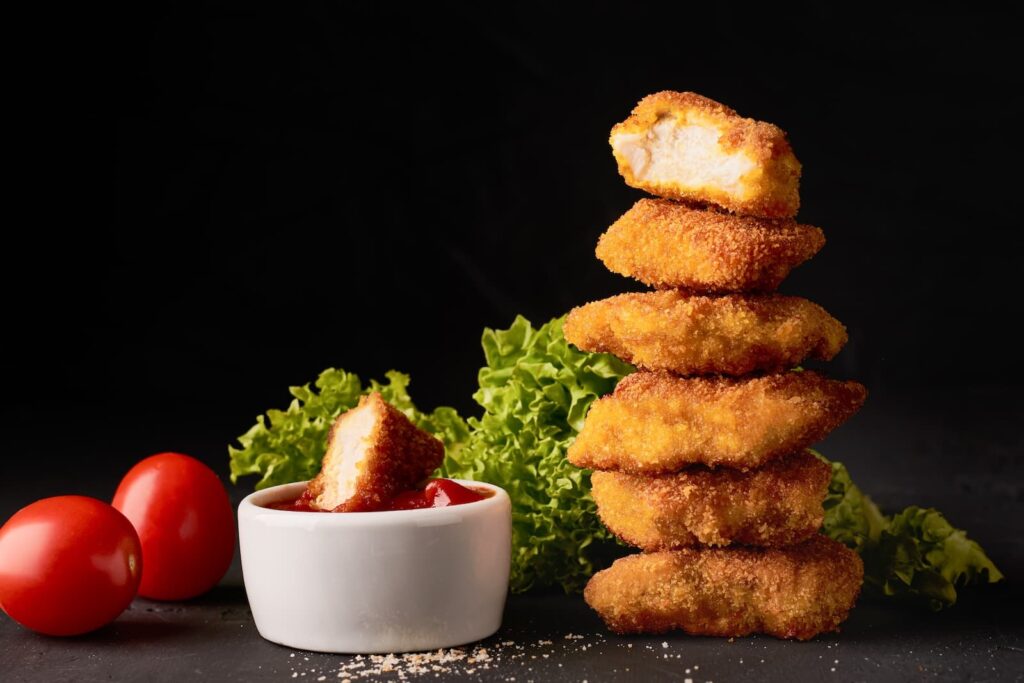
Could cultivated poultry become the first truly mainstream form of cultured meat?
Cultivated poultry is real poultry meat grown from animal cells instead of raising and slaughtering whole birds. In practice, most early progress has focused on cultivated chicken, especially products that can be shaped into familiar foods such as bites, nuggets, patties, dumplings, or blended chicken products.
Cultivated poultry may become one of the first mainstream forms of cultured meat because chicken is already global, familiar, relatively mild in flavor, and commonly eaten in processed forms. Unlike cultivated steak, cultivated chicken does not always need to reproduce thick muscle fibers, complex marbling, or premium whole-cut structure to feel acceptable. A nugget, filling, or patty gives the technology a more forgiving entry point.
But mainstream adoption is still not close. Chicken is cheap, widely available, and industrially efficient. That means cultivated poultry has to compete not only with consumer hesitation, but with one of the most optimized meat supply chains in the world.
Why has cultivated chicken reached restaurants and regulators earlier than cultivated beef?
Cultivated chicken reached regulators and restaurants earlier partly because companies began with products that were easier to formulate and serve in small amounts. Singapore became the first country to approve cultivated meat for sale in 2020, and the product was cultivated chicken from GOOD Meat. The United States later approved cultivated chicken products from UPSIDE Foods and GOOD Meat in 2023 under FDA and USDA oversight. (GFI APAC)
Chicken also fits early food-service formats better than beef steak. A chicken bite, nugget, or blended product can be convincing without recreating the full structure of a whole animal cut. This makes early restaurant launches more realistic, even when production volumes are still limited.
So the early lead of cultivated chicken does not mean it is already easy. It means poultry offered a more practical first test case for regulation, tasting, and public introduction.
Could chicken’s lower biological complexity make cultivated poultry easier to scale than red meat?
Possibly, but only in a limited sense. Cultivated poultry may be easier than cultured beef when the target product is a nugget, minced filling, or processed chicken item. These formats require less structural complexity than a marbled steak, and chicken’s flavor is generally milder than beef.
However, “easier” does not remove the core cultivated-meat bottlenecks. Poultry cells still need affordable growth media, stable cell lines, sterile production, scalable bioreactors, and reliable food-grade manufacturing. Stephens et al. describe these as broad technical and regulatory challenges for cultured meat, not problems unique to beef. Humbird’s scale-up analysis also warns that animal-cell culture remains difficult to industrialize cheaply at very large scale.
So chicken may be easier to commercialize in some forms, but it is not automatically easy to scale.
If conventional chicken is already one of the cheapest meats in the world, can cultivated poultry ever compete economically?
This is one of the hardest questions for cultivated poultry. Chicken is already efficient, cheap, and deeply embedded in global supply chains. Broiler production has been optimized for fast growth, feed conversion, processing, and distribution. That makes price competition much harder than with luxury meats.
For cultivated poultry to compete, companies would need major improvements in growth media cost, cell density, bioreactor productivity, automation, and energy efficiency. Early products are more likely to appear in premium restaurants or blended foods than compete directly with supermarket chicken breasts.
The economic argument may become stronger if conventional poultry faces rising disease costs, antibiotic restrictions, animal-welfare regulation, or supply-chain disruption. But at today’s stage, cultivated poultry is more scientifically plausible than economically proven.
Could processed foods like nuggets, sausages, dumplings, and fast-food products become the natural entry point for cultivated poultry?
Yes. Processed poultry products are probably the most natural early market for cultivated chicken because they are familiar, flexible, and structurally forgiving.
A nugget or dumpling does not need to look like a whole chicken breast. It can combine cultivated chicken cells with plant proteins, binders, seasonings, or other ingredients while still delivering a recognizable chicken experience. GFI’s 2024 industry report noted a Singapore retail product containing 3% cultivated meat blended with other ingredients, showing how early products may enter as hybrid foods rather than fully cultivated cuts. (GFI APAC)
This matters because cultivated poultry may not need to win consumers through perfect imitation immediately. It may first enter foods where people already expect processing, seasoning, and convenience.
If cultivated poultry succeeds commercially before cultivated beef, could it shape public acceptance of cellular agriculture as a whole?
Yes. Cultivated chicken could become the public’s first ordinary encounter with cellular agriculture. If early products taste good, feel safe, and are explained clearly, they could reduce the “lab-grown meat” discomfort that surrounds the entire category.
Chicken may be especially useful for this because it is already eaten globally and often appears in everyday processed foods. OECD-FAO projects global poultry consumption to keep growing strongly through 2034, with poultry accounting for a large share of additional meat consumed globally. (OECD)
If cultivated poultry becomes familiar first, it could make later cultivated beef, pork, seafood, or specialty meats feel less strange. But the opposite is also true: if early products are expensive, overhyped, or disappointing, poultry could become the first major public test that slows trust in the whole field.
References
- Stephens N et al. — Bringing Cultured Meat to Market: Technical, Socio-Political, and Regulatory Challenges
- Humbird D — Scale-Up Economics for Cultured Meat
- Good Food Institute — State of the Industry: Cultivated Meat, Seafood, and Ingredients
- Good Food Institute APAC — World’s First Commercial Sale of Cultivated Chicken
- UC Davis — Federal Regulation of Cultivated Meat
- USDA FSIS — Human Food Made with Cultured Animal Cells
- OECD-FAO — Agricultural Outlook 2025–2034: Meat
How different is cultivated poultry from cultivated red meat scientifically and nutritionally?
Cultivated poultry and cultivated red meat use the same broad idea: growing animal cells into edible tissue. But chicken is not simply “beef with different cells.” Poultry muscle has different fiber types, lower myoglobin levels, different fat behavior, softer texture, and different culinary expectations than beef.
These differences matter because cultivated chicken does not need to solve exactly the same engineering problems as cultivated steak. Processed poultry products such as nuggets, patties, sausages, or dumpling fillings may be easier to reproduce because they do not require the thick muscle architecture, heavy marbling, or dense connective structure associated with beef steak. Chicken’s milder flavor and naturally softer texture may also simplify some sensory challenges.
But realistic poultry is still biologically complex. A convincing chicken breast or thigh requires careful control of aligned muscle fibers, moisture, fat distribution, texture, and cooking behavior. White meat and dark meat also behave differently, creating separate engineering targets within poultry itself.
So cultivated poultry may be easier than cultivated red meat in some formats, especially processed foods, but it still presents its own distinct biological, nutritional, and sensory challenges.
Why are chicken muscle structure and texture different from beef at the cellular and culinary level?
Chicken meat is usually lighter, softer, leaner, and less marbled than beef. Chicken breast is dominated by fast-twitch white muscle fibers, while beef contains more myoglobin and has a denser red-meat structure. This affects color, flavor, texture, cooking behavior, and nutritional profile.
Culinarily, beef is often valued for marbling, chew, aging, and deep flavor. Chicken is often valued for tenderness, mild flavor, juiciness, and its ability to absorb seasoning. For cultivated poultry, this means the target is different: not a marbled steak, but a clean, moist, fibrous white or dark meat texture.
How do white meat and dark meat create different engineering challenges for cultivated poultry?
White meat and dark meat are biologically different targets. Chicken breast is pale, lean, and lower in myoglobin. Dark meat, such as thigh or leg meat, contains more oxidative muscle fibers, more myoglobin, and generally richer flavor.
For cultivated poultry, this means scientists may need different cell types, culture conditions, and fat strategies depending on the product. A cultivated chicken breast needs mild flavor and lean fibrous texture. A cultivated thigh product may need more fat, stronger flavor, and darker color chemistry.
This makes “cultivated chicken” less uniform than it sounds. The challenge is not only growing poultry cells, but deciding which poultry experience is being recreated.
Could cultivated poultry eventually be nutritionally modified through fat composition, protein content, or micronutrient engineering?
Yes, in principle. Because cultivated poultry is grown in controlled conditions, future products could potentially be adjusted through the growth medium, fat-cell composition, or post-harvest formulation.
Scientists may eventually influence protein density, fatty acid profile, micronutrients, or omega-3 content. Poultry is already often perceived as a leaner meat than beef, so cultivated poultry could be designed to preserve that identity while possibly improving specific nutritional traits.
But this remains a future possibility, not a guaranteed commercial reality. Any nutritional modification would need to be tested for safety, stability, flavor, cooking quality, and regulatory approval.
References
- Ben-Arye T, Levenberg S — Tissue Engineering for Clean Meat Production
- Stout AJ et al. — Principles of Cell Proliferation and Differentiation for Cultured Meat
- Fraeye I et al. — Sensorial and Nutritional Aspects of Cultured Meat in Comparison to Traditional Meat
- Good Food Institute — The Science of Cultivated Meat
- New Harvest — Cellular Agriculture Research
- Tufts University Center for Cellular Agriculture
Could cultivated poultry change some of the biggest problems associated with industrial chicken farming?
Cultivated poultry may offer a different argument from cultivated beef. In the cultured red meat article, much of the environmental discussion focused on methane emissions, land use, and cattle-related climate impacts. Poultry creates a different set of concerns.
Industrial chicken farming is often criticized less for greenhouse gases and more for scale, confinement, disease vulnerability, antibiotic use, and animal welfare. Billions of chickens are raised in highly concentrated systems designed for rapid growth and mass production. Because poultry farming already has a lower environmental footprint than beef, cultivated chicken may not create the same dramatic climate reductions associated with replacing cattle. Instead, its strongest potential advantages may involve disease risk, biosecurity, slaughter reduction, and industrial animal welfare.
At the same time, cultivated poultry would not eliminate industrial risks entirely. Large-scale production would still depend on energy-intensive facilities, sterile bioreactors, growth media, and highly controlled manufacturing systems. Some concerns discussed in the cultivated red meat article, especially around industrial scaling, energy use, and bioreactor sustainability, still apply here and are not repeated in detail.
Could cultivated poultry reduce risks linked to avian influenza, antibiotic use, and large-scale poultry confinement?
Potentially yes. Conventional poultry systems are vulnerable to avian influenza outbreaks, high-density confinement problems, and antibiotic use associated with large-scale industrial farming. Cultivated poultry could reduce dependence on raising massive numbers of live birds if production eventually scales meaningfully.
This does not mean disease risk disappears. Instead, the risks shift. Traditional poultry farming faces flock disease and zoonotic concerns, while cultivated poultry would depend heavily on sterile manufacturing environments and contamination control inside industrial facilities.
Since chicken is already cheap and relatively efficient, does cultivated poultry have a different sustainability challenge than cultivated beef?
Yes. Conventional chicken is already one of the most feed-efficient and affordable animal proteins in the world. That means cultivated poultry faces a different challenge from cultivated beef: not proving that chicken production is environmentally intensive, but proving that a far more technologically complex system can realistically compete with an already optimized industry.
This is why cultivated poultry may become important not because it completely transforms climate emissions, but because it tests whether cellular agriculture can realistically enter everyday food systems at large scale.
References
- FAO — Livestock’s Long Shadow: Environmental Issues and Options
- IPCC — Climate Change and Land
- FAO — Avian Influenza
- WOAH — Avian Influenza
- CDC — Antimicrobial Resistance, Food, and Food Animals
- Humbird D — Scale-Up Economics for Cultured Meat
- Risner D et al. — Environmental Impacts of Cultured Meat
Why might cultivated chicken feel psychologically easier for many consumers to accept than cultivated beef?
Cultivated chicken may feel less emotionally disruptive than cultivated beef because chicken does not carry the same symbolic and cultural weight in many societies. Beef is often associated with steak culture, masculinity, barbecue traditions, celebration, wealth, and rural identity. Chicken, by contrast, is usually treated as a more ordinary, flexible, and convenience-oriented food.
This difference matters because resistance to cultivated meat is not only about science or safety. It is also emotional and cultural. Cultivated beef can feel like a challenge to deeply rooted ideas about “real meat,” while cultivated chicken may feel closer to foods people already consume in heavily processed forms such as nuggets, patties, sandwiches, frozen meals, and fast food.
That does not mean consumers will automatically accept cultivated poultry. Concerns about naturalness, biotechnology, and unfamiliar food production still exist. But familiar poultry formats may reduce psychological resistance because consumers are already accustomed to chicken appearing in standardized, processed, and industrial food systems rather than as a premium symbolic product like steak.
Could processed foods like nuggets, patties, and fast-food chicken products make cultivated poultry psychologically easier to accept?
Possibly yes. Cultivated chicken may benefit from the fact that many poultry products are already heavily processed and consumed in familiar convenience-food settings. Nuggets, patties, strips, sausages, sandwiches, and fillings are expected to contain seasoning, breading, binders, and texture modification, so consumers are less focused on comparing them directly with a whole animal.
This reduces some of the psychological barriers associated with cultivated meat. A cultivated chicken nugget does not need to recreate the cultural ritual of eating a steak or roasting a whole bird. It mainly needs to feel familiar, tasty, safe, and convenient. Fast-food settings may also reduce food neophobia because consumers already associate these foods with standardized industrial production.
At the same time, this strategy has limits. Some people already distrust ultra-processed foods, so cultivated poultry products could appear doubly industrial: both processed and cell-cultured. Still, familiar processed formats may provide one of the easiest pathways for cultivated poultry to enter everyday eating habits.
Could religious dietary systems such as halal or kosher create unique debates around cultivated poultry?
Yes. Cultivated poultry raises important halal and kosher questions because religious dietary status may depend on the original animal, how cells are obtained, whether animal-derived media are used, and how the production system is supervised.
Some religious authorities have shown openness to cultivated meat under certain conditions, but there is not one universal answer. A 2024 review of Islamic perspectives found debate over how cultivated meat should be classified and what conditions would make it halal. Kosher discussions also vary: some authorities may focus on the source cells and supervision, while others may ask whether the product should be treated like meat at all.
For cultivated poultry, this matters because chicken is central to many halal and kosher diets. Certification could strongly influence acceptance in global markets.
If cultivated chicken becomes indistinguishable inside processed foods, will most consumers even notice or care?
Some will care, and some may not. If cultivated chicken tastes the same, costs the same, and appears in familiar foods, many consumers may treat it as just another production method. This could be especially true in fast food, where convenience and taste often dominate.
But transparency will still matter. Even if people cannot detect a sensory difference, many want to know how food is made. Hidden introduction could damage trust if consumers feel deceived. Clear labeling, credible safety review, and honest communication are likely to matter more than trying to make cultivated poultry invisible.
Cultivated chicken may become accepted most easily when it is both familiar and transparent: ordinary enough to eat, but not secretive about how it was produced.
Could fast food and processed poultry become the first large-scale gateway for cultivated meat?
Possibly yes. Cultivated poultry fits unusually well into modern fast-food and processed-food systems because chicken is already heavily standardized, globally distributed, and commonly consumed in forms such as nuggets, patties, sandwiches, frozen meals, and prepared foods.
This gives cultivated chicken a practical advantage over products like cultivated steak. Early cellular agriculture may succeed not by replacing premium meat immediately, but by quietly entering foods where consumers already expect industrial processing and uniformity. Fast-food chains, cafeterias, airline meals, and packaged-food companies could become important because they can introduce cultivated poultry gradually through familiar products rather than through expensive luxury experiences.
In this sense, poultry may become the industry’s most realistic “everyday food” pathway.
If cultivated poultry eventually becomes affordable, could it spread globally faster than other forms of cultivated meat?
Potentially yes. Chicken is already one of the world’s most consumed animal proteins and is deeply integrated into global food systems across many cultures, cuisines, and income levels. If cultivated poultry ever reaches industrial affordability, it could theoretically spread through existing poultry supply chains much faster than products that depend on premium dining culture or expensive whole-cut meat markets.
However, this possibility depends on a major unresolved challenge: cultivated poultry must compete against one of the cheapest and most efficient animal-protein industries ever built. So while poultry may offer the clearest large-scale pathway for cellular agriculture, it also faces some of the toughest economic pressure to become commercially realistic.
References
- Bryant C, Barnett J — Consumer Acceptance of Cultured Meat: A Systematic Review
- Verbeke W et al. — Would You Eat Cultured Meat? Consumers’ Reactions and Attitude Formation in Belgium, Portugal and the United Kingdom
- Wilks M, Phillips CJ — Attitudes to In Vitro Meat
- Pakseresht A et al. — Review of Factors Affecting Consumer Acceptance of Cultured Meat
- Hamdan MN et al. — A Review of the Discussions on Cultivated Meat from an Islamic Perspective
- OECD-FAO — Agricultural Outlook 2025–2034: Meat
- World Economic Forum — Creating a Vibrant Food Innovation Ecosystem through Alternative Proteins
- Good Food Institute — State of the Industry: Cultivated Meat, Seafood, and Ingredients
- Humbird D — Scale-Up Economics for Cultured Meat
Could scientists eventually cultivate more than ordinary chicken meat?
Yes. Cultivated poultry does not have to mean only chicken nuggets or chicken breast. The same basic cellular agriculture approach could be applied to duck, quail, foie gras-style products, poultry fat, and eventually more customized forms of animal protein.
This matters because ordinary chicken is cheap, efficient, and difficult to compete with. Specialty poultry may offer a more realistic early path because some products are already expensive, ethically controversial, or difficult to produce at scale. Foie gras is the clearest example: it is a luxury food strongly associated with animal-welfare debate, which makes cultivated duck liver especially attractive as an early target.
So the future of cultivated poultry may not begin with replacing the cheapest chicken in supermarkets. It may begin with premium, hybrid, or highly designed foods where cellular agriculture can offer something conventional poultry cannot easily provide.
Are companies already developing cultivated duck, foie gras, quail, or other specialty poultry products?
Yes. Companies are already working beyond ordinary chicken. Gourmey is developing cultivated foie gras from duck cells and filed the first European Union novel food application for a cultivated food in 2024. Vow has developed cultivated Japanese quail products, including a quail-based parfait approved in Singapore and later approved in Australia and New Zealand. GOOD Meat has focused on cultivated chicken, including restaurant and retail-linked products.
These examples show that cultivated poultry is not moving in only one direction. Some companies are trying to imitate familiar chicken, while others are using poultry cells to create premium or unusual foods that may be easier to justify economically during the early expensive phase of the industry.
Why might premium poultry products become commercially viable before cheap supermarket chicken?
Premium poultry products may arrive earlier because they do not have to compete immediately with very cheap conventional chicken. A cultivated foie gras-style product, quail dish, or chef-led tasting menu can tolerate higher prices than supermarket chicken breast or frozen nuggets.
This is important because cultivated meat production is still expensive and difficult to scale. Early companies need products where small volumes, high prices, and culinary storytelling make commercial sense. Luxury poultry also lets companies focus on flavor, ethics, and novelty rather than only price.
In other words, specialty poultry gives cultivated meat more room to mature before facing the brutal economics of mass-market chicken.
Could mastering poultry fat, flavor chemistry, and texture eventually make cultivated poultry nearly indistinguishable from conventional poultry?
Potentially yes. Poultry is not defined by muscle tissue alone. Fat, moisture, aroma compounds, cooking reactions, and texture all shape how chicken, duck, or foie gras taste and feel. This is especially important because different poultry products depend on very different sensory profiles: chicken breast is mild and lean, while duck and foie gras are valued for richness, fat, and deeper flavor.
If scientists can successfully reproduce these qualities, cultivated poultry could eventually become extremely close to conventional poultry in sensory terms. But the difficulty depends on the product. Processed foods such as nuggets or dumpling fillings may achieve convincing realism earlier because seasoning and structure hide some biological complexity. Whole-cut poultry products, crispy skin, or rich dark meat remain harder because consumers can directly notice texture, juiciness, aroma, and cooking behavior.
So cultivated poultry may first become indistinguishable in processed foods before approaching more complex whole-cut experiences.
Could cultivated poultry eventually expand beyond imitation and become a redesigned category of animal protein?
Potentially yes. Once poultry cells, fats, and flavor systems can be controlled, companies may eventually design products that do not exist in conventional poultry. They could adjust fat composition, texture, protein density, or flavor intensity, or create hybrid foods that combine cultivated animal cells with plant-based or fermentation-derived ingredients.
That would shift cultivated poultry from imitation to design. Instead of asking only whether cultivated chicken can copy ordinary chicken, the deeper question becomes whether cellular agriculture could create poultry-like foods that are safer, more ethical, more nutritionally tailored, or more useful for specific cuisines.
For now, this remains a future possibility. The immediate challenge is still proving that cultivated poultry can be safe, appealing, scalable, and economically realistic.
References
- Fraeye I et al. — Sensorial and Nutritional Aspects of Cultured Meat in Comparison to Traditional Meat
- Gourmey — Cultivated Meat Delights
- EIT Food — Gourmey Files the First EU Novel Food Submission for Cultured Meat
- GOOD Meat — Cultivated Chicken
- Good Food Institute — State of the Industry: Cultivated Meat, Seafood, and Ingredients
- New Harvest — Cellular Agriculture Research
- Tufts University Center for Cellular Agriculture
Cultivated poultry may ultimately become one of the most realistic entry points into the world of cellular agriculture, not because it solves every problem surrounding food systems, but because it sits at the intersection of science, convenience, animal welfare, and everyday eating habits. Chicken already exists at massive industrial scale, which makes cultivated poultry both easier to introduce culturally and harder to compete with economically.
What fascinated me most while researching this article was how different the conversation becomes once we move away from the symbolic world of steak and focus on poultry. The questions become less about luxury and more about ordinary life: fast food, disease risk, industrial farming, processed meals, and how quietly new technologies can enter global food systems.
Whether cultivated poultry becomes a niche product or a common part of future diets, it already forces us to rethink what meat is, how it is made, and what kind of relationship humans may eventually want with animals and food production itself.
This article was created through research, curiosity, and a deep love for animals, science, and future food systems by Niloofar Moharrami for Nested Questions.