
About ten years ago, when I first learned about cultured animal products, I was immediately fascinated. The idea that we could produce materials traditionally obtained from animals without relying on conventional farming felt like one of those rare technologies that could genuinely change the world. I became so interested that I decided I wanted to be part of that future myself and began exploring the possibility of building a company in the field.
As I researched different opportunities, cultivated silk (sometimes called cultured silk or biofabricated silk) stood out as one of the most realistic entry points into the world of cellular agriculture and biofabrication. Compared with products such as cultured meat, eggs, or dairy, silk appeared scientifically less complex and, just as importantly, seemed likely to face fewer regulatory hurdles. Producing food from cultured cells requires navigating extensive safety approvals and food regulations, while cultivated silk is primarily a material. At least from my perspective at the time, that made the path to commercialization seem more achievable.
Eventually, we found a scientist willing to help us begin research and development, and to my surprise, investor interest was strong. Many people saw the potential of cultivated silk, and finding individuals willing to support the idea was easier than I had expected.
What surprised me was the direction nearly everyone wanted to take. The scientists and investors were overwhelmingly interested in developing cultivated silk for medical applications rather than as an alternative to conventional silk production. From a business perspective, that made perfect sense. Silk-based biomaterials have enormous potential in fields such as regenerative medicine, tissue engineering, and advanced medical materials.
My own motivation, however, was different. I was drawn to cultivated silk because of my interest in nature, animal welfare, and environmental sustainability. I was excited by the possibility of reducing the need for conventional silk production and exploring whether biotechnology could provide a more ethical way of producing silk.
Medical applications were harder for me to embrace. When I was a dental student, I was also involved in research, which gave me some firsthand exposure to how new medical technologies are developed and tested. I understood that promising biomaterials often face a long pathway of animal testing before they can eventually reach patients. While I recognize the importance of that process for advancing medicine, it was not something I personally wanted to dedicate my career to.
After nearly two years of working on the company, developing the idea, speaking with researchers and investors, and trying to build a path forward, I ultimately decided to step away. I wished the scientists and investors success and moved on to other projects. Yet my curiosity about cultivated silk never disappeared.
Today, cultivated silk remains one of the most intriguing examples of biofabrication—a technology that sits at the intersection of materials science, synthetic biology, sustainability, and animal welfare. But what exactly is cultivated silk? How is it made? Can it truly replicate the qualities of natural silk, and could it eventually become a mainstream material? Those questions brought me back to the topic years later, and they are the questions this article explores.
Why are scientists trying to make silk without silkworms?
Culture silk exists because scientists want the remarkable properties of silk without the limitations of traditional silk farming.
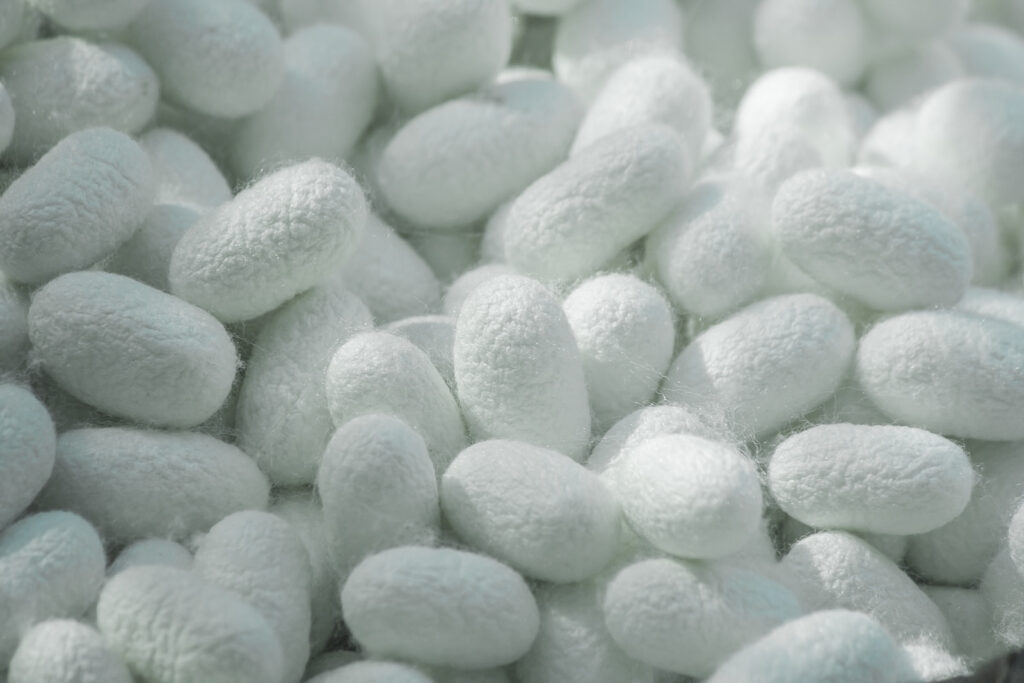
Natural silk is one of nature’s most impressive materials. It combines strength, flexibility, light weight, and biocompatibility in ways that are difficult to reproduce synthetically. However, producing silk through sericulture—the farming of silkworms—places limits on both the quantity and type of silk that can be produced.
Researchers also became interested in silk proteins that are difficult to obtain from animals. Spider silk, for example, has attracted decades of scientific interest because of its exceptional mechanical properties, but spiders cannot be farmed efficiently on an industrial scale. This pushed scientists toward biotechnology-based approaches that could produce silk proteins independently of the animals that originally evolved them.
The result is culture silk: a family of technologies that manufacture silk proteins outside conventional silk farming.
What problems does conventional silk production create?
Traditional silk production faces both practical and ethical challenges.
From a production perspective, silk farming depends on maintaining living silkworm populations and cultivating large quantities of mulberry leaves. This creates biological constraints that do not exist in industrial manufacturing systems.
Environmental assessments also show that silk production is not impact-free. Life-cycle analyses have identified environmental burdens associated with mulberry cultivation, land occupation, freshwater use, energy consumption, and emissions generated during silk processing.
Ethical concerns have become increasingly important as well. Conventional silk production typically requires preventing the moth from emerging from the cocoon so that the silk filament remains intact. While silkworm welfare has historically received less attention than the welfare of larger animals, growing consumer interest in animal-free materials has encouraged companies to explore alternatives.
Could silk be produced without raising silkworms at all?
Yes. This is no longer a theoretical possibility.
Companies such as AMSilk and Spiber have demonstrated that silk-inspired proteins can be produced without conventional silkworm farming. Instead of harvesting fibers from cocoons, they manufacture proteins through biotechnology and then process those proteins into usable materials.
Researchers are also exploring additional production systems, including genetically modified silkworms, cultured cells, and other recombinant protein platforms. Not all of these approaches eliminate animal involvement entirely, but they demonstrate that silk production no longer needs to be tied exclusively to traditional sericulture.
The bigger question is no longer whether silk can be produced without silkworms. It is whether these alternative methods can eventually compete with conventional materials at commercial scale.
References
- Astudillo (2015) Life Cycle Assessment of Indian Silk Production
- Spiber – Brewed Protein™ platform
- AMSilk – biotechnology-based silk production platform
- National Geographic: The Quest to Engineer Silk That’s Stronger Than Steel
How is culture silk made?
Culture silk is made by producing silk proteins outside the traditional cocoon-production process.
Although different technologies exist, most current commercial systems follow a similar principle. Scientists identify genes responsible for producing silk proteins and use biotechnology to reproduce those proteins in controlled manufacturing environments. The proteins are then purified and transformed into fibers, films, coatings, or other materials.
The result is not necessarily a direct copy of natural silk. Some companies aim to replicate natural silk proteins, while others modify them to create materials with new properties.
Where do silk proteins come from if no silkworms are used?
Most commercial culture-silk systems use genetically engineered microorganisms.
Researchers identify silk-protein genes and introduce them into host organisms such as bacteria or yeast. During fermentation, these organisms act as biological factories that manufacture the target proteins.
The microorganisms do not produce finished silk fabric. They produce the raw proteins, which must then be purified and processed into materials. This distinction is important because many of the challenges in culture silk arise not from producing proteins but from transforming them into structures that behave like natural silk fibers.
Are multiple technologies competing to produce culture silk?
Yes, and the field remains highly experimental.
Microbial fermentation currently appears to be the most commercially advanced approach. However, it is not the only one. Researchers are also exploring genetically modified silkworms, recombinant spider silk systems, and silk-gland-derived cell platforms.
Each approach attempts to solve a slightly different problem. Some focus on maximizing production efficiency, others on replicating natural silk more accurately, and others on creating entirely new materials.
At present, no single technology has emerged as the definitive solution. Culture silk is better understood as a collection of competing production strategies than as a single manufacturing method.
References
- AMSilk – biotechnology-based silk production platform
- Spiber – Brewed Protein™ platform
- Kochhar et al. (2021) The Materiobiology of Silk
- Wired: The Race to Put Silk in Nearly Everything
Can culture silk match natural silk?
Partially, but not perfectly.
Researchers have successfully reproduced many of the characteristics that make silk attractive, including its strength-to-weight ratio, flexibility, biocompatibility, and versatility. However, natural silk is more than a collection of proteins. Its performance depends on how those proteins are assembled and spun into fibers inside highly specialized biological systems.
This means that producing silk proteins and producing silk fibers with nature’s exact properties are two different challenges.
Why is natural silk so difficult to reproduce?
Natural silk owes its properties to both chemistry and structure.
In spiders and silkworms, proteins are produced, stored, aligned, and spun through biological processes that scientists still do not fully understand. Small changes in fiber formation can dramatically affect the final material’s strength, elasticity, and durability.
This is one reason spider silk remains so difficult to reproduce. Researchers can manufacture spider-silk proteins, but replicating the sophisticated spinning process that gives natural spider silk its performance remains a major obstacle.
As a result, many culture-silk technologies focus on creating materials that are useful and silk-like rather than attempting to perfectly copy nature.
Does culture silk behave more like silkworm silk or spider silk?
There is no single answer because culture silk is not a single material.
Some companies attempt to reproduce proteins associated with conventional silkworm silk, while others focus on spider-silk-inspired materials. The resulting products can differ substantially in structure, performance, and intended application.
This diversity is one of the strengths of biotechnology-based silk production. Instead of being limited to the silk evolved by a particular species, researchers can potentially design materials that combine properties from multiple biological systems.
References
- Babu et al. Applications of Silk-Based Biomaterials in Biomedicine and Biotechnology
- National Geographic: The Quest to Engineer Silk That’s Stronger Than Steel
- Kochhar et al. (2021) The Materiobiology of Silk
Is culture silk a more ethical and sustainable material?
The ethical case is currently stronger than the environmental case.
Many consumers and companies are attracted to culture silk because it offers a potential alternative to conventional silk production. In fermentation-based systems, silk proteins can be produced without harvesting fibers from silkworm cocoons, addressing one of the main ethical concerns associated with traditional silk.
Environmental claims are more difficult to evaluate. While biotechnology companies often promote cultured materials as sustainable alternatives, the current evidence base remains limited. Independent life-cycle assessments of conventional silk exist, but equivalent analyses for many culture-silk systems are still sparse.
Is culture silk truly animal-free?
Not necessarily.
Some culture-silk technologies produce silk proteins using microorganisms rather than animals. In those systems, the final material may reasonably be described as animal-free.
Other approaches still depend on genetically modified silkworms or animal-derived cell systems. In those cases, animal involvement remains part of the production process.
For this reason, “animal-free” should be treated as a description of a specific production method rather than a universal feature of all culture silk.
Can cultured silk compete with synthetic fibers from a sustainability perspective?
We could not find enough independent evidence to answer this confidently.
The idea is plausible. Silk proteins are renewable biological materials, and many developers hope they will eventually provide alternatives to petroleum-derived fibers. However, sustainability depends on the details of production, including energy use, feedstocks, manufacturing efficiency, and transportation.
At present, stronger comparative life-cycle assessments are needed before firm conclusions can be drawn.
References
- Barcelos et al. (2020) Opportunities for Improving the Environmental Profile of Silk Cocoon Production
- Astudillo (2015) Life Cycle Assessment of Indian Silk Production
- Vogue: Startups Are Developing Plant-Based Alternatives to Silk
Could culture silk change medicine and fashion?
Culture silk may ultimately have its greatest impact outside clothing.
Although silk is usually associated with textiles, researchers increasingly view silk proteins as advanced biomaterials. Their combination of strength, flexibility, and biocompatibility makes them attractive for applications that extend far beyond fabric.
Could scientists grow a silk-making gland in the lab?
Possibly, but the technology remains experimental.
Researchers have investigated silk-gland-derived cells because these cells naturally produce large amounts of silk proteins. Several projects have explored whether cultured gland cells could serve as protein-production systems, potentially bridging the gap between conventional silk farming and microbial fermentation.
However, there is currently no evidence that fully functional laboratory-grown silk glands are ready for industrial production. Most commercial efforts remain focused on microbial systems.
Where is culture silk already being used today?
Current applications are concentrated in high-value products.
In fashion, culture silk has appeared in collaborations with premium and luxury brands. In medicine and biotechnology, researchers are investigating silk-based materials for tissue engineering, regenerative medicine, drug delivery, wound healing, and biofabrication.
These biomedical applications may prove especially important because they exploit properties that conventional synthetic materials often struggle to replicate.
What would need to happen before culture silk becomes widely available?
Three challenges remain: cost, scale, and market adoption.
Production systems must become cheaper, manufacturing capacity must increase, and companies must demonstrate advantages that justify switching from existing materials.
The technology has already proven that silk can be produced outside traditional silk farming. The remaining challenge is turning that scientific achievement into a material that can compete economically across global markets.
References
- Wired: The Race to Put Silk in Nearly Everything
- Karolinska Institute – Spider Silk Biology for Biomedical Applications
- Tufts University: Silk Provides the Building Blocks to Transform Modern Medicine
Cultured silk is ultimately about more than silk. It represents a broader question about humanity’s relationship with the materials we depend on and whether biotechnology can help us produce them in new ways. While many technical, economic, and environmental questions remain unanswered, cultured silk has already demonstrated that it is possible to separate some animal-derived materials from the animals that traditionally produced them.
Whether cultured silk becomes a mainstream textile, a specialized biomaterial, or something entirely different, its story reflects a larger shift taking place across science and industry. It challenges us to reconsider where materials come from, how they are made, and what trade-offs we are willing to accept in the pursuit of innovation.
This article was created through research, curiosity, and a deep love for nature, animals, science, and thoughtful inquiry by Niloofar Moharrami for Nested Questions.