
What is cultivated seafood? That question became unexpectedly personal for me while working on this series about culture and animal products. Of all the topics I’ve explored, cultivated seafood pulled me in the deepest, probably because my strongest connection to nature has always been with marine biology, oceans, and the underwater world itself. Few environments on Earth feel as mysterious, biologically rich, and emotionally compelling to me as marine ecosystems.
Part of what initially drew me toward cultivated seafood was a simple hope: that technologies like cultivated fish and other cultured animal products could eventually reduce some of the pressure humans place on marine life and ocean ecosystems. The possibility that seafood could be produced with less fishing, less habitat disruption, and fewer animals harmed was enough to make me curious. But the more research I read, the more complicated the subject became.
As I followed one question into another, cultivated seafood stopped looking like a single futuristic product and started revealing itself as a much larger intersection of biotechnology, food systems, environmental science, economics, ethics, and human psychology. Some arguments around cultivated seafood are optimistic and scientifically exciting. Others raise difficult questions about cost, energy use, regulation, consumer acceptance, and whether these products can realistically scale into a major industry.
What surprised me most was not simply the technology itself, but how many different ways there are to think about it depending on whether you approach it as a scientist, consumer, environmentalist, investor, policymaker, or someone who simply loves oceans and marine life.
This article is the result of that curiosity journey: an attempt to understand what cultivated seafood actually is, how it works, whether it is safe, whether people will truly accept it, and whether it could meaningfully change how the world eats fish in the future.
Could cultivated seafood change how the world eats fish?
Cultivated seafood could change how the world eats fish, but only if it becomes affordable, scalable, safe, and acceptable to consumers. The basic idea is to grow real fish or shellfish cells in controlled production systems instead of catching fish from the ocean or raising whole animals in aquaculture farms.
This matters because global demand for aquatic foods keeps rising while wild fisheries are under pressure. FAO reports that aquaculture has already become a major source of global seafood supply, while many wild fish stocks remain overfished or fully exploited. Cultivated seafood is being explored as a third pathway: not wild-caught, not traditional fish farming, but cell-based seafood production.
If the technology succeeds, it could provide seafood without some of the ecological costs of industrial fishing, such as overfishing, bycatch, habitat damage, and pressure on endangered species. However, it is not yet proven at global scale. At this stage, cultivated seafood should be seen as a promising future tool, not a guaranteed replacement for fishing or aquaculture.
Why are scientists and companies trying to grow seafood from cells?
Scientists and companies are trying to grow seafood from cells because seafood demand is increasing, but the ocean cannot endlessly supply more fish. Many fisheries are already under stress from overfishing, climate change, pollution, and habitat loss.
Cultivated seafood offers a possible way to produce fish meat without raising or catching the whole animal. A small sample of cells can be taken from a fish or shellfish, then multiplied in a controlled environment using nutrients, growth media, and bioreactors. The goal is to create seafood that is biologically similar to conventional fish meat.
Companies are especially interested because seafood is valuable, nutritious, and difficult to replace. Fish is a major source of protein, omega-3 fatty acids, and micronutrients for many populations. Cultivated seafood could also give producers more control over contamination, supply stability, and product quality.
How serious are overfishing and seafood sustainability problems?
Overfishing is a serious global problem. FAO’s 2024 fisheries report states that only 62.3% of assessed fishery stocks were within biologically sustainable levels in 2021, meaning 37.7% were outside sustainable limits. FAO’s 2025 marine fish stock assessment also reviewed 2,570 fish stocks, showing the scale of global monitoring needed to understand the pressure on marine resources.
The issue is not only that some fish are disappearing. Overfishing can damage marine food webs, reduce biodiversity, weaken coastal economies, and make seafood supplies less reliable. At the same time, seafood demand continues to grow because aquatic foods are central to nutrition and food security in many regions.
Aquaculture has helped fill the gap, and in 2022 farmed aquatic animals surpassed wild-caught aquatic animals for the first time. But aquaculture also has challenges, including disease, feed use, water pollution, and habitat impacts. This is why researchers are looking at cultivated seafood as one possible addition to the global seafood system.
Why is seafood harder to replace with plant-based alternatives than beef or chicken?
Seafood is harder to replace because it is not one single product. “Seafood” includes tuna, salmon, shrimp, eel, crab, oysters, white fish, and many other species, each with different textures, flavors, fat structures, and cooking uses.
A plant-based burger can imitate ground beef because the product is already processed. But seafood is often eaten in forms where texture and freshness are highly visible, such as sushi, sashimi, grilled salmon, shrimp, or eel. Consumers expect specific mouthfeel, color, aroma, flakiness, fat distribution, and sometimes raw-eating quality.
Nutrition is another challenge. Many people choose seafood for omega-3 fatty acids, lean protein, iodine, selenium, and other nutrients. Plant-based seafood can be useful, but it may struggle to fully reproduce the sensory and nutritional profile of fish. Cultivated seafood may have an advantage because it is made from animal cells rather than only plant ingredients.
Could cultivated seafood reduce mercury, microplastics, parasites, and antibiotics?
Cultivated seafood could potentially reduce exposure to mercury, microplastics, parasites, and some antibiotics because it is grown in controlled systems rather than in oceans, rivers, or crowded fish farms.
Wild fish can accumulate mercury and other pollutants from the environment, especially large predatory fish such as tuna. Seafood can also be exposed to microplastics and parasites through marine ecosystems. Farmed seafood may face disease problems that sometimes require antibiotics, depending on the species and production system.
In theory, cultivated seafood avoids many of these risks because the cells are grown in clean facilities using controlled inputs. However, this does not mean it is automatically risk-free. Cell-culture systems must still prevent contamination from bacteria, fungi, and other unwanted organisms. So cultivated seafood may reduce some traditional seafood hazards, but it also creates new food-safety questions that regulators must evaluate carefully.
Would cultivated seafood actually lower environmental damage, or just shift it into factories?
This is one of the biggest unanswered questions. Cultivated seafood could reduce ocean-based damage by lowering pressure on wild fish stocks, reducing bycatch, and avoiding some impacts of fish farming. It may be especially useful for species that are overfished, expensive, or difficult to farm sustainably.
But cultivated seafood still needs factories, bioreactors, electricity, water, nutrients, and growth media. If those factories use fossil-fuel energy or expensive resource-intensive ingredients, some environmental impacts could simply move from the ocean into industrial production.
The environmental outcome will depend on how the technology develops. Cultivated seafood is more likely to be sustainable if production uses renewable energy, efficient bioreactors, low-impact growth media, and strong waste-management systems. For now, the best answer is cautious: it has environmental potential, but it is not automatically sustainable.
Why are tuna, salmon, eel, shrimp, and bluefin species receiving the most attention?
These species receive the most attention because they combine high demand, high price, and serious sustainability concerns.
Tuna and bluefin tuna are prized in sushi and sashimi markets, but some tuna stocks have faced intense fishing pressure. Salmon is globally popular and already produced at large scale through aquaculture, but salmon farming raises concerns about sea lice, disease, feed, pollution, and ecosystem effects. Shrimp is one of the world’s most consumed seafood products, while shrimp farming has been linked in some regions to mangrove loss, pollution, and disease issues.
Eel is especially important because demand remains strong in Japanese and East Asian cuisine, while wild eel populations have been heavily depleted by overfishing, habitat loss, and pollution. This is why cultivated eel has attracted attention as a possible conservation-friendly alternative.
Companies often start with premium seafood because cultivated production is still expensive. High-value species give companies a better chance of reaching early customers before the technology becomes cheap enough for mass-market products.
Could cultivated seafood help countries facing collapsing fisheries or seafood shortages?
Cultivated seafood could help some countries facing seafood shortages, especially countries that depend heavily on imports or have declining local fish stocks. Because it can theoretically be produced in controlled facilities, it may offer a more stable seafood supply that is less dependent on wild fish migrations, climate change, or seasonal catches.
This could matter for food security. FAO emphasizes that fisheries and aquaculture play an important role in nutrition, livelihoods, and resilient food systems. If cultivated seafood becomes affordable, it could add another source of aquatic protein for countries with limited marine resources.
However, access will be a major issue. Cultivated seafood facilities require capital, technology, energy, skilled workers, and regulation. Wealthier countries may benefit first, while lower-income coastal communities may not immediately gain access. It could also disrupt traditional fishing jobs if it scales without careful planning.
So cultivated seafood may help with future seafood security, but it is more likely to complement fishing and aquaculture than completely replace them.
References
- FAO — The State of World Fisheries and Aquaculture 2024
- FAO — Status of Fishery Resources
- FAO — Detailed Global Assessment of Marine Fish Stocks 2025
- Frontiers — Cell-Based Fish: A Novel Approach to Seafood Production
- Nature — A Global Comprehensive Review on Cultured Seafood
- FAO — The Contribution of Fisheries and Aquaculture to Food Security
- Reuters — Aquafarming Becomes Main Global Source for Fish, U.N. Food Agency Says
- The Guardian — Reinventing the Eel: First Lab-Grown Eel Meat Revealed
How does cultivated seafood actually work?
Cultivated seafood is produced by growing real fish or shellfish cells outside the animal in controlled environments. Instead of catching or farming entire animals, scientists isolate living cells capable of multiplying and forming muscle or fat tissue. Those cells are then fed nutrients inside carefully controlled systems designed to imitate biological growth conditions.
The process usually begins with a small tissue sample taken from a fish, shrimp, mollusk, or other seafood species. Researchers isolate specific cells that can continue dividing, such as muscle stem cells or precursor cells. These cells are then placed into nutrient-rich solutions called growth media, where they multiply inside bioreactors.
As the cells grow, scientists encourage them to organize into structures resembling real seafood tissue. To do this, they often use scaffolds or supportive materials that help cells align and develop texture. More advanced approaches involve 3D bioprinting and tissue engineering techniques designed to recreate realistic muscle fibers, fat distribution, and structure.
The goal is not to create synthetic seafood substitutes from plants, but to grow biologically authentic seafood tissue directly from animal cells.
What cells are taken from fish or shellfish, and how are they grown?
Scientists typically collect small biopsies from living fish or shellfish. These samples may come from muscle tissue, fat tissue, embryos, or other areas containing cells capable of continuous growth.
The most important cells are often muscle satellite cells, stem-like cells responsible for muscle repair and regeneration in animals. Researchers may also use fibroblasts, mesenchymal stem cells, or induced pluripotent stem cells depending on the species and production method.
Once isolated, the cells are transferred into sterile laboratory environments containing growth media. The media acts as artificial nourishment, supplying amino acids, sugars, vitamins, minerals, salts, and growth factors that cells need to survive and divide.
Temperature, oxygen, acidity, and nutrient levels must be carefully controlled because fish cells can behave differently from mammalian cells. Some seafood species grow best at lower temperatures than beef or chicken cells, which can reduce certain energy costs but also create unique biological challenges.
After enough cells multiply, researchers attempt to guide them into forming organized tissues that resemble edible seafood products.
Why is growing fish tissue biologically different from growing beef or chicken?
Fish cells behave differently from mammalian cells because fish evolved in very different environments. Many fish are cold-blooded animals adapted to aquatic ecosystems with lower and more variable temperatures.
One major difference is temperature tolerance. Fish cells can often grow at lower temperatures than beef or chicken cells, potentially reducing contamination risks and lowering energy requirements in some production systems. Mammalian cell cultures usually require temperatures near 37°C, while some fish cells grow effectively at much cooler temperatures.
Fish muscle biology is also structurally different. Seafood textures vary enormously between species, ranging from flaky white fish to dense tuna muscle or elastic shrimp tissue. Reproducing these textures requires different engineering approaches than growing beef-like muscle fibers.
Fat composition creates another challenge. Seafood contains unique omega-3 fatty acid profiles that strongly influence flavor, nutrition, aroma, and texture. Replicating these fat distributions accurately is far more complex than simply growing muscle tissue alone.
Fish cells can also adapt differently to oxygen levels, salinity, nutrient concentrations, and growth conditions. Because cultivated seafood research is still relatively young, scientists are still learning how different marine species behave in cell-culture systems.
What are growth media, scaffolds, and bioreactors?
Growth media, scaffolds, and bioreactors are the core technologies that allow cultivated seafood cells to survive and develop into edible tissue.
Growth media is the nutrient solution that feeds the cells. It contains sugars, amino acids, vitamins, minerals, proteins, and growth factors needed for cell growth. In many ways, growth media functions like artificial blood supplying nutrients to living tissue. One major industry challenge is creating affordable serum-free media that can scale commercially without relying on expensive pharmaceutical ingredients.
Scaffolds are structural materials that help cells organize into three-dimensional tissue. Without scaffolds, cells often grow as loose clusters rather than forming realistic muscle structures. Scaffolds guide alignment, texture formation, and thickness. They can be made from edible biomaterials such as plant polymers, algae-derived compounds, or collagen-like substances.
Bioreactors are controlled vessels where cells grow at larger scale. These systems regulate temperature, oxygen, nutrient circulation, acidity, and sterility. Bioreactors essentially function as artificial environments that allow cells to multiply under carefully managed conditions.
Together, these technologies form the foundation of cultivated seafood production systems.
Can cultivated seafood recreate texture, fat distribution, and raw sushi-quality fish?
Recreating realistic seafood texture is one of the industry’s biggest technical challenges.
Simple seafood products such as fish paste, nuggets, dumpling fillings, or ground seafood mixtures are easier to produce because they require less structural complexity. However, recreating whole cuts of salmon, tuna, or sashimi-grade fish is much more difficult.
Real seafood texture depends on highly organized muscle fibers, connective tissue, fat layers, moisture distribution, and cellular structure. Species like salmon and bluefin tuna are especially challenging because their value comes partly from delicate fat marbling and mouthfeel.
Researchers are experimenting with scaffolds, tissue engineering, and 3D bioprinting to recreate these characteristics more accurately. Some companies have already demonstrated cultivated salmon prototypes intended for raw sushi applications, with tasters describing texture and appearance as surprisingly close to conventional fish.
However, the technology is still developing. Producing thin slices for tasting demonstrations is very different from manufacturing large quantities of consistent sushi-grade seafood at commercial scale. Most experts believe realistic texture reproduction remains one of the largest obstacles to widespread adoption.
Why is seafood considered technically easier in some ways and harder in others?
Cultivated seafood is considered easier in some biological respects but harder in sensory and species-diversity challenges.
One advantage is that fish cells often tolerate lower temperatures, which may reduce contamination risks and energy requirements. Some fish cells can also survive under broader oxygen conditions compared to mammalian cells. Certain seafood products may require less structural complexity than thick cuts of beef.
But seafood also creates major technical difficulties. The category includes hundreds of biologically different species with unique textures, fat profiles, smells, and culinary uses. Replicating shrimp is very different from replicating salmon or tuna.
Flavor chemistry is another challenge. Seafood aroma depends heavily on fats, marine compounds, and volatile molecules that are difficult to engineer consistently. Raw seafood applications like sushi increase the pressure for realistic sensory quality because consumers directly evaluate texture, color, and freshness.
Additionally, the seafood industry already includes enormous diversity in production systems, from wild fisheries to aquaculture. This makes it harder for cultivated seafood to position itself as a universal replacement technology.
Could scientists eventually design seafood with altered nutrition or flavor?
Potentially yes. One of the most discussed long-term possibilities in cultivated seafood is the ability to customize nutritional composition and flavor profiles more precisely than conventional seafood allows.
Because cultivated seafood is grown under controlled conditions, scientists may eventually be able to adjust omega-3 levels, fat composition, amino acid profiles, micronutrients, or texture characteristics by modifying growth conditions and nutrient inputs.
Researchers are also exploring whether cultivated seafood could reduce unwanted compounds while enhancing desirable ones. For example, future products might contain higher omega-3 concentrations or reduced environmental contaminants compared to conventional seafood.
Flavor engineering is another possibility. By adjusting fat distribution and cellular composition, scientists may eventually create seafood with modified taste intensity, texture softness, or culinary performance tailored for different cuisines and markets.
However, these possibilities remain largely experimental. Current cultivated seafood companies are primarily focused on reproducing conventional seafood as accurately as possible before attempting major nutritional redesigns or engineered flavor customization.
References
- Frontiers — Cell-Based Fish: A Novel Approach to Seafood Production
- Review on Cell-Based Cultured Seafood (2024)
- Technical, Commercial, and Regulatory Challenges of Cultivated Seafood
- NIH/PMC — In Vitro Fish Cell Culture Review
- PMC — Challenges of Using Fish Cells for Cultivated Seafood
- Review of Scaffold Characterization Methods for Cell-Cultured Meat & Seafood
- Frontiers — 3D Bioprinting and Cultured Seafood
Will people actually want to eat cultivated seafood?
Some people will want to eat cultivated seafood, but acceptance will not be automatic. Consumer research suggests that people are more willing to try cultivated fish when they believe it is safe, tasty, sustainable, and clearly explained. However, many consumers still feel uncertain or suspicious because the product sounds unfamiliar and technologically complex.
Cultivated seafood may appeal to people who care about overfishing, animal welfare, ocean pollution, and mercury contamination. It may also interest consumers who enjoy seafood but worry about sustainability or food safety.
At the same time, many people may reject it because they see it as “unnatural,” “lab-made,” or overly processed. For cultivated seafood to succeed, companies will need to prove that it tastes good, feels familiar, is priced reasonably, and is regulated transparently.
Why do some people find cultivated seafood exciting while others find it disturbing?
People find cultivated seafood exciting because it promises a way to eat fish without some of the harms connected to conventional seafood. Supporters see it as a possible solution to overfishing, bycatch, fish farming problems, ocean pollutants, and animal suffering.
But others find it disturbing because it challenges their idea of what food should be. Many consumers associate food with nature, tradition, freshness, and trust. A fish grown from cells in a bioreactor can trigger disgust or suspicion, even if the final product is biologically similar to conventional seafood.
This reaction is not only scientific. It is emotional and cultural. Words like “lab-grown” can make the product sound artificial, while terms like “cultivated” or “cell-based” may feel more neutral. Public trust will depend heavily on how honestly companies explain the process.
Could cultivated seafood overcome the “unnatural food” reaction?
Yes, but it will take time. Many foods that once seemed strange eventually became normal after people understood them, tasted them, and saw them used by trusted chefs or restaurants.
Cultivated seafood may overcome the “unnatural” reaction if it offers clear benefits. Consumers are more likely to accept it if they believe it reduces overfishing, avoids contaminants, protects endangered species, or improves food security. Taste and safety will matter even more than environmental claims.
The biggest challenge is trust. If people feel companies are hiding how the food is made, the unnaturalness reaction may grow stronger. But if the process is explained clearly and regulators approve the products transparently, consumer resistance may soften.
Why might sushi consumers respond differently from traditional seafood consumers?
Sushi consumers may be more demanding because sushi often depends on raw texture, appearance, freshness, fat quality, and cultural authenticity. A breaded fish nugget can hide imperfections, but sashimi cannot.
For sushi, cultivated seafood must look, slice, smell, and feel like premium fish. Salmon or tuna used for sushi has to deliver a clean taste, smooth mouthfeel, and convincing fat distribution. This is especially difficult because raw seafood gives consumers very little seasoning or cooking to mask differences.
There is also a cultural issue. Many sushi consumers value tradition, craftsmanship, and the idea of natural wild fish. Some may welcome cultivated fish as cleaner and more sustainable, while others may see it as less authentic.
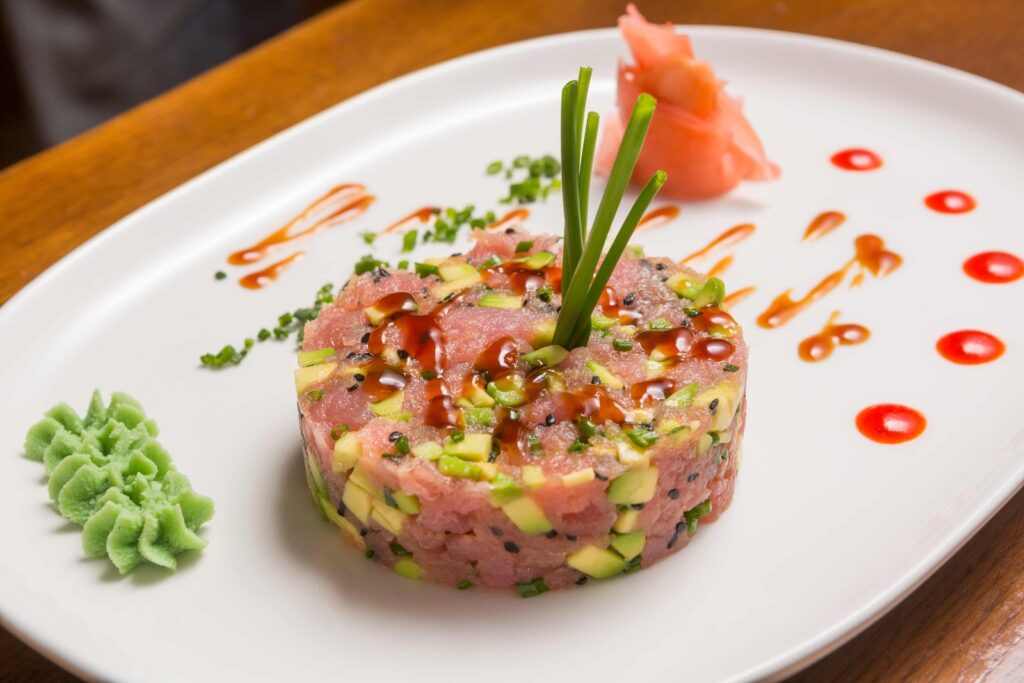
This is why early cultivated salmon tastings are important. They show that cultivated seafood companies are not only targeting processed products, but also trying to prove that cell-based seafood can work in high-sensory formats like sushi and sashimi.
Would people accept cultivated seafood more easily than cultivated beef?
Possibly. Some consumers may accept cultivated seafood more easily than cultivated beef because the sustainability and contamination arguments are especially strong for seafood. Concerns about overfishing, mercury, microplastics, parasites, and collapsing fish populations may make cultivated seafood feel more useful or urgent.
Seafood is also already highly diverse. Consumers are used to eating fish from wild capture, aquaculture, frozen supply chains, canned products, imitation crab, and processed seafood. This diversity may make some people more open to another production method.
However, cultivated seafood also faces unique barriers. Many people strongly associate seafood with freshness, oceans, local identity, and naturalness. For products like sushi, the emotional standard may be even higher than for burgers or chicken nuggets.
So cultivated seafood may be easier to justify intellectually, but not necessarily easier to sell emotionally.
How important are taste, texture, price, and cultural identity?
Taste, texture, price, and cultural identity are probably the most important factors for consumer acceptance.
Most people will not keep buying cultivated seafood just because it is sustainable. It must taste good and feel like the seafood they already know. Texture is especially important for fish, shrimp, eel, and sushi products because consumers notice flakiness, chewiness, fat, moisture, and freshness.
Price is also critical. If cultivated seafood remains much more expensive than wild or farmed seafood, it will likely stay a luxury or restaurant product. For mass adoption, it must become affordable enough for ordinary shoppers.
Cultural identity may be the hardest factor to control. Seafood is deeply tied to national cuisines, coastal communities, religious practices, family traditions, and ideas of authenticity. A cultivated eel dish may be accepted by one group as a conservation-friendly innovation, while another group may reject it as fake or disrespectful to tradition.
Could luxury restaurants normalize cultivated seafood before supermarkets do?
Yes. Luxury restaurants may be one of the most realistic early paths for cultivated seafood.
Because cultivated seafood is still expensive, it makes more sense at first in restaurants where customers already pay premium prices for rare or high-quality seafood. Chefs can also introduce the product in a controlled way, explaining its sustainability story and preparing it carefully.
Restaurants are especially important for products like cultivated salmon, tuna, or eel because these species are tied to premium dining and sushi culture. If respected chefs serve cultivated seafood successfully, it may help reduce consumer fear and make the product feel more legitimate.
Supermarkets will likely come later, when production costs fall and companies can supply larger volumes. Early products may also appear first as fish balls, nuggets, fingers, or blended seafood items because these are easier to produce and less demanding than whole-cut sushi-grade fish.
References
- Springer — Consumer Acceptance of Cultivated Fish: A Scoping Review
- GFI — Consumer Preferences for Seafood and Applications to Alternative Seafood
- Nature — A Global Comprehensive Review on Cultured Seafood
- The Guardian — Reinventing the Eel: First Lab-Grown Eel Meat Revealed
- The Guardian — From Petri Dish to Plate: Meet the Company Hoping to Bring Lab-Grown Fish to the Table
Could cultivated seafood become a major global industry?
Cultivated seafood could become a major global industry, but it is still far from that point today. The industry is growing because seafood demand is rising, wild fisheries are limited, and aquaculture cannot solve every sustainability problem by itself. FAO reports that aquaculture has already surpassed capture fisheries as the main source of aquatic animal production, showing how much the world is looking beyond wild-caught seafood.
However, cultivated seafood still faces major barriers: high production costs, expensive growth media, limited cell lines, scaling bioreactors, regulatory approval, and consumer acceptance. Reviews describe the sector as promising but less mature than cultivated meat.
Which countries are leading cultivated seafood research and regulation?
The leading countries include Singapore, the United States, Israel, Japan, South Korea, China, and several European countries. Singapore is especially important because it has taken an early regulatory and food-security interest in cultivated proteins. The United States is also important because of its biotech ecosystem, alternative protein companies, and regulatory work around cell-cultured foods.
Research and startup activity are spread globally, but regulation is uneven. Some countries are building approval pathways, while others are debating restrictions, labeling rules, or bans. This means cultivated seafood may commercialize first in countries with supportive food-tech regulation and strong investment ecosystems.
Why has Singapore become an early center for cultivated seafood development?
Singapore has become an early center because it imports most of its food and sees food technology as part of national security. Cultivated seafood fits Singapore’s goal of producing more food locally while reducing dependence on imports and vulnerable global supply chains.
Singapore also has a strong regulatory interest in novel foods and has supported alternative protein innovation earlier than many countries. This makes it attractive for companies that need a clear approval pathway before launching products.
Could cultivated seafood become cheaper than wild-caught or farmed fish?
Possibly, but not soon. Today, cultivated seafood is still expensive because it requires specialized cells, sterile production systems, growth media, scaffolds, bioreactors, and skilled technical labor.
For prices to fall, companies must make growth media much cheaper, improve cell growth rates, scale bioreactors, automate production, and use lower-cost ingredients. Reviews identify serum-free media, cell-line development, and bioreactor scaling as major commercial bottlenecks.
In the long term, cultivated seafood could become competitive for expensive species such as bluefin tuna, eel, salmon, or shrimp before it competes with cheap white fish. Premium seafood gives companies a better chance because conventional prices are already high.
Why are governments and fishing industries already fighting over regulation and labeling?
The fight is about identity, market protection, and consumer trust. Cultivated seafood companies want labels that show the product is real seafood made from animal cells. Fishing and aquaculture groups may argue that terms like “fish” or “seafood” should be reserved for animals caught or farmed traditionally.
Governments must decide whether labels such as “cultivated,” “cell-based,” “cell-cultured,” or “lab-grown” are accurate and fair. This matters because wording can strongly affect consumer reactions. “Lab-grown” may sound artificial, while “cultivated” sounds more acceptable.
The debate is also economic. Fishing communities worry that cultivated seafood could compete with traditional products, while food-tech companies worry restrictive labeling could block innovation.
Could cultivated seafood coexist with fishing and aquaculture rather than replace them?
Yes. The most realistic future is coexistence, not total replacement. Wild fisheries, aquaculture, and cultivated seafood could serve different markets.
Wild-caught seafood may remain important for tradition, local economies, and premium natural products. Aquaculture will likely continue supplying large volumes of fish and shellfish. Cultivated seafood may first target high-value, vulnerable, or difficult-to-farm species.
This mixed system could reduce pressure on overfished species while still allowing fishing and aquaculture to continue where they are sustainable. FAO emphasizes that fisheries and aquaculture are both food systems and livelihood systems, so replacing them abruptly would create serious social consequences.
What would happen to coastal economies and fishing communities if cultivated seafood scaled globally?
If cultivated seafood scaled globally, the effects on coastal communities could be mixed. It could reduce pressure on depleted fish stocks, create new food-tech jobs, and make seafood supply more stable. But it could also disrupt fishing jobs, seafood processing businesses, and coastal economies that depend on traditional fisheries.
Small-scale fishers could be especially vulnerable if cultivated seafood competes directly with species they depend on. On the other hand, if cultivated seafood focuses mainly on endangered or overfished premium species, it could help reduce ecological pressure without replacing all fishing.
The key issue is transition planning. Governments would need policies to protect fishing livelihoods, support sustainable fisheries, retrain workers where needed, and make sure benefits do not go only to wealthy biotech companies. FAO notes that fisheries are both a source of food and livelihood, especially in fishing-dependent communities.
References
- Nature Review — Comprehensive Review on Cultured Seafood
- Technical, Commercial, and Regulatory Challenges of Cultivated Seafood
- Food of the Future? Environmental Impacts of Cultivated Meat
- FAO — The State of World Fisheries and Aquaculture 2024
- Reuters — Aquaculture Surpasses Wild Fisheries
- The Guardian — Bringing Lab-Grown Fish to Market
- FAO — Committee on Fisheries / Overfishing Economics
Cultivated seafood is ultimately not just a question about technology, but about the future relationship between humans, food, animals, and the ocean itself. After exploring the science, environmental debates, safety concerns, consumer reactions, and economic possibilities surrounding cultivated seafood, I came away seeing it less as a simple replacement for fish and more as a potential new layer within the global seafood system.
Whether cultivated seafood succeeds or fails will depend on far more than biotechnology alone. It will depend on trust, transparency, affordability, culture, regulation, and whether the technology can genuinely deliver meaningful environmental benefits rather than only ambitious promises.
What makes the subject so fascinating to me is that it sits at the intersection of hope and uncertainty. It reflects both humanity’s growing technological power and our increasing awareness that ocean ecosystems are not limitless resources. For now, cultivated seafood remains an experiment in progress, but it is also a window into how societies may rethink seafood, sustainability, and marine life in the decades ahead.
This article was created through research, curiosity, and a deep love for marine life and scientific exploration by Niloofar Moharrami for Nested Questions.